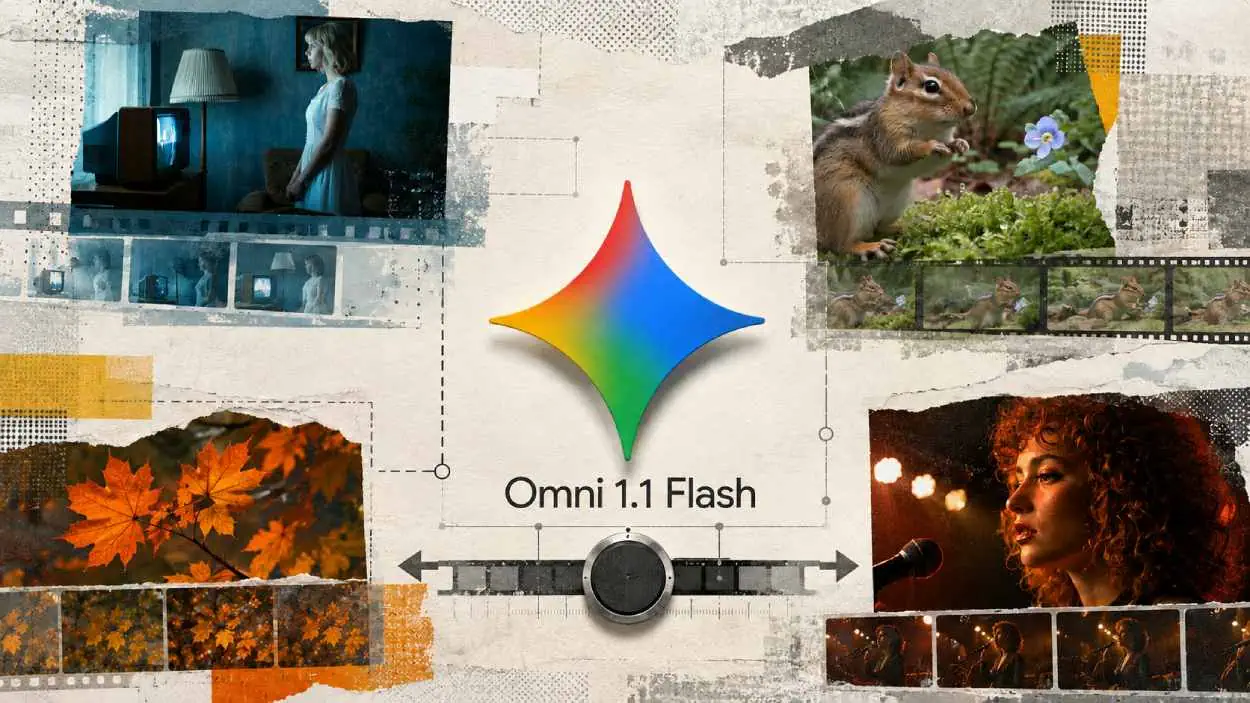






Google introduced Gemini Omni 1.1 Flash on 27th August, 2026, adding scene extension, keyframe control, 360p draft rendering and 4K upscaling to its generative video model through the Gemini API in Google AI Studio.
The Big Picture
- Google DeepMind’s Omni 1.1 Flash reads up to 10 seconds of prior footage when extending a scene. Earlier models only referenced the final second.
- Developers can extend a clip in 10-second increments up to a cumulative 40 seconds.
- A new 360p draft mode renders up to 60% faster and at a third of the cost of 720p output.
- Upscaling now reaches 1080p or 4K, and video references in a prompt can run up to three seconds.
- Google Flow and the Gemini app also get Omni 1.1 for AI Plus, Pro and Ultra subscribers starting today.
Google gives developers keyframes and longer scenes
Google DeepMind product managers Anish Nangia and Alisa Fortin say the update makes Omni 1.1 “production-ready for professional use,” according to the announcement. Because the model now sees 10 seconds of context instead of one, Google says extended footage holds visual consistency and follows the narrative across the full 40-second ceiling.
The API exposes this through an interactions call that passes a previous_interaction_id and a plain text instruction such as “Continue the scene.” First and last frame control works the other way round; a developer supplies two keyframes and the model fills the motion between them, aimed at camera orbits, zoom transitions and looping clips.
introducing Gemini Omni 1.1 Flash
— Google AI Studio (@GoogleAIStudio) August 27, 2026
this model brings a new suite of creative controls and generative video capabilities to developers
– extend scenes for longer storytelling
– specify first and last frames
– draft videos more efficiently in 360p
– upscale up to 4K resolution
-… pic.twitter.com/24Bmqz2k4Z
Cheaper drafts, one published rate
The 360p mode is the cost story. Google claims up to 60% faster generation and a third of the cost against Omni 1.1’s standard 720p, though its own footnote ties the speed figure to system throughput, not a reproducible benchmark. Google’s Gemini API pricing page lists gemini-omni-1.1-flash video output at $17.50 per million tokens, billed at 5,792 tokens per second of 720p footage, or roughly $0.10 per second; it publishes no separate 360p, 1080p or 4K rates.
Enterprise developers get the model on Gemini Enterprise Agent Platform, and Google says customers already run Omni Flash in production via the Agent Platform API. Two things the post leaves unanswered: how 4K output is billed, and whether the 40-second cap also applies inside Flow and the Gemini app.
SQ Magazine’s Takeaway
Omni 1.1 Flash targets the iteration loop first. Rendering storyboards at 360p, then upscaling one approved take to 4K, is the workflow this release makes cheap; it also puts Google’s developer video tooling up against OpenAI’s Sora 2 app on the consumer side. Whether 40 seconds of extended footage stays coherent still needs a human eye; Google’s consistency claim is a description, not a measurement.
What’s next: teams already building on Omni Flash should confirm how their draft tier is billed before defaulting to 720p, then read the developer documentation for the scene extension and upscaling parameters. Expect the 40-second limit to get tested first.