





The Government of Maharashtra has approved Sarvam AI’s Indus workspace for around 2,500 officials, the first step in a partnership that also covers voice agents and speech tools for public services.
- The Government of Maharashtra approved Sarvam AI’s Indus workspace for about 2,500 officials across state departments.
- Indus runs on Sarvam’s 105B sovereign model and works in 22 languages, including Marathi, on infrastructure kept entirely inside India.
- The rollout follows Maharashtra’s April 2026 creation of a dedicated AI department and extends a March letter of intent that also named OpenAI.
The Government of Maharashtra has approved deployment of Indus, Sarvam AI’s sovereign AI workspace, across its state departments. Around 2,500 officials will start using the platform in their daily work.
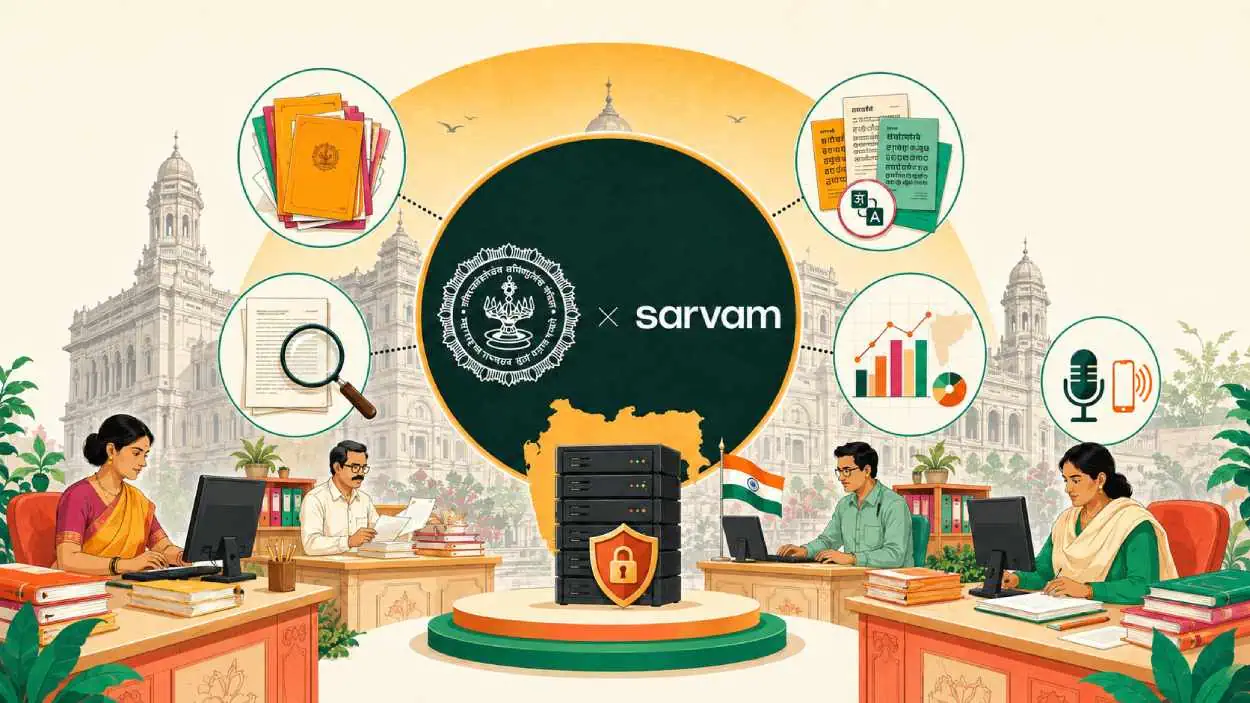
Officials get access to deep research across policies and precedents, first drafts of notes and replies, translation and summarization of scheme and policy documents, and data analysis for patterns and exceptions, according to Sarvam’s announcement of the partnership. Indus can also turn scanned records into searchable text, and it works across 22 Indian languages, including Marathi. The system runs on infrastructure located entirely within India, which the state can inspect directly.
Announcing our partnership with the Government of Maharashtra.
— Sarvam (@SarvamAI) August 12, 2026
Sarvam has partnered with the Government of Maharashtra to bring Indus into the daily work of 2,500 officials across the state.
Officials will use Indus to research policies and precedents, draft notes and replies,…
In March, Chief Minister Devendra Fadnavis announced letters of intent with OpenAI and Sarvam, alongside MoUs with IIT Bombay, one of India’s top engineering institutes, and BharatGen.
The state has since stood up an Electronics, Information Technology and Artificial Intelligence Department, created through a government notification dated April 21, 2026, covering AI policy, digital governance, data governance, cybersecurity and digital infrastructure. Maharashtra has also published an AI Policy 2026 and announced plans for an advanced State Data Centre in Nagpur, part of a broader build-out of India-based cloud capacity that includes Microsoft’s largest India cloud region in Hyderabad.
Bengaluru-based Sarvam opened Indus to users in limited beta in February, describing it as an interface for its Indian-language AI models. “True AI sovereignty means building the full stack of technology from the ground up,” the company said at the time.
Maharashtra skips the department-by-department pilot
Most government AI rollouts start small, with a single department testing a single use case before anyone else gets access. Maharashtra’s approval covers the administration at once. Sarvam calls Maharashtra “one of the first states in India to make that commitment at this scale,” against a backdrop of accelerating government and enterprise AI adoption.
The sovereignty framing extends beyond India. Nvidia and Palantir unveiled a reference architecture for sovereign AI operating systems earlier this year, aimed at governments and regulated industries that want full ownership of their data, models and applications instead of capability rented from a foreign cloud. India runs its own version of that logic through the IndiaAI Mission, which selected Sarvam in 2025 to build a sovereign large language model, and now through state-level moves like Maharashtra’s new AI department and its planned Nagpur data centre.
Sarvam has the balance sheet to back a rollout this size. The company raised $234 million in the first close of a planned $300 million Series B in June, at a $1.5 billion valuation, in a round SQ Magazine covered in detail at the time. HCLTech (NSE: HCLTECH), the Indian IT services company, led with $150 million, and Bessemer Venture Partners, Khosla Ventures and Peak XV Partners also took part.
Sarvam separately secured $75 million from investors including Nvidia, Glade Brook, Gaja Capital, IndiGo Ventures and several individual backers, money the company says will fund research on its next models and expand compute and deployments across enterprise, developer and government customers.
Sarvam says the underlying data stays within audited Indian infrastructure for the officials who will use Indus. Neither Sarvam nor Maharashtra has published details on what access or retention controls individual departments retain over the records they feed into the system, or how long that data is kept, questions worth asking before scanned files and draft replies start moving through it at scale.
Indus is only the opening move. Sarvam says the wider partnership with Maharashtra will next bring voice agents for citizen outreach and speech technologies for public services, extending the same 22-language sovereign stack from officials’ desks to the people they serve.