





The global crypto options ecosystem is gaining momentum, offering both institutional and retail players sophisticated ways to hedge, speculate, and generate yield. In one real-world scenario, a hedge fund used Bitcoin options to hedge treasury holdings during the quarter and locked in downside protection. In another, a derivatives desk at a crypto exchange launched Ethereum options products for retail traders, expanding access to hedging strategies. The following article dives into key statistics, trends, and data points shaping the options market in crypto today, inviting readers to explore the full picture.
Editor’s Choice
- The overall crypto derivatives market reached an estimated $8.94 trillion in monthly volume in 2025.
- Crypto derivatives now account for roughly 76% of total cryptocurrency trading volume.
- Average daily notional volume for crypto futures & options at CME Group rose to $10.5 billion in 2025, up ~140% year-on-year.
- In Q1 2025, average daily volume (ADV) for crypto futures/options reached 198 K contracts, representing $11.3 billion notional.
- A single expiry event for BTC & ETH options hit about $17 billion in notional value in 2025.
- The notional open interest (OI) for BTC options in Q2 2025 at CME approached $4 billion.
- Options trading volume for major altcoins (e.g., SOL, MATIC) rose by ~25–30% in 2025.
Recent Developments
- The crypto derivatives sector hit a new monthly trading volume record of $8.94 trillion in 2025.
- On the regulatory front, broader institutional access via regulated venues like CME is driving volume growth.
- A major options-expiry event in June 2025 saw ~$17 billion of BTC and ETH contracts settle in one day.
- Retail platforms like Binance opened Bitcoin options writing to all users, citing over 3,200% growth from 2020 to June 2025.
- Data providers such as CoinMetrics are publishing in-depth options-metrics reports, reflecting growing transparency.
- The crypto trading platform market, driven in part by options demand, was valued at ~$27 billion in 2024 with ~12.6% CAGR predicted through 2034.
- A surge in implied volatility and open interest across major crypto options indicates increased hedging and speculative activity.
- Platforms are offering more granular options contracts, including shorter expiries and weekly options, to meet trader demand.
Institutional vs Retail Participation in Options
- In 2025, 55% of institutional investors report exposure to crypto options.
- Institutions account for ~42% of total derivatives volume, including options.
- Retail traders dominate altcoin options, driving 60–70% of volume in less liquid pairs.
- Deribit controls 85% of open interest, with 80% of its activity from institutional participants.

Growth Trends in Crypto Options Trading
- The average daily notional volume for crypto futures & options at CME reached $11.3 billion in Q1 2025.
- Year-on-year ADV increase for CME’s crypto product suite was ~140% in 2025.
- Options trading volume for the broader crypto derivatives market hit an all-time high in 2025.
- Crypto derivatives’ share of total crypto trading climbed to ~76%.
- Open interest in BTC options at CME’s suite reportedly neared $4 billion in Q2 2025.
- The number of users writing crypto options expanded significantly as retail platforms onboarded new options functionalities.
- Growing institutional participation, with hedge funds and trading desks increasingly using crypto options for risk management and yield.
- The altcoin options segment, beyond BTC/ETH, showed ~25-30% volume growth in 2025.
- Platforms expanded expiry profiles, including weekly and daily options, improving flexibility and volume.

Bitcoin Options Market Statistics
- On May 9, 2025, the options market for crypto reported a new all-time high in trading volume.
- CME reported that BTC futures/options ADV in Q1 2025 was ~18.3 K contracts daily (+13% year-on-year).
- The same CME suite showed BTC-options open interest growing ~202% vs. Q1 2024.
- A major expiry saw ~$15 billion in BTC options notional across 139,000 contracts.
- According to Binance, BTC options writing availability corresponded to a growth >3,200% from 2020 to June 2025.
- Implied volatility on Bitcoin futures options was ~42.26% for the Nov 2025 expiry.
- Major options events represented ~30% of total open interest in the underlying market at that time.
Crypto Options Expiry Impact on Spot Markets
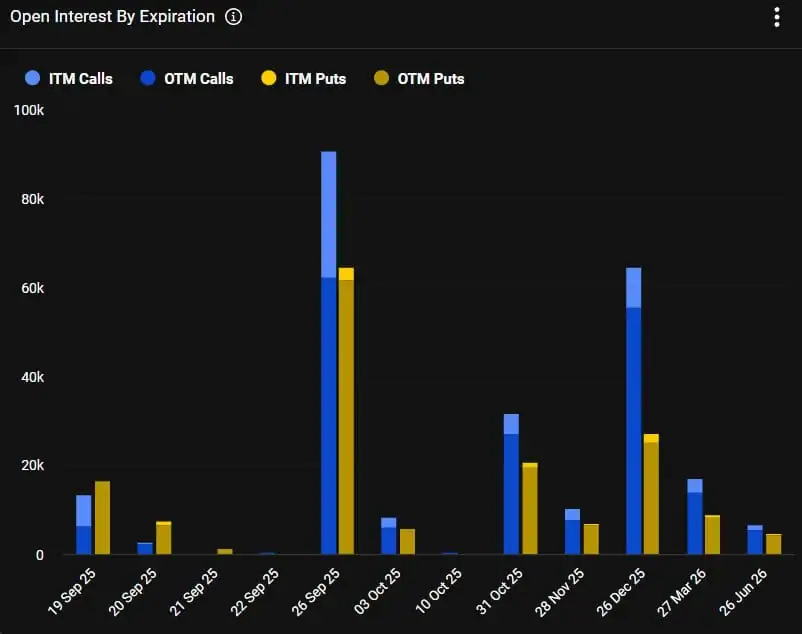
- 26 Sep 2025 expiry leads with 90,000 ITM Calls, 62,000 OTM Calls, 65,000 ITM Puts, and 67,000 OTM Puts.
- 20 Dec 2025 expiry shows 65,000 ITM Calls and 28,000 OTM Puts, reflecting strong year-end hedging demand.
- 31 Oct 2025 expiry records 28,000 ITM Calls and 22,000 OTM Puts, indicating balanced speculative and protective trades.
- 19–21 Sep 2025 short-term expiries reach 17,000 OTM Puts, showing active short-dated protection demand.
- Mar–Jun 2026 long-dated contracts carry 18,000 ITM Calls and 13,000 OTM Puts, signaling institutional strategic exposure beyond 2025.
Ethereum Options Market Statistics
- The average daily volume of Ethereum (ETH) options grew ~65% year-on-year in Q2 2025 compared with Q2 2024.
- On August 29, 2025, ETH options data showed heavy call positioning for December expiries, signaling traders’ bets on upside in ETH.
- The put-call ratio for ETH options during large expiry events hovered near 0.99, indicating nearly balanced call vs. put demand.
- As of Q3 2025, the ETH options suite at CME recorded a record $1.2 billion average daily open interest (ADOI) for options, up ~37% from the prior record.
- Weekly and micro-ETH options contracts were introduced in 2025, offering traders more expiry flexibility and contributing to increased volume.
Altcoin Options Market Growth
- Solana (SOL) options trading grew by approximately 27% year-on-year in 2025.
- Cardano (ADA) options volume increased by around 31% year-on-year in 2025.
- Altcoin options constituted less than 10% of the total crypto options market in 2025.
- Polygon (MATIC), Polkadot (DOT), and Solana (SOL) options were listed on multiple exchanges in 2025.
- Bid-ask spreads in altcoin options are 1.5-2x wider compared to BTC/ETH options due to lower liquidity.
- Retail traders represent over 70% of activity in the altcoin options market segment.
- Institutional participation in altcoin options remains below 15% as of 2025.
- Altcoin options implied volatility shows swings up to 35% during network upgrades or major announcements.
- Yearly growth for altcoin options volume ranged between 20-40% in 2025, indicating a growing niche.
Monthly Price Performance of Top 10 Coins
- XRP surged 47.8%, leading the market with the strongest monthly gain.
- Solana (SOL) rose 24.7%, reinforcing its top-performing altcoin status.
- Bitcoin (BTC) gained 11.7%, showing steady growth and renewed institutional demand.
- Chainlink (LINK) increased 9.6%, and Cardano (ADA) climbed 7.2%, signaling solid altcoin strength.
- Dogecoin (DOGE) edged up 2.2%, showing modest growth versus peers.
- Binance Coin (BNB) slipped 3.6%, starting the month in negative territory.
- TRON (TRX) dropped 6.3%, extending its weak performance trend.
- Ethereum (ETH) declined 8.2%, reflecting profit-taking and rotation.
- Avalanche (AVAX) fell 9.9%, marking the weakest performance among the top 10.

Geographic Distribution of Crypto Options Volume
- The Asia-Pacific region contributes >48% of global crypto derivatives volume as of 2025.
- North America accounts for approximately 30% of crypto options volume, driven by institutional participation.
- The U.S. ranks first in Bitcoin search interest with over 25% of global searches in 2025.
- Nearly 33% of global crypto-related queries originated from the U.S. in 2025.
- India leads global crypto adoption in 2025, with a 69% year-over-year increase in on-chain transaction volume.
- Southeast Asia and Latin America show more than 60% year-over-year crypto adoption growth, but have lower total options volume.
- Institutional platforms in North America and Europe contribute around 40% of global derivatives and options volume.
- Pakistan and Vietnam have high crypto adoption rates despite lower GDP per capita, representing 5-7% of global options flow proxies.
- U.S. regulated venues like CME maintain a modest daily options volume comparatively, less than 5% of global volume.
- Multi-jurisdiction platforms in Europe, the U.S., and Asia are expanding market share, with the U.S. market reflecting nearly 35% of global options demand.
Impact of Options Expiry on Spot Markets
- A single expiry event involving ≈ $14 billion in combined Bitcoin and Ethereum options in mid-2025 has been shown to correlate with increased spot-market volatility immediately afterwards.
- One expiry slated for roughly $4.3 billion in notional contracts may shift spot Bitcoin toward $120,000 if support holds, indicating that expiry flows can influence directional moves.
- The week of a large options expiry sees implied volatility of Bitcoin increase from ~33% to ~37% on average before rollover, reflecting hedging and roll-activity.
- The proportion of open interest in strike-clusters near at-the-money levels rises by ~20% just ahead of major expiries, indicating concentration of risk and potential gamma squeezes.
- In Ethereum’s options expiries, over 241,000 contracts expired at one event, totaling ≈ $624 million in notional value, with a put-call ratio around 0.67 that week.
- Expiry events frequently trigger hedging flows, as option writers and market-makers hedge by buying or selling the underlying spot, which can amplify spot moves.
- For BTC options, the market’s put-call skew flipped from ~-2% to +5% favoring calls following an expiry, indicating a sentiment shift around expiry events.
- Around the August 2025 expiry cluster, single-day spot volume on major exchanges rose ~18% compared to average non-expiry days, underscoring the liquidity impact of option settlements.
Bitcoin Options Market Statistics
- BTC options open interest hit a record $4 billion on regulated platforms in Q2 2025.
- Aggregated open interest across exchanges surged to $50–57 billion by mid-2025.
- A major August 2025 expiry saw combined BTC+ETH options totaling $14.6 billion set to expire.

Data Metrics: Greeks, Implied Volatility, Open Interest, and Volume
- For Bitcoin futures options (August 2025 expiry), implied volatility (IV) was ~36.17%.
- Ethereum futures options (June 2025 expiry) showed an IV of ~65.14%, reflecting higher expected variability compared to Bitcoin.
- One notable BTC/ETH expiry event showed ~$6 billion+ in notional expiring in a single week in October 2025, about 30% above average monthly expiry.
- The 30-day implied volatility for BTC dropped from ~44% to ~36% in the first half of 2025, and for ETH from ~68% to ~60%, indicating volatility compression.
- Option chains reveal that for BTC, delta and gamma exposures are increasingly concentrated in strikes between $90,000–$180,000, signaling key risk zones for market-makers.
- Volume in crypto futures & options (combined) for Q1 2025 averaged 198 K contracts daily, with notional volume of ~$11.3 billion.
- The put-call ratio for major ETH option expiries hovered near ~0.99, showing almost balanced positioning between puts and calls.
- The difference between implied volatility and realized volatility in crypto remains larger than in equities, meaning options pricing incorporates wider risk premia.
Common Pitfalls and Challenges in Crypto Options Trading
- Deribit dominates with 60%+ of crypto options liquidity, complicating cross-platform data aggregation.
- Greeks are inconsistently calculated across exchanges, causing 15-20% higher hedging errors.
- Latency on expiry days can spike mispricing risks by over 25% for retail traders.
- Altcoin options have spreads 2-3 times wider than Bitcoin, increasing execution costs.
- Tail events occur 3x more frequently in crypto, raising risk management complexity.
- One-day expiries may represent up to 30% of monthly options volume, concentrating risk.
- Regulatory uncertainty affects 40% of traders, limiting access and increasing legal risk.
- Non-standardized options contracts lead to operational risks for over 35% of participants.
- Limited liquidity and fragmented venues cause 20%+ inefficiency in price discovery.
- Large gamma squeezes create volatility spikes that can exceed 15% price moves in hours.
Regulatory Considerations in Crypto Options Markets
- The Financial Stability Board reports that 60%+ of crypto-asset-derivatives lack comprehensive global regulation.
- The U.S. GENIUS Act, passed in July 2025, enforces stricter stablecoin regulations impacting derivatives collateral.
- Institutional investors used crypto options at a rate of approximately 55% in 2025.
- Institutions contributed around 42% of total crypto derivatives volume, including options, in 2025.
- The EU’s MiCA regulation became fully effective in December 2024, mandating transparency and licensing for options trading.
- U.S. crypto options platforms must comply with AML/KYC rules under the Bank Secrecy Act and FinCEN guidelines.
- Global unified clearing for crypto options is not established, increasing cross-border trade risk by over 30%.
- Pakistan’s Virtual Assets Regulatory Authority introduced licensing regimes for crypto service providers in 2025.
- Regulators increased monitoring of expiry-day flows, prompting 50%+ of platforms to enhance audit and disclosure capabilities.
- Regulatory clarity in major markets is expected to boost institutional crypto options participation by 20-25% over two years.
Frequently Asked Questions (FAQs)
Approximately $10.5 billion per day.
About $17 billion in expiring contracts.
About 140% year-over-year.
Roughly 76% of total crypto trading volume.
Conclusion
The crypto options market today has matured into a substantial segment of crypto-derivatives trading, with large-scale expiries, rising open interest, and sophisticated risk metrics playing a central role in how spot markets behave. Expiry events not only concentrate risk but can drive spot price momentum through hedging flows and concentrated positioning. Key data metrics, implied volatility, the Greeks, and notional open interest should be part of any trader’s or institutional portfolio manager’s toolkit.
Yet despite the growth, significant pitfalls remain, including fragmented data, liquidity constraints, and regulatory uncertainties that threaten execution and structural stability. As global jurisdictions advance their regulatory frameworks, market participants must adapt with transparency, scale, and integration of risk-management protocols. In short, options are no longer niche; they’re a force in crypto markets, and understanding the numbers behind the market is critical to stay ahead.