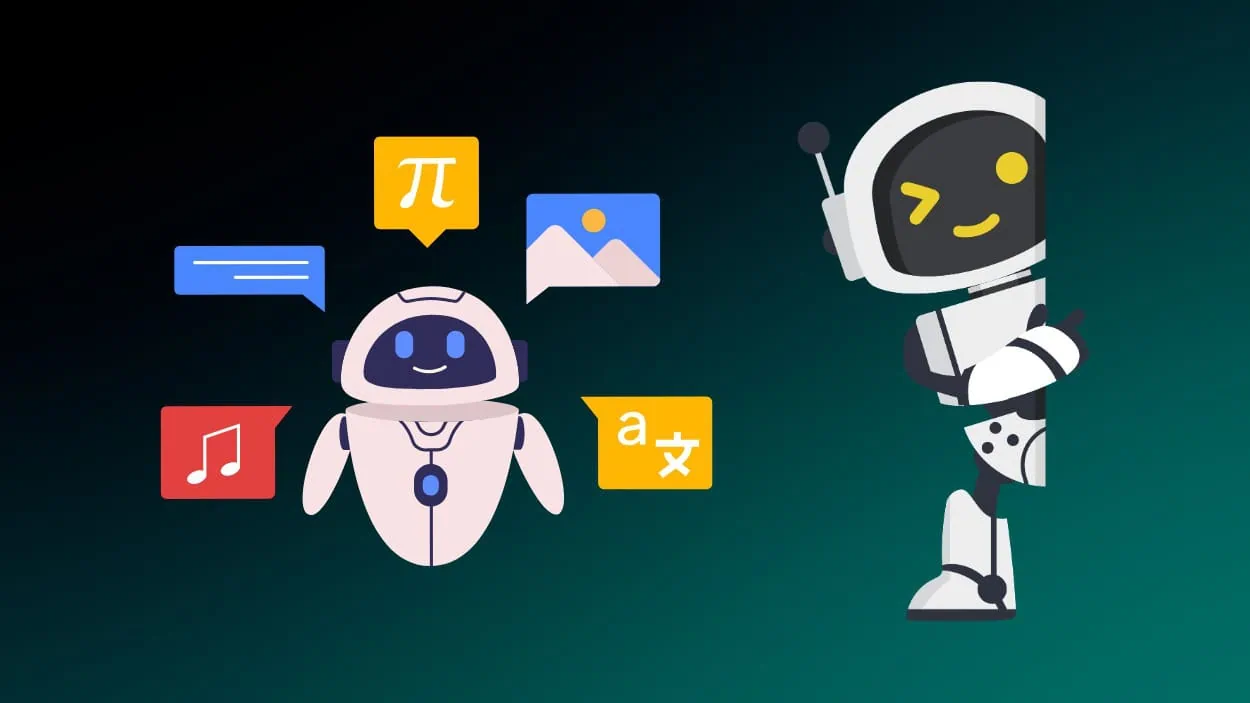
Multimodal AI is a system that processes and relates information from multiple modalities. A modality is the way in which something happens or is experienced. Text, audio, images, video, and even entire code repositories all sit inside long context inputs of >1 million tokens on the natively multimodal Gemini 2.X series, according to Google DeepMind.
The sense used here is one model taking several input types at once, which differs from several separate single-purpose systems chained behind a shared interface. Product copy calls both arrangements multimodal. Only one of them changes what a single set of weights actually sees.
Key Takeaways
- The Gemini 2.X series is built to be natively multimodal and supports long context inputs of >1 million tokens, spanning text, audio, images, video, and even entire code repositories, according to Google DeepMind.
- The Gemini 2.5 models are sparse mixture-of-experts transformers with native multimodal support for text, vision, and audio inputs, per Google DeepMind.
- Llama 4 takes a different route, using a mixture-of-experts architecture that incorporates early fusion for native multimodality, with 17 billion activated parameters in both Scout and Maverick, according to Meta.
- The rise of multimodal AI introduces unique prompt injection risks, and malicious actors could exploit interactions between modalities, such as hiding instructions in images that accompany benign text, according to OWASP.
- A redundancy of information across the different modalities does not necessarily make the model more robust against adversarial perturbations of a single modality, per NIST.
How Does Multimodal AI Work?
One model handles every input type by converting each of them into the same currency before any reasoning starts. Three stages describe that path.
1. Each Input Becomes Tokens the Same Model Can Read
The Gemini 2.5 models are sparse mixture-of-experts transformers with native multimodal support for text, vision, and audio inputs, according to Google DeepMind. Sparse mixture-of-experts models activate a subset of model parameters per input token. They do this by learning to dynamically route tokens to a subset of parameters, called experts. That decouples total model capacity from computation and serving cost per token.
Picture one reception desk that accepts letters, photographs, and voicemails, then files all three in a single cabinet. The alternative is three desks that never speak to each other, each holding a partial record of the same visitor.
2. Fusion Happens Early Rather Than After the Fact
The Llama 4 models are autoregressive language models that use a mixture-of-experts architecture and incorporate early fusion for native multimodality, per Meta.
Early fusion mixes the ingredients before the tin goes in the oven. The older approach bakes separate cakes and stacks them at the end, so any interaction between the layers has to be improvised afterwards.

3. One Set of Weights Reasons Across All of It
That shared pathway lets these models comprehend vast datasets, according to Google DeepMind. They handle complex problems from different information sources, including text, audio, images, video, and even entire code repositories, inside long context inputs of >1 million tokens.
Every input channel that opens is also a channel somebody can write into. The complexity of these systems expands the attack surface, according to OWASP. Multimodal models may also be susceptible to novel cross-modal attacks that are difficult to detect and mitigate with current techniques.
| Design choice | What it means in practice |
|---|---|
| Native multimodality | Text, audio, images, and video enter the same model instead of a text model wrapped around separate converters |
| Early fusion | Modalities combine at the input stage rather than after each has been processed alone |
| Sparse mixture-of-experts routing | Each input token activates a subset of parameters, separating total capacity from cost per token |
| Shared long context | A single request holds document, image, and audio evidence together |
Sources: Google DeepMind Gemini 2.5 technical report, Meta Llama 4 model card
Multimodal AI vs LLM: Where the Line Falls
A Multimodal Large Language Model uses powerful Large Language Models as a brain to perform multimodal tasks. GPT-4V is the representative model named in the survey by Yin and co-authors. Its emergent capabilities, such as writing stories based on images and OCR-free math reasoning, are rare in traditional multimodal methods.
Llama 4 lists input modalities as multilingual text and image, and output modalities as multilingual text and code, per Meta. Input multimodality and output multimodality are separate properties, and a system can hold one without the other.
The boundary matters when reading capability claims. A text-only model with an image captioner bolted onto its front end answers many of the same questions as a natively multimodal one. The gap opens on hard cases rather than demos. Reading that gap starts with a clear picture of what a plain large language model does on its own.
Is Every Multimodal AI a Large Language Model?
No. Multimodal machine learning aims to build models that can process and relate information from multiple modalities, under a taxonomy covering representation, translation, alignment, fusion, and co-learning. The MLLM branch is narrower, defined by the use of powerful Large Language Models as a brain to perform multimodal tasks. The wider field is older, and it still covers systems with no language model anywhere in them.
Why Does Multimodal AI Matter?
Until recently, most attacks and defenses in adversarial machine learning have operated under a single modality, according to NIST’s adversarial machine learning taxonomy. A new trend in the field is to use multimodal data, particularly the combination of image and text data modalities.
Gemini 2.5 Pro is a thinking model that excels at multimodal understanding and is now able to process up to 3 hours of video content, according to Google DeepMind. The same series supports long context inputs of >1 million tokens.
The shape of the input changed, which is a different order of change from a model scoring higher on one benchmark. Evaluation harnesses, editorial review, and security review were all built around text. A system that accepts an image accepts everything an image can carry.
Our AI coverage keeps surfacing the same lag. Capability rankings move every few months, while reader assumptions about what a model can take in move far more slowly. The consequence lands hardest where models act rather than answer, which is the risk profile sitting behind current AI agent adoption data.
Pros, Cons, and Risks
Advantages
- One model can comprehend vast datasets and handle complex problems from different information sources, including text, audio, images, video, and even entire code repositories.
- MLLMs show surprising emergent capabilities that are rare in traditional multimodal methods, including writing stories based on images and OCR-free math reasoning.
- Several papers have shown that multimodal models may provide some resilience against attacks, according to NIST, while other papers show that multimodal models themselves could be vulnerable to attacks mounted on all modalities at the same time.
Trade-offs and Risks
- The rise of multimodal AI introduces unique prompt injection risks, and the complexity of these systems expands the attack surface, according to OWASP. Text-channel injection is counted separately in prompt injection incident data, which does not cover the cross-modal case.
- Combining modalities and training the model on clean data alone does not seem to improve adversarial robustness, per NIST.
- Adversarial training, which is widely used in single modality applications, may become prohibitively expensive as the number of modality combinations increases.
- Single modality attacks can be effective and compromise multimodal models across a wide range of multimodal tasks, despite the information contained in the remaining unperturbed modalities.
OWASP writes that it is unclear if there are foolproof methods of prevention for prompt injection. It describes its listed measures as steps that can mitigate the impact. That sets the honest ceiling at helping reduce exposure. Nothing on the published list removes cross-modal injection.
Types of Multimodal AI
Baltrusaitis, Ahuja, and Morency go beyond the typical early and late fusion categorization and identify five broader challenges faced by multimodal machine learning: representation, translation, alignment, fusion, and co-learning.
Most explainers stop at fusion. The authors of the canonical taxonomy treat it as one of five challenges. That is a useful correction for anyone reading a model card and looking for the rest of the problem.
| Challenge | What it means | Where it shows up |
|---|---|---|
| Representation | Encoding data from several modalities in a form one model can use together | Shared embedding space behind combined text and image input |
| Translation | Mapping content from one modality into another | Image captioning, speech transcription, text-to-image generation |
| Alignment | Identifying which parts of one modality correspond to which parts of another | Matching a spoken phrase to the video frame it describes |
| Fusion | Joining information from several modalities to produce one prediction | Early fusion at the input stage, late fusion after separate encoders |
| Co-learning | Transferring knowledge between modalities, including when one is scarce | Using a data-rich modality to support a data-poor one |
Source: Baltrusaitis, Ahuja and Morency, Multimodal Machine Learning: A Survey and Taxonomy
The use of ML models trained on multimodal data has gained traction, particularly the combination of image and text data modalities, according to NIST.
Another axis runs across input versus output. Llama 4 takes multilingual text and image in and emits multilingual text and code, per Meta. The Gemini 2.X series handles text, audio, images, video, and even entire code repositories, according to Google DeepMind.
Real-World Applications
Long-Form Video and Document Understanding
Gemini 2.5 Pro is a thinking model that excels at multimodal understanding and is now able to process up to 3 hours of video content, according to Google DeepMind. Long context inputs of >1 million tokens let a single request hold text, audio, images, video and even entire code repositories at once.
A recording, its slide deck and its written minutes can therefore enter one prompt rather than three tools. The model reasons over all of them in the same pass.
Open-Weight Multimodal Models in Production
Meta released the Llama 4 collection on April 5, 2025, as natively multimodal AI models that enable text and multimodal experiences. Llama 4 Scout is a 17 billion parameter model with 16 experts and 109 billion total parameters. Llama 4 Maverick is a 17 billion parameter model with 128 experts and 400 billion total.
Open weights make that pair a reference point for teams running multimodal inference on their own hardware. The input contract is published rather than inferred from an endpoint.
Modality Support Across Shipping Models, Side by Side
The two input contracts above are the whole comparison in miniature. The gap between them decides which prompts are even expressible on each system.
- Gemini 2.X information sources: Text, audio, images, video, and even entire code repositories.
- Llama 4 input modalities: Multilingual text and image.
- Llama 4 output modalities: Multilingual text and code.
Support shifts with every release, so the current picture lives in a per-model capability and modality tracker rather than in any single definition.
Is Multimodal AI More Secure Than Text-Only AI?
The evidence does not support that assumption. A redundancy of information across the different modalities does not necessarily make the model more robust against adversarial perturbations of a single modality, according to NIST. Single modality attacks can be effective and compromise multimodal models across a wide range of multimodal tasks. Researchers have devised efficient mechanisms for constructing simultaneous attacks on multiple modalities, which suggests that multimodal models might not be more robust against adversarial attacks despite improved performance.
The complexity of these systems expands the attack surface, and robust multimodal-specific defenses are an important area for further research and development, according to OWASP. The safe reading runs in neither direction. Guardrail-bypass attempts against text-only systems are counted in LLM jailbreak attempt data, a separate failure class again.
What Are the Modalities in Multimodal AI?
Modality refers to the way in which something happens or is experienced, and a research problem is characterized as multimodal when it includes multiple such modalities. On shipping systems, the list runs to text, audio, images, video, and even entire code repositories for the Gemini 2.X series, according to Google DeepMind. Llama 4 lists multilingual text and image, per Meta.
No fixed inventory exists across vendors. The set a given system accepts is a product decision written into its model card. Two systems described with the same word can therefore take in very different things.
Conclusion
The Gemini 2.X series is built to be natively multimodal, according to Google DeepMind. It supports long context inputs of >1 million tokens across text, audio, images, video and even entire code repositories. That figure describes one request holding evidence that used to need several separate systems. The term itself names an arrangement rather than a quality: one model, several input types, one shared set of weights.
Testing and characterizing the resilience of a variety of multimodal ML models against evasion, poisoning, and privacy attacks remains an open challenge, according to NIST. Robust multimodal-specific defenses are an important area for further research and development, per OWASP. Both are research positions rather than shipped answers, which leaves the practical weight on whoever decides what a system is allowed to read.