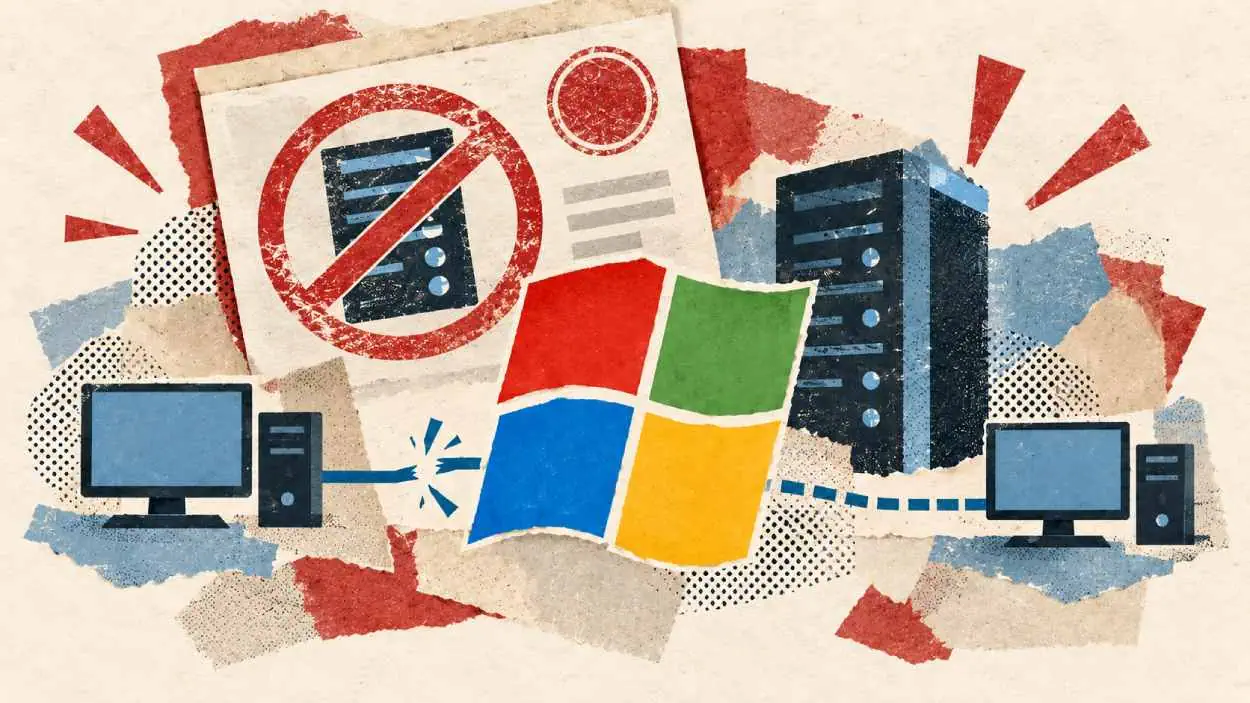






Microsoft (NASDAQ: MSFT) plans to deprecate its Windows Deployment Services (WDS) server role in the next Windows Server release, per a September 2026 company notice. WDS-provided PXE boot and multicast deployment go on the list with it.
The Brief
- Microsoft will deprecate the WDS server role and its PXE boot function starting with the next Windows Server release.
- Windows Server 2025 and earlier releases keep WDS, and Microsoft says support on those versions does not change.
- Configuration Manager’s PXE responder without WDS supports unicast only, so multicast imaging jobs will need a new plan.
- The notice follows two earlier cuts: boot.wim Setup support in 2021 and hands-free deployment in April 2026.
The cut reaches PXE, multicast and WinPE tools
WDS is a revised version of Remote Installation Services (RIS). IT teams use it to install Windows over the network on dozens or hundreds of machines at a time.
Microsoft’s early notice goes well past the role itself. The deprecation list covers:
- The WDS server role, including its Deployment Server and Transport Server role services.
- WDS-provided PXE boot and network bootstrap.
- WDS management tools, command-line interfaces and APIs.
- WDS multicast transport and any multicast workflow that depends on it.
- WinPE-WDS-Tools and other Windows PE components used only to build or run WDS clients.
“Deprecated products are supported until they are eventually removed from a future OS version,” Microsoft said. The company added that WDS “will continue to work on all currently supported Windows Server versions according to their published servicing lifecycles.“
The move closes out a wind-down that started in 2021, when Microsoft deprecated boot.wim Setup workflows in WDS mode for Windows 11 and later. Hands-free deployment went next. Under hardening guidance tied to CVE-2026-0386, that scenario is now off by default. It lost support on systems with updates released on or after April 14, 2026.
Configuration Manager multicast must move to unicast
Microsoft said Configuration Manager operating system deployment is not affected. The problem sits one layer down, in environments that still lean on WDS-backed PXE or WDS-dependent multicast.
The Configuration Manager PXE responder without WDS supports unicast, not WDS-dependent multicast, according to the notice. A lab that images a room of PCs from one multicast stream will instead push a separate copy to each machine. Microsoft tells admins to assess distribution point capacity, network bandwidth, scheduling and deployment wave size before they switch.
HTTP(S) Boot won’t close that gap on its own. Microsoft said it “may be an alternative for applicable deployment solutions,” but it doesn’t replace Configuration Manager PXE-based deployment.
Admins running WDS today can start where the notice does, with an inventory. That means finding every server with the WDS role, then tracing WDSUTIL calls, scripts, custom WinPE images and apps that call WDS components. Teams that need more time can keep WDS on a supported Windows Server release, subject to that release’s lifecycle and Microsoft’s WDS security guidance. Third-party deployment tools and independent PXE setups that don’t rely on the inbox role are unaffected.
What’s Next?
Two questions stay open in the notice: when the next Windows Server ships, and which later release removes WDS outright. Microsoft said it will update the article “as the release schedule, deprecation and removal milestones, and additional migration guidance become available.” Until that update lands, the only hard deadline for any WDS server is the servicing lifecycle of the Windows Server version underneath it.