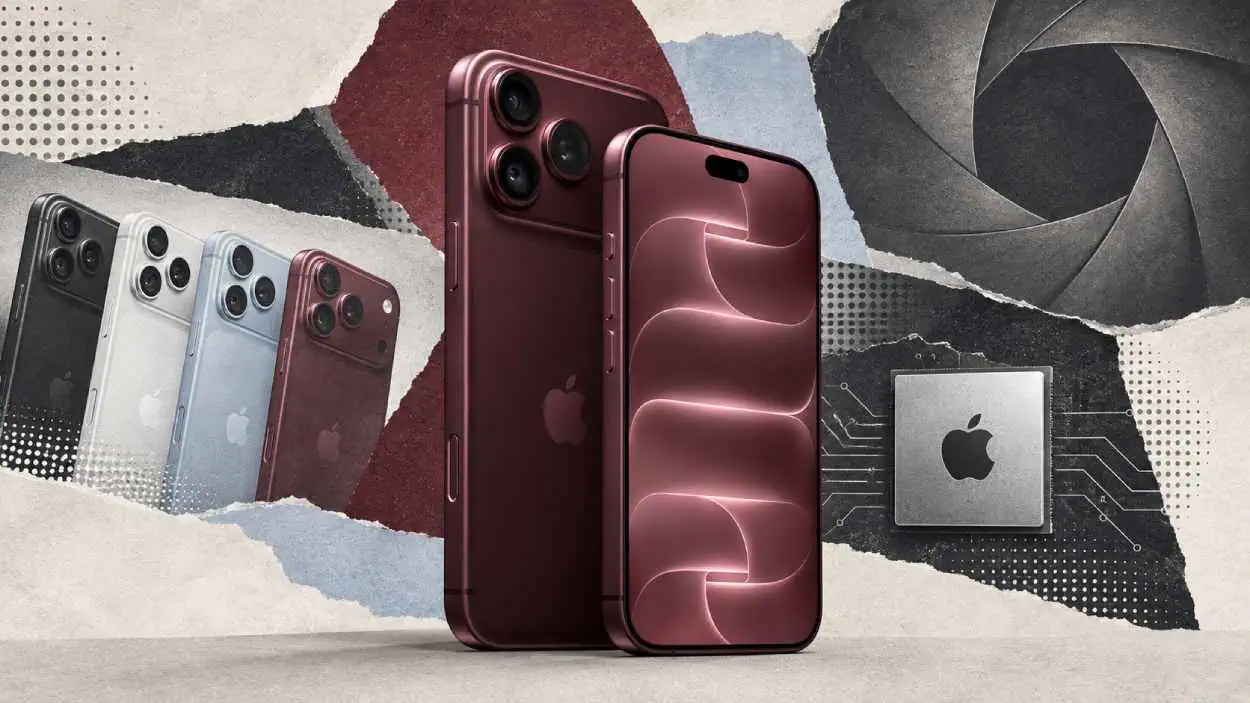






Apple launched the iPhone 18 Pro and iPhone 18 Pro Max on September 9, 2026, raising the Pro starting price to $1,199. That is $100 above the equivalent iPhone 17 Pro, and both phones carry Apple’s first 2-nanometer chip.
Key Takeaways
- Apple priced the iPhone 18 Pro at $1,199 and the Pro Max at $1,299, each $100 above last year’s model.
- The A20 Pro is Apple’s first iPhone processor built on a 2-nanometer manufacturing process.
- Analyst Tim Culpan found TSMC holding roughly $1 billion of unpackaged processors waiting on memory chips in August.
- The 48-megapixel main camera gains a mechanical variable aperture built from six laser-cut blades.
- Pre-orders open Saturday, September 12, with retail availability in more than 65 countries on September 18.
What We Know?
Apple set the iPhone 18 Pro at $1,199 and the iPhone 18 Pro Max at $1,299, both starting at 256GB and topping out at a new 2TB tier. Pre-orders open at 5 a.m. PT on Saturday, September 12. The phones reach more than 65 countries on Friday, September 18, with additional markets a week later.
The increase arrives during a genuine supply squeeze. Semiconductor analyst Tim Culpan reported on August 6 that TSMC was holding roughly $1 billion worth of unpackaged processors waiting on memory chips, because the A20 Pro’s wafer-level packaging needs DRAM present during assembly. Apple cannot stockpile finished dies ahead of a memory delivery, so the constraint runs straight through to retail inventory.
Memory makers have spent the year steering supply toward higher-margin AI data center parts, leaving phone builds to compete for what is left. Against that backdrop, $100 on a $1,099 base is a smaller pass-through than the market was braced for.
JUST IN: Apple $AAPL unveils iPhone 18 Pro & Pro Max. pic.twitter.com/jLhZsLAk4d
— Watcher.Guru (@WatcherGuru) September 9, 2026
The camera picks up a moving part
The 48-megapixel Fusion main camera is the first iPhone sensor with a physically variable aperture. Apple lists a range of f/1.48 to f/4, driven by six laser-cut blades, each thinner than a human hair and cut from a polymer composite chosen for flexibility and durability. In low light the aperture opens wider and admits around 50% more light.
A new Pro Controls layer exposes white balance, a live histogram, manual aperture and shutter speed for both stills and video. Smart Focus Tracking runs on device to hold a subject and reacquire it after the subject leaves the frame and returns. Time-lapse now records at 4K in Dolby Vision HDR, and Cinematic mode effects can be applied to standard footage after it is shot.
Apple’s launch announcement also lists a feature called Apple Reference Image, aimed at marking a photo as camera-captured rather than generated. Authenticity signals are becoming a phone-camera category of their own, and the iPhone install base means any Apple format reaches scale on day one.
Sustained performance is the chip story
The A20 Pro pairs a 6-core CPU, whose two performance cores Apple calls the fastest in any smartphone at 20% faster than the previous generation, with a 7-core GPU rated 40% quicker than the A19 Pro. A dual 16-core Neural Engine doubles the prior AI throughput, and memory bandwidth rises 50%.
Apple framed the release around that trade. Greg Joswiak, Apple’s senior vice president of worldwide marketing, said in the announcement:
Cooling turns those numbers into usable speed. A redesigned vapor chamber carries three times the surface area of the iPhone 17 Pro’s and circulates deionized water across the memory as well as the die, which Apple credits for up to 40% higher sustained performance. Battery claims follow: up to 36 hours of video playback on the Pro and 45 on the Pro Max, or 24 and 30 hours in Apple’s typical-use measure. Wired charging reaches 50% in about 15 minutes.
Read those battery figures carefully before ordering. Apple attaches them to eSIM-only configurations, so buyers in markets that still receive physical-SIM hardware should not plan around the 45-hour ceiling.

What We Don’t Know?
Apple’s own lab supplied every performance figure above, and no independent benchmark has run on shipping hardware. Several other gaps stayed open as the event closed.
- Siri AI timing is contested. Apple’s live event put six languages into beta this month. According to Engadget’s launch-day report, English is already in beta through the iOS 27 and Apple Intelligence betas, with French, Japanese, Korean, Portuguese and Spanish arriving in October.
- Apple has not said whether Apple Reference Image uses the C2PA Content Credentials standard or an Apple-only format other platforms cannot read.
- Apple gave no figure for secured DRAM supply, which leaves Culpan’s packaging bottleneck as the main unknown behind delivery dates.
- Nobody has tested whether the variable aperture assembly holds calibration across a two-year or three-year ownership window.
Pre-orders on September 12 are the first real signal. Slipping ship dates in the opening hours would point to the memory constraint reaching customers, and the first independent benchmarks should land near the September 18 retail date. Buyers who want a launch-window unit should order early rather than wait for reviews.