






Most video games like to present themselves as systems of mastery. You learn the mechanics. You improve through repetition. You earn outcomes through effort. Yet beneath that surface, many of the games people return to most often are driven less by control than by rhythm, probability, and tolerance for uncertainty.
This is not always obvious while playing. Progress bars, skill trees, and tutorials create the impression of linear movement. But the emotional pull often comes from something else entirely. The small moment of reveal. The anticipation before an outcome. The sense that the next attempt might feel different, even if the structure remains the same.
If you strip away genre and presentation, a surprising number of games rely on the same abstract loop. Action is taken. Time passes. A result appears. Sometimes it is meaningful. Sometimes it is not. What keeps players engaged is not certainty, but the willingness to stay inside that loop.
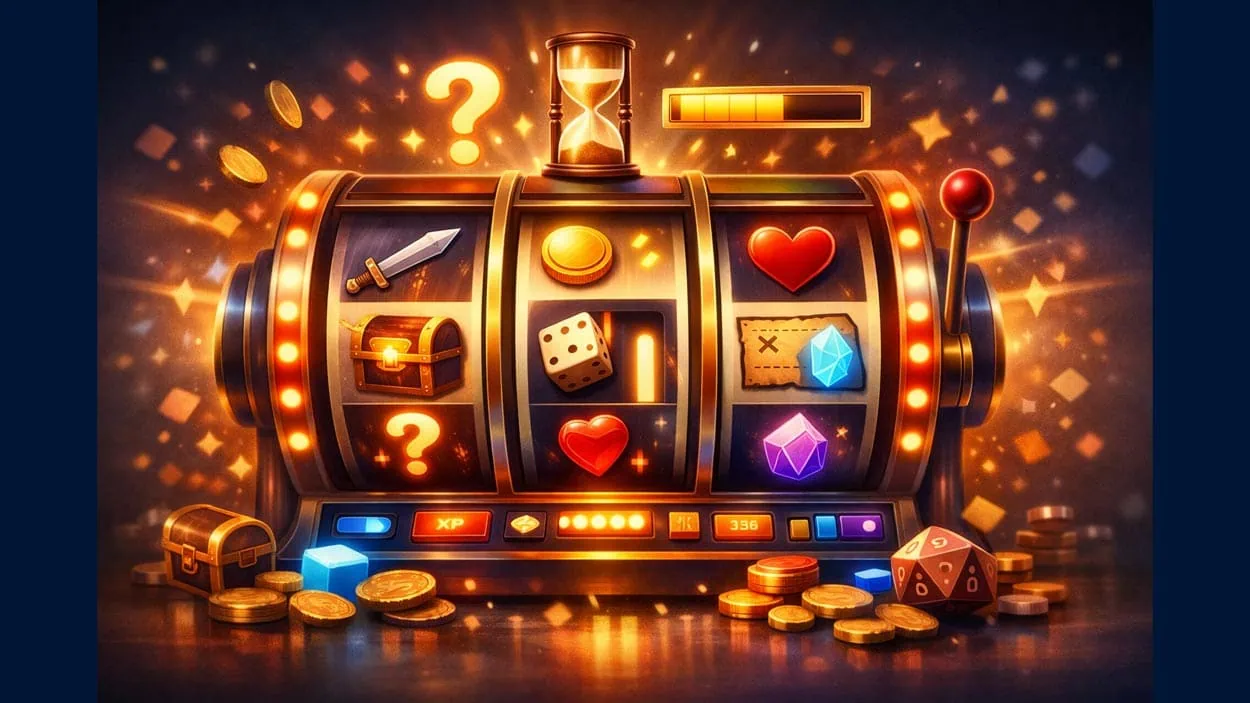
Seen this way, many modern games begin to resemble the logic of UK slots, where interaction is less about directing outcomes and more about participating in a process that unfolds gradually and without guarantees.
When Control Is Mostly Cosmetic
The idea that games are primarily about skill is comforting, but not always accurate. In many popular titles, skill determines efficiency rather than outcome. You can improve the odds, but rarely remove uncertainty altogether.
Loot systems make this clear. You defeat an enemy or complete a task, and the reward arrives according to probability rather than precision. The player’s role is not to dictate the result, but to trigger the opportunity for something to happen.
This does not diminish the experience. In fact, it often enhances it. Total control can feel exhausting. Partial control leaves room for surprise.
Familiar Games Through a Different Lens
Imagine familiar games reduced to their abstract components. A role-playing game becomes a cycle of inputs followed by delayed feedback. A sports game becomes a sequence of attempts punctuated by moments of resolution. A simulation becomes an exercise in waiting for conditions to align.
Even games built around exploration often rely on chance. You move through space, not knowing exactly what you will find. The pleasure lies in discovery, not prediction.
Viewed this way, the visual spectacle fades, and the underlying structure comes into focus. Repetition. Anticipation. Reveal.
Why This Does Not Feel Like Gambling to Players
Players rarely describe these systems as gambling, even when they share mechanical similarities. The distinction lies in framing. Games contextualise chance within narrative, progress, or environment. Outcomes feel earned because effort preceded them, even if effort did not determine them.
This framing matters. It turns waiting into engagement and uncertainty into texture. The player is not chasing loss. They are inhabiting a system that rewards attention over time.
The experience feels purposeful rather than extractive.
The Role of Repetition in Engagement
Repetition is often misunderstood as a lack of creativity, yet it is central to how games hold attention. Repeating an action builds familiarity. Familiarity sharpens perception. Small changes become meaningful because the baseline is known.
Slot machines rely on the same principle. So do games. The difference is aesthetic and emotional rather than structural.
In games, repetition is often dressed as progression. In slots, it is presented more honestly. Both depend on the player’s willingness to stay present.

Abstraction as Design Philosophy
Many of the most successful games are abstract at their core. They reduce complex experiences to simple interactions repeated over time. The abstraction allows players to project meaning onto outcomes.
This is why minimalist games can be so absorbing. They do not overwhelm with information. They create space for anticipation.
The same abstraction underpins chance-based systems. When outcomes are not fully explained, players fill the gaps themselves.
The Comfort of Predictable Uncertainty
There is a paradox at the heart of these systems. They are unpredictable in outcome, yet predictable in structure. You know what will happen next in broad terms, even if you do not know how it will resolve.
This balance creates comfort. The system feels stable even when the results vary. Players trust the loop, if not the reward.
That trust is what keeps people returning long after novelty fades.
What This Reveals About Modern Play
The popularity of chance-inflected mechanics suggests that players are not seeking constant success. They are seeking continuity. A space where effort leads somewhere, even if the destination is unclear.
Games that understand this do not rush to satisfy. They allow anticipation to do the work. They respect the player’s patience.
In an era of constant stimulation, this restraint is quietly radical.
Why the Comparison Matters
Thinking about games as abstract slot-like systems is not an accusation. It is an observation. It highlights how engagement is built through timing and uncertainty rather than constant reward.
It also explains why certain games endure. They are not solved. They live in.
The abstract reality is that many favourite games succeed not because they guarantee outcomes, but because they make waiting feel worthwhile.