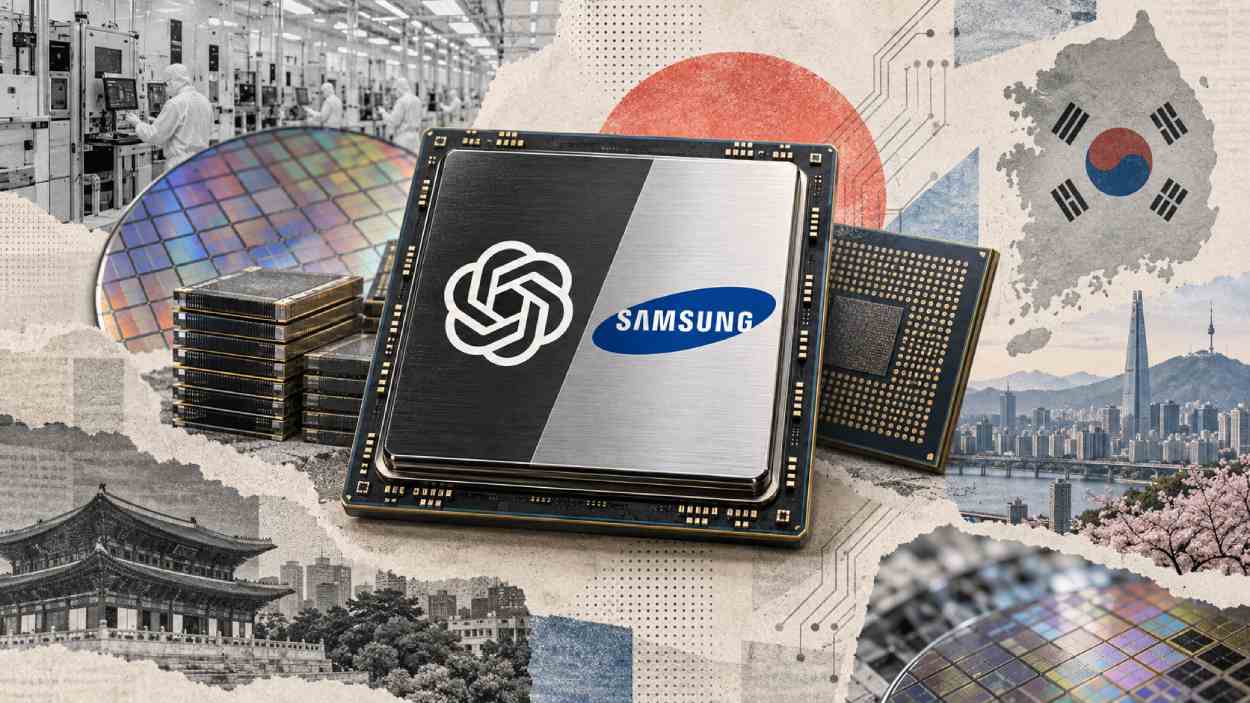






OpenAI said on September 9 that it is jointly researching and producing next-generation chips with Samsung Electronics, extending a partnership that already makes the Korean manufacturer one of the largest corporate deployments of ChatGPT anywhere.
The Big Picture
- Harrison Kim, General Manager of OpenAI Korea, named joint chip work as the partnership’s most advanced area.
- ChatGPT Enterprise use across South Korean companies and institutions grew roughly 28 times in a year to late August.
- Samsung declined to comment on customer matters, leaving the scope of the chip work unstated.
- OpenAI’s first custom chip, an inference part called Jalapeno, was built with Broadcom and made by TSMC.
- Samsung shipped the industry’s first HBM4E memory samples earlier this year, ahead of rival suppliers.
OpenAI and Samsung widen joint chip work
Kim told reporters at a Seoul press conference that semiconductors are the relationship’s clearest result. “One of the areas where we have made the most progress and gained the most recognition with Samsung Electronics is our joint production and research on the next-generation chips we are developing,” he said, declining to elaborate.
The refusal to elaborate matters as much as the disclosure. OpenAI’s known silicon program runs through Broadcom, and Jalapeno, revealed in June, handles inference and is fabricated by TSMC. Neither company has said whether Samsung’s contribution is memory, advanced packaging, or foundry capacity.
#Business | OpenAI says working with Samsung on next-generation chips, deepening cooperation
— Moneycontrol (@moneycontrolcom) September 9, 2026
– OpenAI and Samsung deepen cooperation on chip development.
– Samsung is a major global user of ChatGPT for enterprise.
– OpenAI Korea GM noted joint chip production with Samsung.
Read…
Korea has become OpenAI’s strongest enterprise market
ChatGPT Enterprise use across South Korean companies and institutions ran roughly 28 times higher in late August than a year earlier, OpenAI said, though it withheld absolute user counts. South Korea also held more paying ChatGPT subscribers than any country outside the United States at the end of last year.
Samsung sits at the center of it. Kim said staff in Korea and overseas use the tool in research, marketing, and sales. Its Device eXperience division, which covers phones, televisions, and appliances, cleared employees to use ChatGPT, Google’s Gemini, and Anthropic’s Claude in daily work. OpenAI’s enterprise deployment arm exists for rollouts of this shape.
Memory supply is the real constraint
Kim said more capable AI hardware keeps raising memory demand, making Korean suppliers a priority for OpenAI’s office there. Samsung and SK Hynix signed letters of intent last year to supply memory for the Stargate data center program, and Samsung’s semiconductor unit now carries most of its operating profit.
It has since begun shipping HBM4E samples to customers including AMD, Nvidia, and Google. Memory of that class feeds accelerators such as Nvidia’s Rubin and Google’s Ironwood Tensor Processing Unit.

Why It Matters?
Silicon independence is the point. Every inference query OpenAI serves on hardware it co-designs is one it does not buy at a supplier’s margin, and a second memory relationship softens its exposure during a shortage. What the record shows is a stated collaboration. Neither side has confirmed volume, process node, timeline, or contract.
The open questions are specific. Which chip is being co-developed, what Samsung physically builds, and whether any of it reaches production before Korean Stargate capacity comes online. Companies already running ChatGPT Enterprise should review admin controls and data-handling settings before the next model rollout widens usage, a step that helps reduce risk.