






Programmatic advertising has reshaped how brands buy and optimize digital media. Instead of manual negotiations, marketers now rely on automated platforms to purchase ad inventory in real time, helping retailers personalize product ads and enabling streaming services to deliver targeted video campaigns at scale.
As budgets shift toward data-driven media buying, programmatic tools also help advertisers optimize spend, improve audience targeting, and measure performance more precisely. The statistics below highlight how programmatic advertising continues to influence digital marketing strategies in the United States and worldwide.
Editor’s Choice
- Over 90% of U.S. digital display advertising is now bought programmatically as of 2025, showing how automated media buying has become the dominant method for online advertising.
- Global programmatic advertising spending is expected to reach more than $725 billion by 2026, reflecting sustained investment from brands and agencies.
- Connected TV (CTV) programmatic ad spending in the U.S. is projected to exceed $30 billion by 2026, driven by the growth of streaming platforms and ad-supported subscription models.
- Mobile devices account for over 70% of programmatic ad impressions worldwide, highlighting the central role of smartphones in digital ad delivery.
- Real-time bidding (RTB) auctions process millions of ad requests per second, enabling advertisers to evaluate and bid on individual impressions instantly.
Recent Developments
- Global programmatic ad spend surpassed $200 billion.
- Programmatic accounts for ~90% of global display ad spending.
- US programmatic ad spending topped $200 billion.
- US programmatic display spending exceeded $203 billion.
- Programmatic CTV ad spend grew with 14% net new budgets.
- Retail media networks exceeded $30 billion.
- Programmatic will account for nearly a third of digital audio ad spending.
- First-party data became the core operating system for advertising.
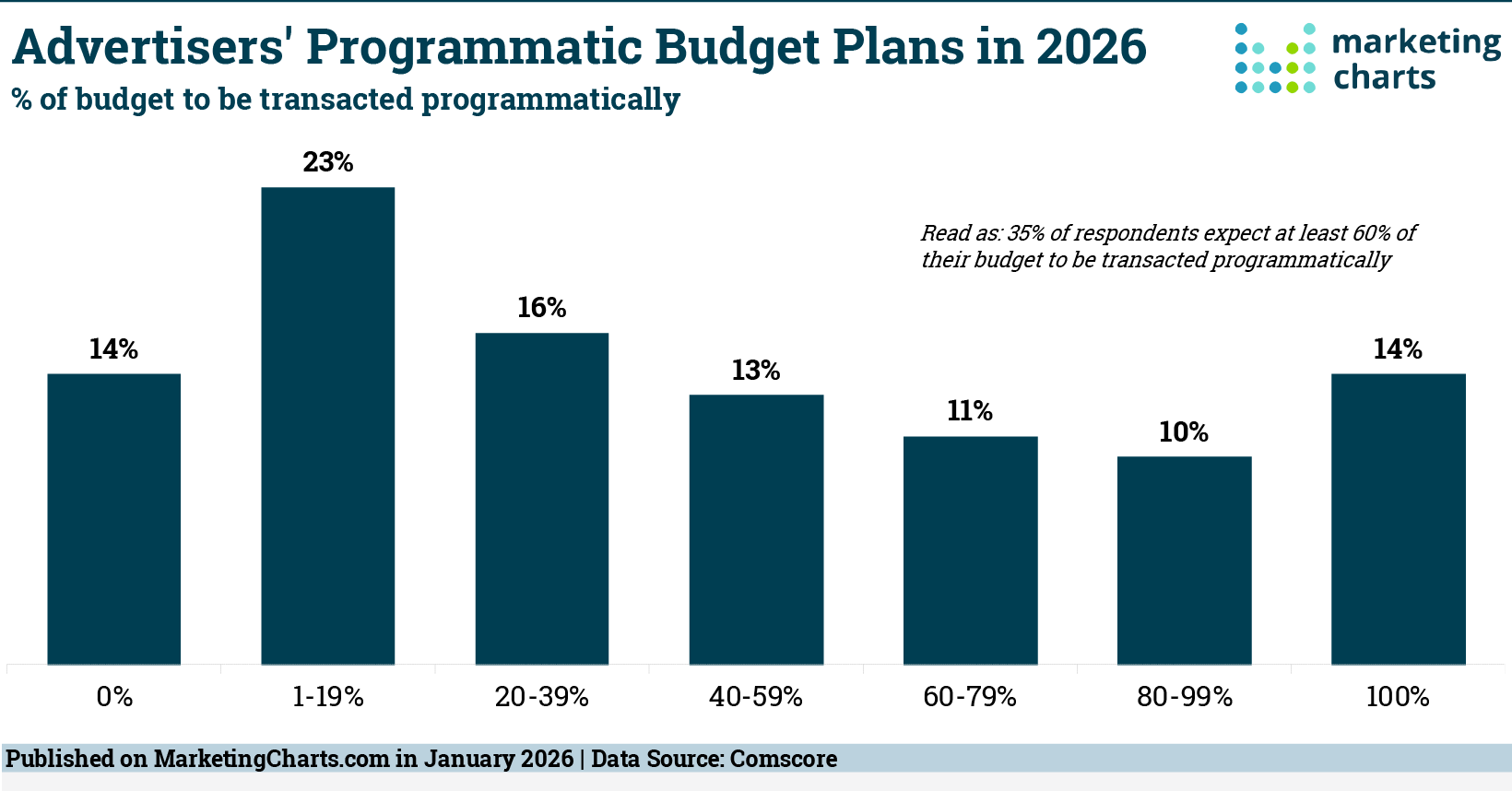
Advertisers’ Programmatic Budget Plans
- 23% of advertisers plan to allocate 1%–19% of their advertising budget to programmatic buying, making it the most common allocation range.
- 16% of advertisers expect to spend 20%–39% of their ad budget through programmatic platforms.
- 13% of respondents say 40%–59% of their advertising budget will be transacted programmatically.
- 11% of advertisers plan to allocate 60%–79% of their marketing budget to programmatic advertising.
- 10% of respondents expect 80%–99% of their ad budget to run through programmatic channels.
- 14% of advertisers plan to execute 100% of their advertising budget programmatically, showing strong confidence in automated media buying.
- Another 14% of respondents report 0% programmatic spending, meaning they do not plan to use programmatic advertising in their budgets.
- Overall, 35% of advertisers expect at least 60% of their ad budgets to be transacted programmatically in 2026, highlighting the continued shift toward automated ad buying.
Share of Overall Digital Ad Spend
- US programmatic display ad spending exceeded $203 billion, nearly 92% of total digital display spend.
- Programmatic accounts for 90% of global display ad budgets.
- US programmatic display share reached 92% of digital display ad spend.
- Global programmatic display penetration hit 90%.
- Native display ad spend comprised 63.1% of the US total display ad spend.
- Programmatic native ad placements account for over 91.3% of US digital display spending.
- Programmatic display market CAGR projected at 6.4% through 2033.

Adoption by Region and Country
- North America holds 40% of the global programmatic market share.
- Europe contributes 30% of global programmatic ad spending.
- UK’s programmatic market accounts for 64% of the UK/FR/DE display spend.
- Asia-Pacific ad spending hit $325.39 billion, growing 6.5% YoY.
- China’s ad spend grew 6.1% YoY, leading APAC.
- Brazil leads the Latin American programmatic market.
- Programmatic is highly advanced in the US and Canada.
- India’s digital ad growth is at 8.6%, APAC at 9.6%.
- Japan ad growth slows to 2.9% YoY.
Most Leveraged Marketing Channels
- Website, blog, and SEO rank as the top marketing channels, with 45% of marketers using them the most.
- Organic social media content comes next, with 40% of marketers relying on it to reach audiences and build engagement.
- Email marketing also records 40% usage, showing that direct communication still plays a strong role in marketing strategies.
- Paid social media content follows closely, with 39% of marketers using paid campaigns to expand reach and target specific audiences.
- Brand awareness campaigns remain important, with 36% of marketers focusing on activities that increase brand visibility.

Budgets and Investment Trends
- U.S. programmatic display ad spend reached $170 billion.
- Global programmatic spending exceeded $595 billion.
- 72% of marketers increased programmatic budgets.
- 60% of U.S. leaders allocate over half digital display budgets to programmatic.
- U.S. retail media programmatic spend surpassed $50 billion.
- 65% of advertisers expect programmatic budget growth.
- 55% of SMBs use programmatic platforms.
- Automation reduced campaign costs by 20%.
- Programmatic video budgets are planned to increase by 45%.
Reach, Impressions, and Frequency Metrics
- Programmatic platforms process 12 million ad impressions per second globally.
- Programmatic reaches 92% of U.S. internet users.
- Mobile programmatic generates 72% of digital ad impressions worldwide.
- The average frequency in programmatic campaigns is 4.2 impressions per user.
- Programmatic video viewability exceeds 72%.
- Display ad viewability averages 67% in programmatic exchanges.
- Global programmatic video impressions up 22% YoY.
- DSPs enable reach to 5,000+ audience segments.
- Frequency capping boosts efficiency by 32%.
CPM, CPC, and CPA Benchmarks
- Average US programmatic display CPM rose to $3.50.
- Premium CTV programmatic CPM averaged $28.
- Programmatic display CPC stabilized at $1.20.
- Video programmatic CPC reached $2.10.
- Display programmatic CPA averaged $42.
- Retargeting lowered CPA by 52%.
- eCommerce programmatic CPM hit $9.
- AI bidding cut CPC by 18%.
- Global programmatic video CPM $22.

CTV and OTT Advertising Statistics
- U.S. CTV ad spending exceeded $30 billion.
- Programmatic CTV transactions surpassed 45%.
- 85% of U.S. households own connected TV devices.
- 65% of streaming platforms offer ad-supported tiers.
- OTT video consumption averages 3.4 hours daily per viewer.
- CTV ad completion rates over 92%.
- 60% of advertisers boosted CTV budgets.
- Shoppable CTV formats lifted engagement by 32%.
Mobile and In-App Advertising Statistics
- Mobile accounts for 75% of global programmatic impressions.
- US mobile programmatic display spend topped $115 billion.
- Mobile video programmatic grew 25% YoY.
- In-app generates 88% of mobile programmatic impressions.
- Average mobile programmatic CTR is at 0.25%.
- 93% of US smartphone users see monthly mobile ads.
- Programmatic ads comprise 65% of global in-app gaming revenue.
- Mobile video completion rates exceed 82%.
- 70% of retail media campaigns use mobile programmatic.
Data, Identity, and Audience Targeting in Programmatic
- Around 72% of advertisers now rely on first-party data as their primary signal for programmatic targeting.
- Roughly 64% of brands increased investment in identity resolution and clean room solutions.
- About 67% of advertisers use alternative IDs to reach non-addressable audiences.
- Nearly 84% of companies already use or plan to test identity graphs for cross-device matching.
- Over 50% of advertisers actively test contextual AI tools as a cookieless targeting strategy.
- CDPs and DMPs routinely activate 1,000+ audience segments for programmatic campaigns.
- Approximately 58% of marketers cite data privacy compliance as a top criterion in choosing programmatic partners.
- Retail media networks leveraging first-party shopper data power over $50 billion in US ad spend.

AI and Machine Learning in Advertising
- Around 80% of digital advertisers use AI-driven tools to optimize programmatic campaigns and audience targeting.
- AI now influences roughly 60% of all digital ad spending via targeting, optimization, and automation systems.
- AI-driven programmatic advertising spend reached $134.8 billion, growing 18% year-over-year.
- Machine learning–optimized campaigns typically see 10–30% higher conversion rates than non-AI programmatic.
- Generative AI in the advertising market size hit $4.18 billion, on track for 23.8% CAGR to $9.81 billion by 2030.
- About 65% of US advertisers have adopted generative AI tools for ad creation and optimization.
- AI-based fraud detection saves roughly $6.5 billion annually by blocking invalid traffic and fake impressions.
- AI-optimized ads see around 28% higher CTR and 17% better ROI on average.
Ad Fraud and Brand Safety in Advertising
- Global ad fraud losses are estimated at $100–120 billion annually, equal to 8–15% of global digital ad spend exposed to invalid traffic.
- Around 20.64% of ad traffic was invalid in a dataset of 105.7 billion impressions, putting about $37 billion of US programmatic spend at risk.
- Roughly 22% of global digital ad spend is lost to ad fraud, with brands often losing 15–25% of budgets to non-human traffic and fake clicks.
- IVT rates in open programmatic display environments range from 12–25%, compared with much lower levels in curated or private marketplaces.
- About 20% of all digital traffic is non-human, highlighting the scale of invalid impressions and clicks.
- Click spam and related schemes expose 5–12% of mobile app install campaigns to fraudulent activity.
- Estimated global annual losses from domain spoofing alone are projected to exceed $9 billion.
- US advertisers risk roughly $37 billion in programmatic ad spend annually due to invalid traffic.
- Industry benchmarks suggest 8–15% of global ad budgets require protection with advanced fraud and brand safety tools.
Privacy, Cookieless Advertising, and Data Protection in Programmatic
- Around 70% of marketers say they are actively preparing for a cookieless future and shifting toward privacy-first targeting.
- Roughly 71% of industry respondents believe there are viable alternatives to third-party cookie tracking, yet only 8% feel fully prepared.
- About 40% of users now refuse cookies when given a choice, with average consent rates dropping to 39%.
- 70% of B2B marketers plan to increase their use of first-party data, while 67% of brands and 80% of publishers expect to grow their first-party data sets.
- Activating first-party data can reduce customer acquisition costs by up to 50% and lift revenue 10–15%.
- Research shows 79% of consumers feel more comfortable with contextual ads than with behaviorally targeted ads.
- The contextual advertising market is forecast to surpass $562 billion by 2030, supported by a double-digit CAGR as budgets shift to privacy-safe methods.
Frequently Asked Questions (FAQs)
About 90% of digital display ads globally are purchased programmatically as of 2025–2026.
Global programmatic ad spending reached roughly $716 billion in 2025, with forecasts pushing the market toward $800 billion by 2028.
Programmatic advertising accounts for about 83.2% of global digital ad spending.
Programmatic buying represents around 91%–92% of all U.S. digital display ad spending.
Conclusion
Programmatic advertising has become the backbone of modern digital media buying. Automated platforms now power the majority of display advertising transactions, enabling brands to reach highly targeted audiences across mobile apps, websites, streaming services, and connected devices. At the same time, emerging trends such as AI-driven optimization, first-party data strategies, and retail media networks continue to expand programmatic capabilities.
However, the industry also faces important challenges. Advertisers must address issues such as ad fraud, privacy compliance, and the transition to cookieless targeting while maintaining campaign efficiency. As technology evolves, marketers who combine automation, high-quality data, and transparent supply chains will likely achieve stronger results in programmatic advertising. These statistics highlight how the ecosystem is evolving and where advertisers can focus their strategies today.