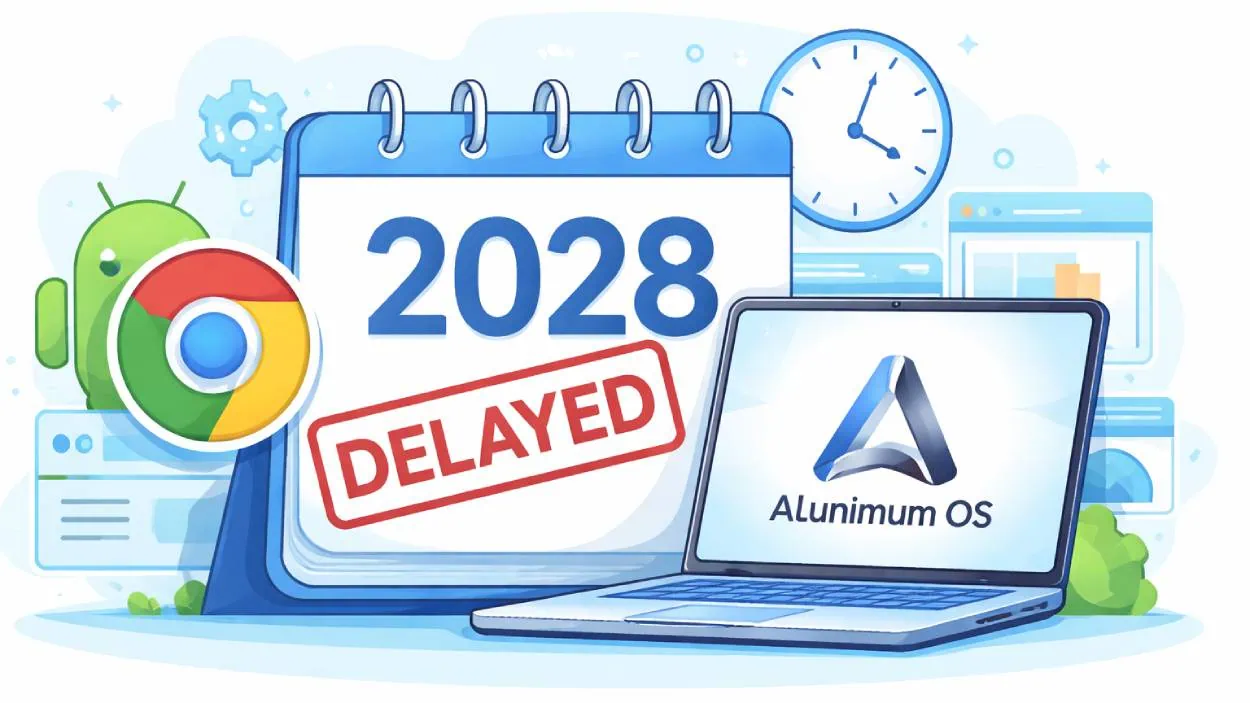







Google’s ambitious Aluminium OS, a unified platform merging Android and ChromeOS, is now officially delayed until 2028.
Quick Summary – TLDR:
- Aluminium OS full rollout delayed to 2028, despite earlier expectations for 2026.
- Commercial testing set to begin in late 2026, for select partners only.
- ChromeOS will continue to receive updates until at least 2034.
- Some existing Chromebooks won’t support Aluminium OS due to hardware limitations.
What Happened?
Court documents from Google’s antitrust trial have revealed that Aluminium OS, Google’s next-generation operating system designed to replace both Android and ChromeOS, will not see a full public release before 2028. Although initial messaging pointed to a 2026 launch, internal timelines tell a different story. Google plans to give early access to trusted commercial testers by the end of 2026, with broader availability for enterprises and schools two years later.
🚨 ChromeOS is expected to be fully phased out by around 2034.
— Abhishek Yadav (@yabhishekhd) February 4, 2026
Court documents reveal Google’s long-term plan:
👉 Replace ChromeOS with an Android-based desktop OS called “Aluminium OS”
Timeline:
• 2026 → Aluminium OS early development
• 2028–2030 → Wider rollout on laptops… pic.twitter.com/x25vuYcQIQ
Google’s OS Merger Vision Hits a Speed Bump
Aluminium OS was first confirmed by Google in mid-2025 as an effort to unify the mobile strength of Android with the desktop stability of ChromeOS. Designed for a wide range of devices, including laptops, tablets, and desktops, the system is being built with Qualcomm’s Arm-based chips in mind. While some leaks and teasers led to hopes of a 2026 release, the real timeline paints a more cautious picture.
According to The Verge and PCWorld, the platform’s “fastest path” includes:
- Late 2026: Limited release to commercial trusted testers
- 2028: Full rollout to enterprise and education sectors
This rollout strategy is influenced by both technical challenges and regulatory requirements, particularly in regions where long-term device support is mandated.
ChromeOS Will Stick Around for a Decade
One of the more surprising outcomes from the legal filings is Google’s updated commitment to continue supporting ChromeOS until at least 2034. The company currently guarantees 10 to 11 years of updates for newer Chromebooks. That means while Aluminium OS is coming, millions of current Chromebook users will stay on the older system for years to come.
John Maletis, VP at Google, stressed the importance of continuity during testimony, stating:
Key points:
- Devices running ChromeOS Classic will remain supported via security updates until their Auto Update Expiration (AUE) dates
- Not all current Chromebooks will be eligible to upgrade to Aluminium OS due to hardware limitations
- This approach ensures Google meets regulatory demands in markets that require extended device support

Legal Proceedings Reveal Internal Contradictions
One reason for the confusion around Aluminium OS’s timeline stems from public statements that differed from Google’s internal documents. In September 2025, Android head Sameer Samat said at the Snapdragon Summit that the OS would arrive “next year.” But under oath during the same period, he clarified it was a hope, not a certainty.
These contradictions surfaced during Google’s antitrust trial, where the U.S. government was evaluating whether the company should be forced to split its Android and Chrome divisions. The court ultimately ruled against such action, but the filings offered rare insight into how Google plans product rollouts behind closed doors.
SQ Magazine Takeaway
I’m not surprised by this delay. Unifying two massive platforms like Android and ChromeOS is no small feat, especially with the pressure of long-term support promises and legal scrutiny. While it’s a letdown for those hoping to try Aluminium OS sooner, I appreciate Google’s transparency in sticking to support commitments for existing users. As a user myself, I’d rather wait for a stable product than rush into something half-baked. But Google now has a ticking clock to prove Aluminium OS is worth the wait.