






E-commerce conversion rates are a key performance indicator for online retailers, reflecting how effectively a store turns visitors into paying customers. This continues to vary widely across industries, regions, and platforms, influenced by trends like mobile shopping growth, AI personalization, and rising customer expectations.
In practical terms, many stores see average conversion rates around 2% to 3%, while top performers reach 4% or higher. This directly impacts revenue; higher converting stores capture more value from the same traffic. Whether you’re optimizing marketing spend or refining the checkout flow, understanding current benchmarks helps frame realistic goals. Explore the data below to see the latest conversion rate insights.
Editor’s Choice
- ~2.5% to 3.2%, Typical global ecommerce conversion range in 2025–2026 benchmarks.
- ~1.9%, Estimated global average ecommerce conversion rate from blended benchmarks.
- 3.2%+, Top 20% of Shopify stores’ conversion rate.
- ~6%+, Highest conversion category benchmarks in repeat-purchase sectors like food & beverage.
- 70%+, Typical cart abandonment rate affecting conversion upsides.
- Mobile conversion lower than desktop due to UX constraints.
- AI and personalization trends continue to lift conversion optimization results.
Recent Developments
- Mobile traffic reaches 70% of total ecommerce visits, converting at 1.8-2.5% vs desktop’s 3.5-4.0%.
- AI personalization boosts revenue by 40%, with chat increasing conversions 4X to 12.3%.
- Cart abandonment averages 74.8-76.8%, highest on mobile at 78.74%.
- Abandoned cart recovery via AI reaches 35%, reducing revenue loss significantly.
- Social commerce sales projected at $2.9T globally, penetration at 25%.
- LTV benchmarks target a 3:1 CAC-to-LTV ratio for ecommerce profitability.
- Average session duration benchmarks 3-4 minutes for high-engagement ecommerce sites.
- Data privacy shifts 74% of brands to first-party strategies amid tracking restrictions.
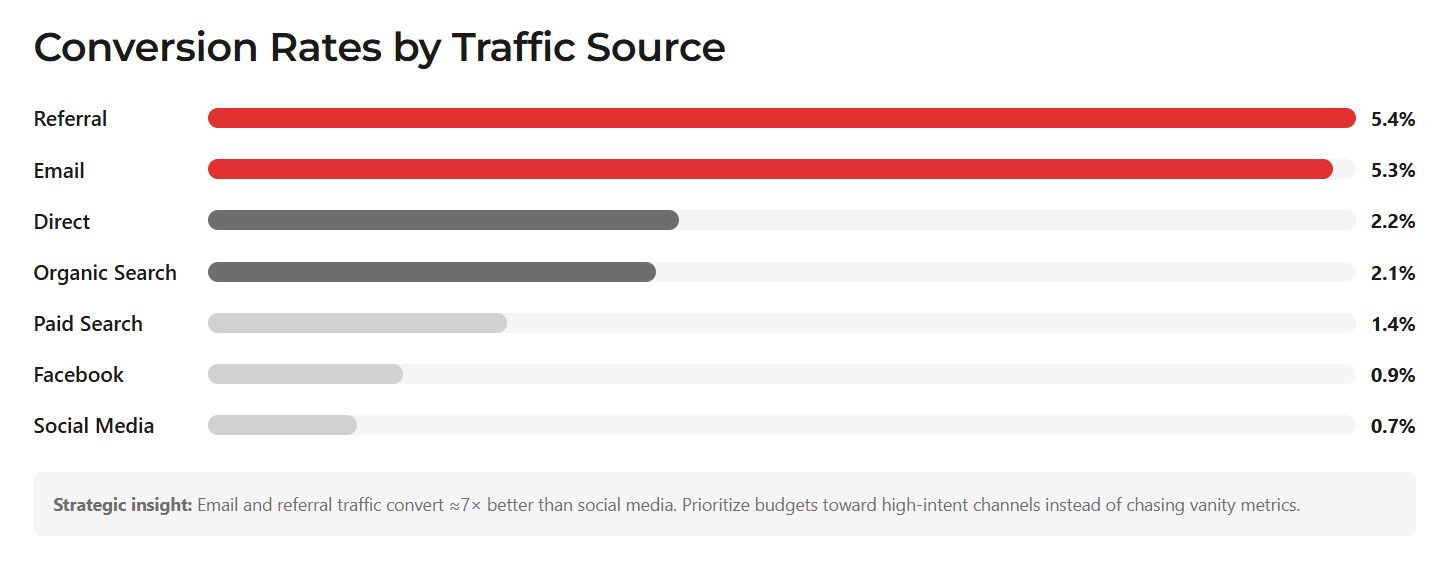
Conversion Rates by Traffic Source
- Referral traffic delivers the highest conversion rate at 5.4%, indicating strong trust and intent from third-party recommendations.
- Email marketing closely follows at 5.3%, proving highly effective due to targeted messaging and engaged subscriber lists.
- Direct traffic converts at 2.2%, suggesting brand-aware visitors are more likely to complete purchases than casual browsers.
- Organic search shows a 2.1% conversion rate, reflecting steady performance from high-intent users actively searching for solutions.
- Paid search converts at 1.4%, indicating moderate effectiveness but lower efficiency compared to organic channels.
- Facebook traffic records just 0.9% conversion, highlighting challenges in turning social engagement into purchases.
- Overall, social media traffic has the lowest conversion rate at 0.7%, emphasizing its role as an awareness channel rather than a direct sales driver.
- Referral and email traffic convert roughly 7× better than social media, underscoring the importance of prioritizing high-intent acquisition channels.
Global Average E-commerce Conversion Rate
- ~2.5% to 3%, is widely cited as the global average ecommerce conversion rate in late 2025–2026.
- Some benchmark tools report a slightly lower ~1.9% global average across platforms.
- Average rates for Q3 2025 hovered around 2.5% in multiple global e-commerce studies.
- Desktop sites generally convert better than mobile, with desktop often near 4%+, in platform reports.
- Mobile conversion rates commonly range 1.2% to 2.9%, depending on optimization and device context.
- Conversion rate fluctuations are common month over month due to seasonal and marketing influences.
- Markets with higher disposable incomes show slightly improved average conversion rates.
- Retailers using multichannel strategies tend to see higher blended average conversion rates.

Conversion Rates by Region
- The United States’ ecommerce conversion rate averages between 2.5% and 3.5%, depending on device and vertical.
- The United Kingdom reports some of the highest e-commerce conversion rates globally, often exceeding 3.5%.
- Germany typically converts around 2.2% to 2.8%, reflecting cautious purchasing behavior.
- Asia Pacific markets average roughly 1.5% to 2.5%, though mobile commerce dominates traffic share.
- Nordic countries show above-average e-commerce trust, with conversion rates often above 3%.
- Emerging markets in Latin America convert closer to 1% to 2%, influenced by payment infrastructure and logistics factors.
- Cross-border ecommerce shoppers convert at slightly lower rates than domestic shoppers due to shipping concerns and duties.
- Regions with high digital wallet adoption report faster checkout completion, positively impacting conversion.
Desktop vs. Mobile vs. Tablet: Conversion, Traffic & Revenue Comparison
- Desktop and mobile show identical conversion rates at 2.8%, indicating mobile optimization has reached parity with traditional desktop shopping.
- Tablet users deliver the highest conversion rate at 3.1%, suggesting more focused browsing behavior despite lower usage.
- Mobile dominates traffic with 60% share, making it the primary gateway for e-commerce visitors.
- Desktop accounts for 35% of traffic but drives 42% of revenue, indicating higher spending per user.
- Tablet traffic is minimal at just 5%, yet it contributes 6% of total revenue, outperforming its traffic share.
- Mobile generates 52% of revenue, slightly below its traffic share, implying lower average order values compared to desktop.
- Desktop users exhibit stronger purchasing power, maintaining a larger revenue share despite lower traffic volume.
- The data highlights a multi-device reality, where mobile drives discovery while desktop and tablets often capture higher-value transactions.

Platform Specific Benchmarks
- Shopify averages 1.4-1.8%, top performers exceed 3.2-4.7%.
- BigCommerce reports 2.5% average, 20% above industry norms.
- WooCommerce hovers near 2.0%, optimized stores reach 3.4%.
- Amazon averages 9.9-11.1%, Prime-eligible hits 15-25%.
- Etsy sellers average 2-3%, a good performance benchmark.
- Shop Pay boosts conversions 1.7x higher than guest checkout.
- One-click checkout increases rates 10-20%, up to 50% with Shop Pay.
- Accelerated mobile pages lift mobile conversions 15-30%.
Top Performers and Benchmarks
- The top 10% of ecommerce stores achieve conversion rates above 4%, outperforming industry averages.
- Top quartile Shopify brands exceed 3.2% conversion, more than double the platform average.
- E-commerce brands optimizing product pages with high-quality imagery see conversion lifts of up to 40%.
- Checkout flow simplification can improve conversions by 20% or more, according to usability studies.
- Personalized product recommendations drive 10% to 30% revenue increases, directly impacting conversion metrics.
- Sites loading in under two seconds experience significantly higher conversion rates than slower competitors.
- E-commerce brands leveraging user-generated content report conversion rate increases of up to 29%.
- Email remarketing campaigns targeting cart abandoners recover 10% to 15% of lost conversions.
Conversion Rates by Industry
- Food & Beverage averages 4.5-6.0%, top performers exceed 6.0%, driven by impulse buys.
- Health & Beauty ranges 3.3-4.5%, leaders hit 5.0% via loyalty and subscriptions.
- Fashion & Apparel benchmarks 2.0-2.8%, top at 3.5% despite sizing issues.
- Electronics averages 1.4-1.8%, high performers reach 2.5% amid price comparisons.
- Luxury goods & furniture hover 0.8-1.5%, limited by long decision cycles.
- Consumer goods near 2.5-3.0% as a solid average performance.

Seasonal E-commerce Conversion Trends
- Q4 peaks with November-December rates 20-30% above the annual average.
- Black Friday-Cyber Monday conversions spike 131% from the early November baseline.
- US holiday sales hit $257.8B Nov-Dec, 6.8% YoY growth.
- January post-holiday dip 10-15% from December peaks.
- Back-to-school apparel/electronics uplift 15-25% in late Q3.
- Holiday mobile traffic 54.5% of sales, and desktop converts 2x higher.
- Flash sales boost rates up to 35%, 78% for 80% discounts.
- Early campaigns ensure 20% better consistency vs late promotions.
Social Commerce Conversion Rates
- Global social commerce sales are projected to exceed $1 trillion by 2028, reflecting rapid channel growth.
- Conversion rates from social media traffic typically range between 1% and 2%, lower than direct or email channels.
- TikTok Shop reports conversion rates higher than traditional social referral traffic due to integrated checkout experiences.
- Instagram Shopping users demonstrate higher engagement and purchase intent compared to standard organic traffic.
- Influencer-driven ecommerce campaigns can deliver conversion rate increases of up to 3x, compared to non-influencer traffic.
- Livestream commerce events can generate conversion rates exceeding 10%, in certain categories, especially in beauty and fashion.
- Social proof elements such as user reviews and community content significantly improve conversion rates from social traffic.
Cart Abandonment and Checkout Conversion Statistics
- Mobile cart abandonment rates exceed 80%, significantly higher than desktop abandonment.
- Unexpected extra costs, such as shipping and taxes, account for 48% of abandoned carts.
- Mandatory account creation causes 24% of shoppers to leave checkout before purchase.
- Long or complicated checkout processes contribute to abandonment in 17% of cases.
- Offering guest checkout improves completion rates and reduces friction in early funnel stages.
- Brands using abandoned cart email sequences recover 10% to 20% of lost sales.
- Buy Now Pay Later integration has been shown to increase checkout completion by 20% or more in select retail segments.

Conversion Rate Optimization CRO Statistics
- Companies investing in structured CRO programs are 2x more likely to see significant sales growth.
- A one-second delay in page load time can reduce conversion rates by 7%.
- E-commerce sites loading in under two seconds see materially higher average conversion rates.
- Personalized product recommendations can increase e-commerce revenue by 10% to 30%.
- A B testing high traffic landing pages delivers average conversion improvements of 15% to 20%.
- Simplified navigation structures improve user engagement and reduce bounce rates, indirectly supporting conversion gains.
- Adding trust badges and security seals can increase checkout conversions by measurable margins, especially among first-time buyers.
- E-commerce brands using AI-powered product recommendations report higher average order value and stronger conversion consistency.
Frequently Asked Questions (FAQs)
Average global e-commerce conversion rates typically range from 2% to 4% in 2026.
Most e-commerce sites convert at around 1.9% to 2.2% on average in 2026.
Top 10% of Shopify stores convert at about 4.7%+, whereas the average Shopify store converts around 1.4%.
Global average add-to-cart rates hover around 6.17%, with Food & Beverage as high as 10.45%.
Conclusion
E-commerce conversion rates today continue to reflect a complex mix of device behavior, industry differences, seasonal demand, and user experience quality. Cart abandonment remains a major revenue leak, yet targeted recovery campaigns and simplified checkouts help reclaim lost sales. At the same time, social commerce and AI-driven personalization are reshaping how shoppers discover and complete purchases.
For US-based retailers and global brands alike, understanding these benchmarks provides a foundation for realistic goal setting and measurable growth. Conversion rate optimization is no longer optional; it directly determines how effectively traffic translates into revenue.