







The Content Management System (CMS) landscape today continues to shape how websites are built and managed across industries. Today, CMS platforms power a significant majority of websites worldwide, influencing everything from brand sites to e-commerce storefronts. From marketers driving agility in content delivery to developers leveraging open-source flexibility, CMS usage impacts digital strategy and user experience.
As businesses increasingly prioritize scalable digital operations, understanding current adoption and platform trends becomes crucial. Let’s explore why CMS data matters and what the latest numbers reveal.
Editor’s Choice
- Around 64% of all websites use a CMS as of 2026, underscoring how mainstream content management platforms have become for modern sites.
- WordPress holds about 60.2% of the CMS market share among platforms in 2026.
- WordPress powers roughly 43% of all websites on the internet.
- Shopify commands around 7.1% of the CMS market share, showing steady growth.
- Wix accounts for about 5.9% of the CMS market share, climbing over the past year.
- The global CMS market is valued at about $33.28 billion in 2026.
- CMS adoption continues upward, with top business sites increasingly using established and SaaS platforms.
Recent Developments
- CMS market is projected to hit $48.17 billion by 2031 at 7.68% CAGR.
- WordPress holds 62.8% CMS market share, powering 43.2% of websites.
- Cloud CMS commands 62.88% market share, growing at 19.1% CAGR.
- Headless CMS is growing at 18.85% CAGR amid omnichannel demand.
- Joomla at 2.4% market share, down from prior highs.
- Drupal at 1.8% market share, steadily declining.
- Services segment is expanding at 16.02% CAGR for migrations.
- AI personalization tools added $125 million ARR for Adobe.
- Asia-Pacific fastest growing at 14.52% CAGR.
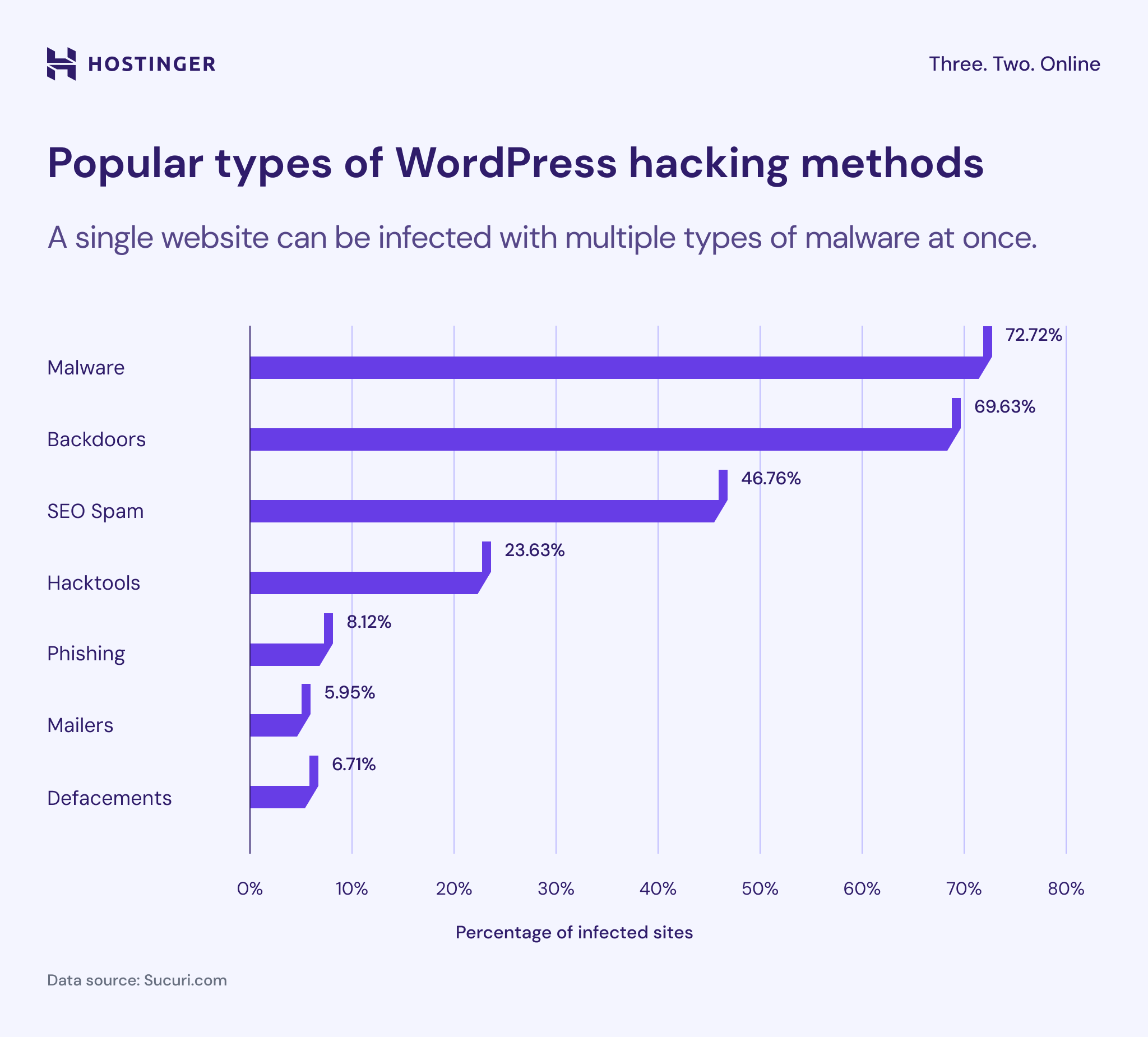
Popular Types of WordPress Hacking Methods
- Malware is the most common threat, affecting 72.72% of infected WordPress sites.
- Backdoors are nearly as prevalent, present in 69.63% of compromised websites.
- SEO spam attacks impact 46.76% of infected sites, manipulating search rankings and traffic.
- Hacktools are found in 23.63% of cases, enabling attackers to maintain control or launch further exploits.
- Phishing malware appears in 8.12% of infections, often used to steal user credentials.
- Defacement attacks affect 6.71% of sites, altering website content to display unauthorized messages.
- Malicious mailers are detected in 5.95% of infected websites, commonly used to send spam from compromised servers.
Overall CMS Adoption Rates
- About 64% of all websites worldwide run on a CMS, confirming that CMS platforms now underpin the majority of the modern web.
- WordPress powers 43.3% of all websites.
- 31% of websites operate without a traditional CMS.
- WordPress holds 62.7% CMS market share.
- Drupal holds 1.1% CMS market share.
- Joomla at 2% CMS market share.
- Shopify CMS share 6.7%.

Key Benefits After Migrating to a Headless CMS
- Time-saving is the most reported benefit, cited by 31.4% of organizations after migration.
- Increased website traffic follows, with 16.8% reporting improved visitor volumes.
- Higher return on investment (ROI) is achieved by 14.2% of adopters.
- Reduced budget spend is noted by 13.7%, indicating improved cost efficiency.
- Access to new markets expands for 12.3% of organizations using a headless CMS.
- Improved user-experience satisfaction is reported by 11.6%, reflecting better frontend performance and flexibility.

Other Notable CMS Platforms
- HubSpot CMS Hub powers more than 200,000 live websites globally, with strong B2B adoption.
- TYPO3 maintains around 0.5% global CMS share, particularly strong in Germany and parts of Europe.
- Magento (Adobe Commerce) powers roughly 0.7% of all websites but commands a higher share among high-revenue online stores.
- PrestaShop accounts for about 0.6% of websites, with concentration in Europe and Latin America.
- BigCommerce powers over 40,000 live online stores, competing in the mid-market retail segment.
- Ghost supports more than 50,000 live websites, appealing to publishers and membership-based businesses.
- Contentful, a headless CMS, serves 30% plus of Fortune 500 companies, highlighting enterprise demand for composable architectures.
- Strapi surpassed 50,000 GitHub stars, reflecting rapid developer adoption of open-source headless CMS frameworks.
- Sitecore remains a leading enterprise CMS, widely adopted in financial services and healthcare sectors.
Top 10 CMS Platforms
- WordPress powers 43.3% of all websites on the internet and commands about 62.7% of the CMS market share among sites using a known CMS.
- Shopify runs approximately 4.6% of all websites, representing around 6 to 7% of the CMS market share overall.
- Wix accounts for 3.7% of all websites, with CMS share hovering near 5%.
- Squarespace powers about 2.2% of all websites, continuing steady adoption among U.S. small businesses and creators.
- Joomla’s CMS market share declined to roughly 2.4%, reflecting a multiyear downward trend.
- Drupal powers about 1.2% of all websites, maintaining strength in government and enterprise deployments.
- Adobe Experience Manager (AEM) holds under 0.5% of total websites but ranks highly among Fortune 100 enterprise sites.
- Webflow now powers around 0.9% of websites, nearly doubling its share over the past three years.
- Blogger (Blogspot) accounts for approximately 0.8% of all websites, though growth remains flat.
- OpenCart controls about 0.6% of websites globally, primarily in small to mid-sized eCommerce markets.

CMS Market Share Trends
- WordPress increased from about 39% of all websites in 2021 to over 43% in 2026, though annual growth has slowed.
- Shopify’s share of all websites grew from roughly 3% in 2020 to 4.6% in 2026, fueled by U.S. retail digitization.
- Wix’s total website share climbed past 3.7% in 2026, reflecting growth in drag-and-drop builders.
- Squarespace crossed the 2% threshold in global website share for the first time in recent years.
- Joomla’s CMS market share has steadily declined over five years, dropping below 3%.
- Drupal’s share decreased slightly year over year but remains stable in public-sector deployments.
- North America accounts for more than 35% of global CMS revenue, leading the market in enterprise adoption.
- Cloud-based CMS deployments now represent over 60% of new implementations, signaling a shift away from on-premise infrastructure.
- Headless CMS adoption is expanding at a 20% plus projected CAGR, outpacing traditional CMS growth rates.
eCommerce CMS Share
- Shopify 28.8% top 1 million eCommerce sites.
- WooCommerce 18.2% top 1 million eCommerce sites.
- Magento 0.98% top 1 million eCommerce sites.
- OpenCart 0.29% top 1 million eCommerce sites.

Market Share by Top Sites
- WordPress 32% among the top 1 million websites.
- Drupal 3% share in the top 1 million sites.
- Drupal 4% in the top 10k websites.
- WordPress 47% of the top 5,000 domains.
- Adobe Experience Manager 16% top 5,000 domains.
- Drupal 4.7% top 5,000 domains.
- Drupal 7.5% top 1,000 sites.
- WordPress 47.5% top 1,000 sites.
- Shopify 28.8% top 1 million sites.
Frequently Asked Questions (FAQs)
Approximately 71.3% of all websites use a content management system.
The global CMS market is estimated at around $33.28 billion in 2026.
About 28.6% of websites use none of the content management systems monitored.
The CMS market is projected to grow at a CAGR of about 7.68% from 2026 to 2031.
Conclusion
The CMS market today reflects both maturity and transformation. WordPress remains the dominant platform, yet SaaS builders and headless architectures steadily reshape the competitive landscape. Meanwhile, eCommerce adoption, enterprise cloud migration, and AI-driven functionality accelerate market expansion. For U.S. businesses and global organizations alike, CMS selection now plays a central role in digital performance, scalability, and customer experience. As adoption rises and platforms evolve, tracking these statistics helps decision-makers align technology investments with measurable growth outcomes.