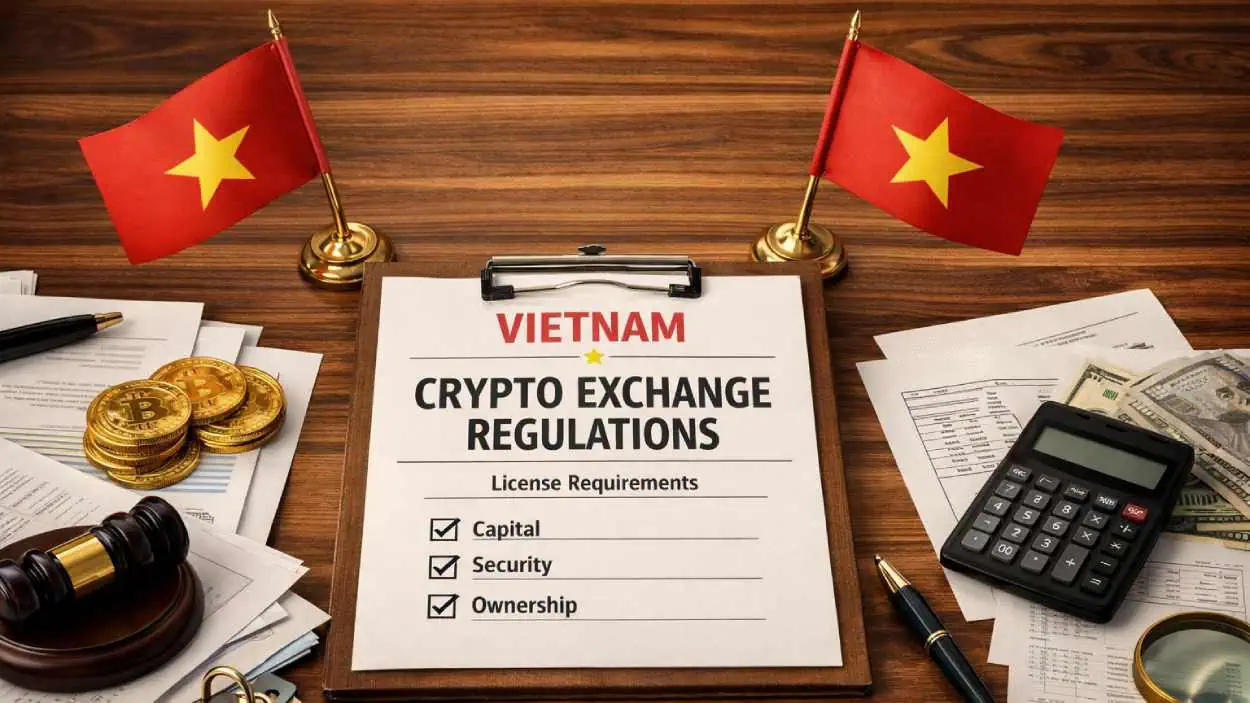







Vietnam has officially opened the gates for cryptocurrency exchanges with a strict licensing program that sets one of the world’s highest entry barriers.
Quick Summary – TLDR:
- Vietnam launched its first official crypto exchange licensing program on January 20, 2026.
- Applicants must have at least $380 million in capital, 65% of which must come from institutional investors.
- At least five major banks and investment firms are preparing to launch exchanges.
- The move marks a shift from regulatory gray zone to structured oversight, aiming for investor protection and market stability.
What Happened?
On January 20, 2026, Vietnam began accepting applications for crypto exchange licenses under a new government-backed pilot program. After years of operating in a regulatory gray area, crypto trading in the country is now entering a tightly controlled and structured phase. The program comes on the heels of Vietnam’s new Law on Digital Technology Industry, which took effect at the start of the year and provides a formal regulatory foundation for digital assets.
🇹🇭 Thailand introduces guidelines supporting crypto ETF and futures trading
— Bitcoin Malaya (@bitcoinmalaya) January 22, 2026
🇻🇳 Vietnam opens crypto exchange license with the highest capital threshold ($400M) in the region
Our neighbours in the SEA are making moves in the crypto scene pic.twitter.com/WXRz3mlmZU
Vietnam’s Licensing Program Sets the Bar High
The licensing framework introduced by the State Securities Commission and the Ministry of Finance is part of Government Resolution No. 05/2025/NQ-CP. It outlines one of the toughest capital requirements globally for crypto service providers. Applicants must meet a minimum charter capital of VND 10 trillion (approximately $380 million), with 65 percent of that from institutional shareholders.
Further rules include:
- At least two institutional investors from banking, securities, insurance, fund management, or tech sectors must contribute over 35 percent of the capital.
- Companies must have a registered headquarters in Vietnam.
- All transactions must be processed in Vietnamese Dong (VND).
- IT systems must meet Level 4 security standards as verified by the Ministry of Public Security.
Foreign investors are allowed a maximum 49% ownership, ensuring that Vietnamese entities maintain control.
The high capital requirement is nearly 600 times greater than Hong Kong’s crypto exchange capital rule, which sits at roughly $640,000. Vietnam is expected to license just five exchanges during the pilot program’s five-year run, indicating a highly selective and cautious rollout.
Big Banks Lead the Way
Vietnam’s financial sector is already stepping up. MBBank, Techcombank, and VPBank are among the five major institutions ready to enter the market.
- MBBank signed a cooperation agreement with Dunamu, the company behind South Korea’s Upbit exchange.
- SSI Securities created a crypto-focused entity called SSI Digital Technology JSC and partnered with Tether and Amazon Web Services.
- VIX Securities launched its own platform named VIX Digital Asset Exchange.
These moves by traditional finance giants signal confidence in the new regulatory framework and aim to position Vietnam as a credible player in the digital finance landscape.

A Top Crypto Market Steps Into the Light
Vietnam is already a heavyweight in the crypto world. According to Chainalysis’s 2025 Global Crypto Adoption Index, the country ranks fourth globally and third in Asia-Pacific. Crypto is widely used in remittances, gaming, and savings, with annual transaction volumes surpassing $220 billion.
Now, by legalizing and regulating the market, Vietnam is formalizing what had long been informal infrastructure. The pilot program allows regulators to closely monitor crypto exchanges, test operational systems, and refine policies before opening up further licensing.
SQ Magazine Takeaway
I think Vietnam just dropped a bold message: if you want to play in their crypto space, come in strong and play by the rules. This is not a playground for untested startups. Requiring nearly $400 million upfront is serious business, and only the most prepared players will make the cut.
But here’s the upside: this kind of structure and oversight brings real trust to a space that desperately needs it. With big banks leading the charge and clear rules in place, Vietnam could become one of Asia’s most trusted hubs for digital asset trading. This might just be the start of something big.