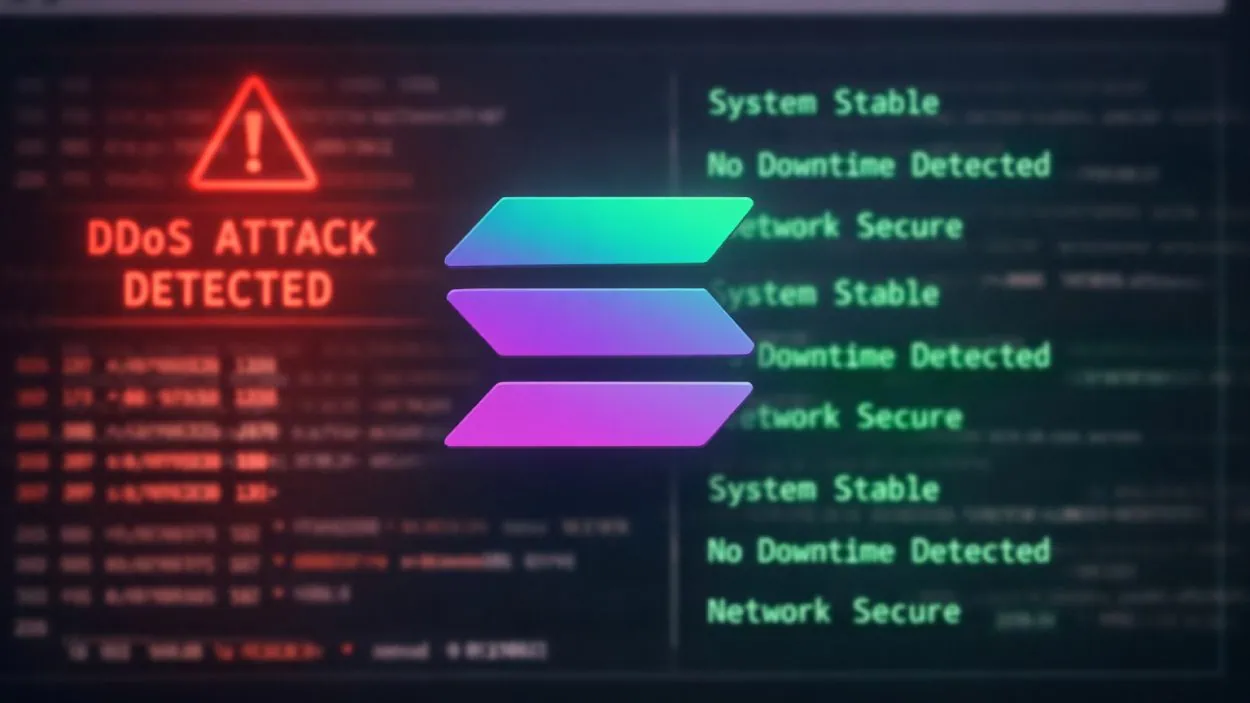







A record-breaking cyberattack hit Solana this month, but the network stood tall with no downtime and barely a hiccup in performance.
Quick Summary – TLDR:
- Solana endured a 6 terabit per second DDoS attack, one of the largest in internet history, without any visible downtime.
- Transaction speed and fee structure remained stable, a sharp contrast to past outages that plagued the network.
- Validator landscape has become more centralized but also more resilient, led by enterprise-grade infrastructure.
- Solana’s stability during the attack strengthens its case as a viable platform for fintech and crypto payroll use cases.
What Happened?
In December 2025, Solana was hit with a massive distributed denial-of-service (DDoS) attack peaking at around 6 terabits per second. Despite the scale of this attack among the largest ever recorded, alongside incidents targeting Google Cloud and AWS, Solana’s blockchain remained fully operational. Unlike previous years when similar disruptions caused long outages, this time the network didn’t flinch.
🚨BREAKING: @Solana has been under a sustained DDoS attack for the past week, peaking near 6 Tbps, the 4th largest attack ever recorded for any distributed system. Network data shows no impact, with sub second confirmations and stable slot latency.
— SolanaFloor (@SolanaFloor) December 16, 2025
The Sui network was also… pic.twitter.com/CpQJrTiZnt
Solana’s Industrial-Grade Resilience
The attack, confirmed by Solana co-founders and data from Pipe Network, spanned more than a week. Yet, block production, transaction confirmations, and user fees remained unaffected. The median confirmation time stayed around 450 milliseconds, with 90 percent of transactions clearing in under 700 milliseconds.
This stability wasn’t just luck. It stemmed from a serious architectural overhaul that included:
- A high-availability system for validator clusters that detects failures and downgrades faulty nodes automatically.
- Adoption of QUIC protocol and local fee markets to filter traffic more aggressively and block spam before it hits core systems.
- A strategic pivot toward a leaner, more professional validator set, with enterprise-level operators such as Galaxy Digital, Figment, Binance Staking, and Helius leading the charge.
As a result of these changes, over 35 percent of validators exited in 2025, primarily smaller operators affected by reduced subsidy support from the Solana Foundation. The Foundation has been trimming its delegation program to prioritize reliability over decentralization, removing three validators for every new one added since April.
Why It Matters for the Broader Crypto Ecosystem?
The timing of the attack coincided with a crypto market slump, dragging SOL’s price below $130. But many investors saw the real story in Solana’s performance, not its price. Solana is increasingly behaving like hardened financial infrastructure, with the muscle to absorb internet-scale stress without faltering.
Even more telling was the comparison with rival networks. Sui, another Layer 1 chain, suffered block production delays under a separate but smaller DDoS incident around the same time. The contrast emphasized Solana’s advantage in engineering maturity and network discipline.

Implications for Stablecoin Use and Payroll Systems
The attack also highlighted Solana’s growing importance in stablecoin ecosystems and fintech services. With about $15 billion in stablecoin float and annual trading volume nearing $1.6 trillion, businesses rely on it for real-time crypto payments, including payroll systems.
When performance wavers, user trust does too. But Solana’s ability to handle a DDoS of this size without disruption builds confidence in its suitability for instant and reliable stablecoin transactions, especially in mission-critical use cases like salary disbursements.
SQ Magazine Takeaway
I’m genuinely impressed by how Solana handled this attack. We’ve all seen how bad things got in 2022 when smaller traffic spikes could knock it offline. This time, with six terabits of pressure coming at it, the network didn’t blink. That’s not just a technical win but it’s a message to the market that Solana is ready to play in the big leagues. Yes, the validator set has gotten smaller and more centralized, and that’s a valid concern. But when it comes to reliability and performance, Solana just proved it’s no longer an experimental chain. It’s hardened, industrial-grade infrastructure, and that changes everything.