






Solana Company has launched a new institutional borrowing model that allows firms to unlock liquidity from natively staked SOL while keeping assets in qualified custody.
Quick Summary – TLDR:
- Solana Company, Anchorage Digital, and Kamino launched a tri party custody borrowing model.
- Institutions can borrow against natively staked SOL without moving assets out of custody.
- Collateral remains at Anchorage Digital Bank in segregated accounts.
- The model aims to become a blueprint for institutional on chain finance.
What Happened?
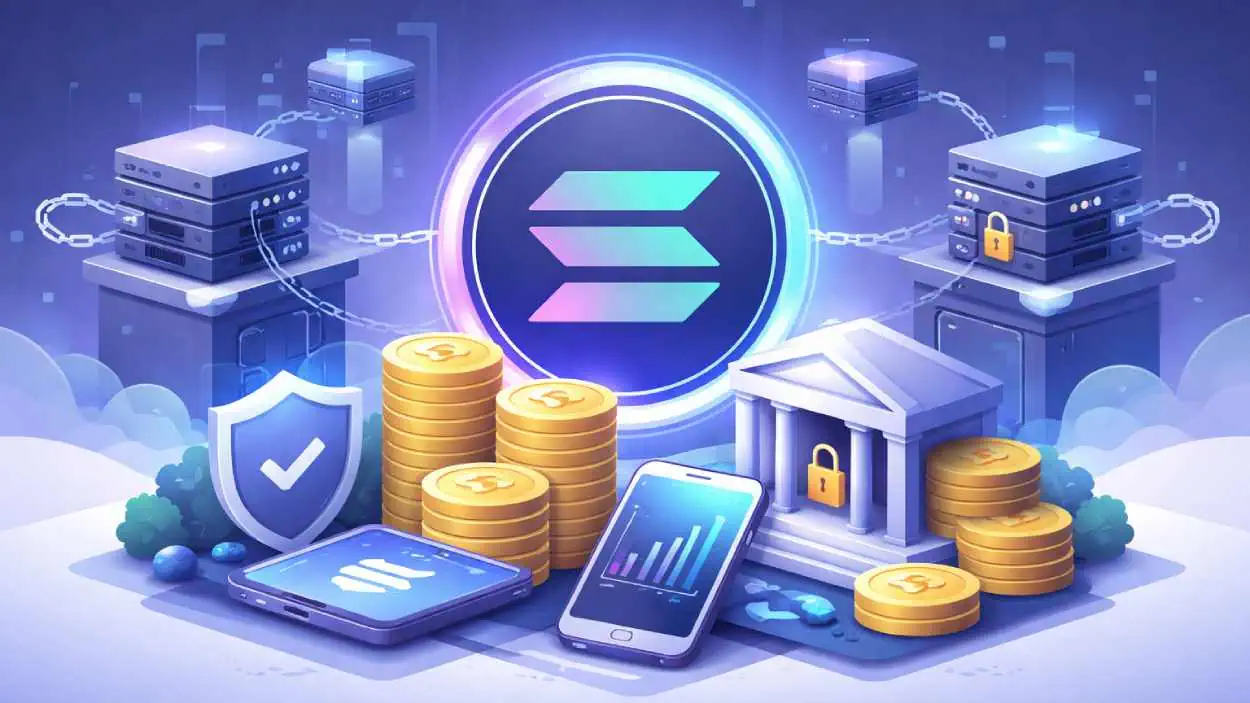
Solana Company, listed on NASDAQ under HSDT, has partnered with Anchorage Digital and Solana lending protocol Kamino to introduce the first digital asset treasury structure that enables borrowing against natively staked SOL held in qualified custody.
The collaboration creates a tri party custody framework where institutions can earn staking rewards while accessing liquidity through Kamino, all without transferring control of their assets outside a regulated custodian.
DeFi 🤝 Tradfi: We’re proud to collaborate with @Anchorage and @Kamino to drive public market efficiency into @Solana.
— Solana Company (NASDAQ: $HSDT) (@Solana_Company) February 13, 2026
This tri-party model optimizes $HSDT, enabling our $SOL to earn staking rewards while enhancing on-chain liquidity.pic.twitter.com/IkT7RXFsPw
A New Institutional Model for On Chain Finance
At the center of the launch is a first of its kind tri party custody model designed to bring institutional capital into Solana’s decentralized finance ecosystem.
Under this structure, Anchorage Digital Bank acts as the collateral manager. Assets remain securely stored in borrowers’ segregated accounts under a tri party account control agreement. At the same time, their economic value is reflected within Kamino’s lending markets, allowing institutions to borrow without compromising custody or compliance standards.
Anchorage Digital provides 24 hour automated oversight of loan to value ratios, margin scheduling, and rules based liquidation execution. This setup mirrors the type of risk management systems institutions are already familiar with in traditional finance.
Nathan McCauley, CEO and Co Founder of Anchorage Digital, said:
Why This Matters for Solana?
Solana has positioned itself as one of the fastest growing blockchains, processing more than 3,500 transactions per second and surpassing 23 billion transactions year to date. The network averages around 3.7 million daily active wallets and continues to lead in transaction revenue.
SOL is also productive by design, offering roughly a 7 percent native staking yield. That makes it different from non yield bearing assets like Bitcoin. This new model allows institutions to earn staking rewards while simultaneously unlocking borrowing power.
Cosmo Jiang, General Partner at Pantera Capital Management and board member of Solana Company, said:
Cheryl Chan, Head of Strategy at Kamino, added:

Built as a Blueprint for the Industry
The companies describe the initiative as a flagship model for institutional on chain finance. It is designed to be repeatable and scalable for other treasury firms, venture investors, and protocols seeking to attract institutional participation.
Key features include:
- Direct access to protocol native credit.
- Collateral held securely at a federally regulated custodian.
- Support for reward bearing digital assets including native SOL.
- Full integration into existing compliance and risk management workflows.
As an independent treasury company, Solana Company aims to support the growth and security of tokenized networks by acting as a long term holder of SOL while continuing its neurotech and medical device operations.
SQ Magazine Takeaway
I believe this is one of the clearest signals yet that institutional DeFi is maturing. For years, institutions stayed cautious because custody and compliance were deal breakers. This model removes that friction. It lets them earn yield, borrow capital, and stay within a regulated framework. If this structure proves successful, I expect other treasury firms to quickly adopt similar models. This could quietly become a turning point for Solana’s institutional adoption story.