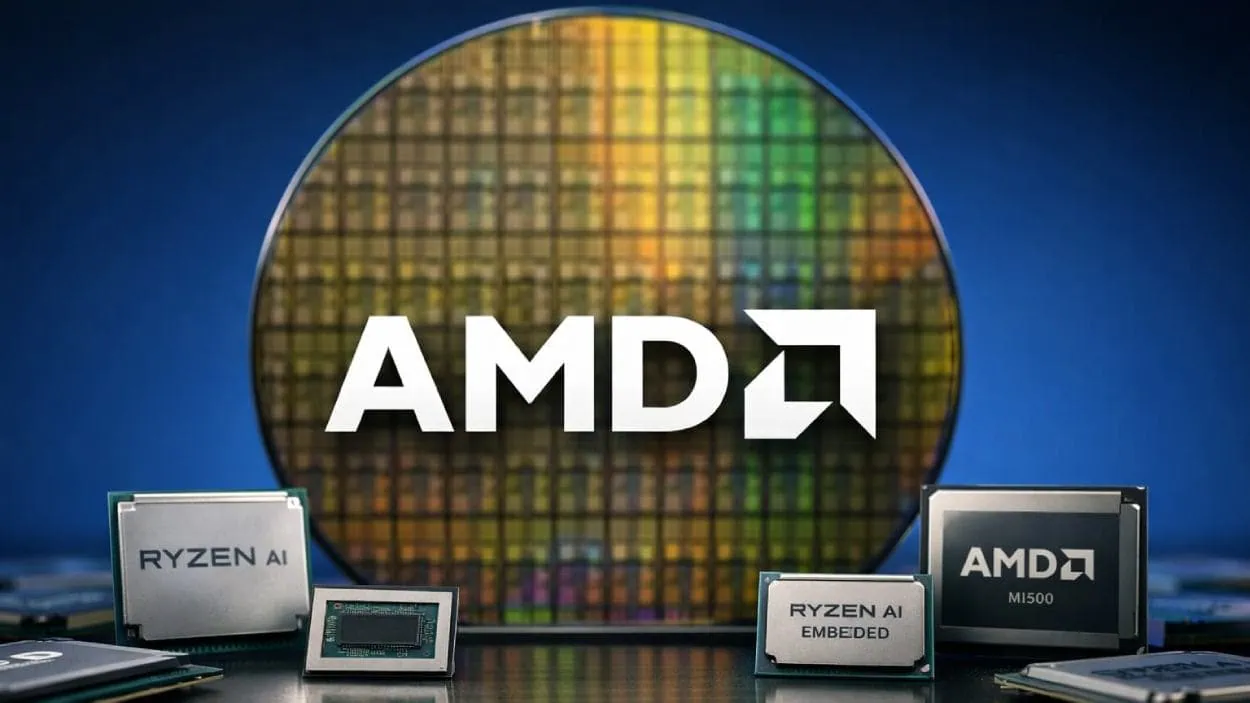







AMD is going all-in on artificial intelligence with a sweeping rollout of new chips for PCs, embedded systems, and data centers at CES 2026.
Quick Summary – TLDR:
- AMD launched the Ryzen AI 400 Series for PCs, promising major boosts in multitasking and content creation.
- The new Ryzen AI Embedded P100 and X100 chips target automotive and industrial AI applications.
- AMD CEO Lisa Su showcased the MI500 data center chip, boasting a 1000x AI performance leap.
- AMD’s AI push includes a partnership with OpenAI, competing head-to-head with Nvidia’s next-gen processors.
What Happened?
AMD Chair and CEO Lisa Su took the stage at CES 2026 with a bold vision: bring AI to everyone. With that goal, she introduced new processors spanning consumer devices to enterprise data centers. The lineup includes the Ryzen AI 400 Series for personal computers, the Ryzen AI Embedded P100 and X100 for industrial and automotive applications, and a preview of the MI500 for large-scale AI workloads.
.@AMD CEO @LisaSu shows off the MI455X GPU along with Venice on stage at #CES2026 pic.twitter.com/r1CEKZFVba
— Anshel Sag (@anshelsag) January 6, 2026
Ryzen AI 400 Series Powers the Next-Gen PC
The Ryzen AI 400 Series is AMD’s newest chip for AI-enhanced personal computing. It improves multitasking performance by 1.3x over competitors and offers a 1.7x boost in content creation speed.
- Features 12 CPU cores and 24 threads.
- Builds on the 2024 Ryzen AI 300 Series.
- Ships in PCs during Q1 2026.
- Includes upgraded gaming chip, the Ryzen 7 9850X3D, plus Redstone ray tracing for better game visuals.
Rahul Tikoo, AMD’s SVP and GM of client business, said AMD’s AI PC platforms now number over 250, doubling from last year. Tikoo said:
Embedded AI for Industry and Automotive
AMD also launched the Ryzen AI Embedded P100 and X100 Series to serve in-vehicle experiences, industrial automation, and physical AI like robotics.
- Combines “Zen 5” CPU, RDNA 3.5 GPU, and XDNA 2 NPU into one chip.
- Offers up to 50 TOPS (trillions of operations per second) for AI inference.
- Supports up to four 4K or two 8K displays at 120 FPS.
- Built for rugged use with operating temps from –40°C to 105°C.
The P100 is optimized for digital cockpits and HMIs, while the X100 targets more demanding AI tasks in robotics and autonomous systems. Salil Raje, SVP of AMD Embedded, said the chips bring “leadership CPU, GPU and NPU capabilities together in a single device, enabling smarter, more responsive automotive, industrial, and autonomous systems.”

MI500 Brings Massive AI Power to Data Centers
In one of the biggest reveals, AMD showcased the MI455 and upcoming MI500 chips for data centers. Su claimed the MI500, due in 2027, will offer 1,000 times the AI performance of an earlier generation.
The MI455 is already positioned as a core part of AMD’s deal with OpenAI, where AMD will supply key processors for OpenAI’s data centers. OpenAI President Greg Brockman joined Su on stage to highlight the importance of high-performance chips to power next-gen AI like ChatGPT.
A Direct Shot at Nvidia
The timing of AMD’s announcement closely followed Nvidia CEO Jensen Huang’s own CES presentation of the Vera Rubin AI platform, expected later this year. AMD’s aggressive roadmap signals a clear intent to close the gap with Nvidia in the red-hot AI chip market. While AMD has lagged behind Nvidia in AI chip sales, its latest deals and product lineup show a renewed competitive fire.
SQ Magazine Takeaway
I’m genuinely impressed by how broad and ambitious AMD’s AI rollout is. From the laptops we use at home to cars and factory robots, and even the AI supercomputers behind ChatGPT, AMD wants a piece of everything. What stands out is their focus on integration of CPU, GPU, and NPU all in one chip, which could mean smoother, more efficient AI experiences across the board. Nvidia’s still ahead in market share, but AMD is showing up with serious tech and serious partners. This is going to be a fun battle to watch.