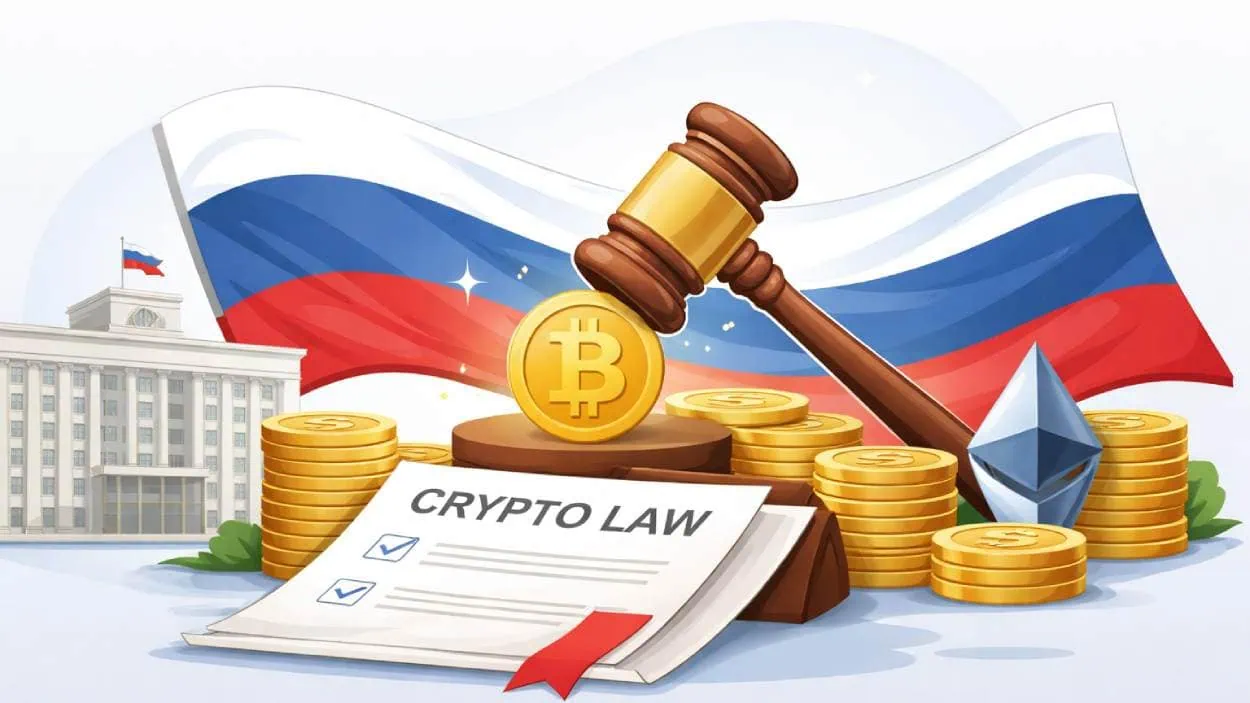







Russia is moving swiftly to implement a law for seizing cryptocurrencies, even as broader regulations for the digital asset market are still being finalized.
Quick Summary – TLDR:
- Russia’s parliament is fast-tracking a bill that sets out how authorities can seize cryptocurrencies involved in crimes.
- Full crypto market regulation is expected by July 2026, allowing legal investment for both retail and institutional buyers.
- Retail investors may face a $4,000 annual cap and will need to pass an eligibility test to trade crypto.
- The legislation reflects a major shift in the Russian government’s stance on crypto, prompted by sanctions and rising domestic demand.
What Happened?
A key Russian parliamentary committee has approved a new bill that creates formal procedures for the confiscation of cryptocurrencies in criminal cases. At the same time, lawmakers are finalizing a separate, sweeping set of regulations to govern the broader use and trading of digital assets like Bitcoin and Ethereum, set for rollout by July 2026.
Russia is signaling a shift in its crypto stance
— Kong Trading 🦍 (@KongBTC) January 27, 2026
New proposals would introduce simplified licensing rules for crypto exchanges
According to Elvira Nabiullina, the goal is to reduce illicit activity while moving crypto trading into a clear legal framework
Instead of pushing… pic.twitter.com/dLuGPF9nF7
Russia Prioritizes Crypto Seizure Law
While Russia continues to work on its broader regulatory framework for cryptocurrencies, one piece of legislation is already nearing completion. The Committee on State Building and Legislation at the State Duma has recommended the final adoption of a bill focused on the seizure of digital assets in criminal cases.
According to the committee, the bill addresses a growing need for legal mechanisms to combat crimes involving crypto, including money laundering, terrorism financing, and corruption. The legislation aims to officially recognize cryptocurrencies as property under Russian criminal law, enabling investigators and law enforcement to take clear legal action.
Key points from the seizure bill include:
- Digital currencies can be seized by taking control of physical storage devices or moving assets to a dedicated government-controlled wallet.
- The bill grants law enforcement explicit authority to handle digital assets as part of criminal investigations or civil claims.
- It closes existing legal gaps and aligns Russia’s approach with international standards and practices in other countries.
Pavel Krasheninnikov, the legislative committee’s chair, stated that the law will eliminate the current legal vacuum and give law enforcement the tools to manage crypto assets effectively.
Full Crypto Market Regulation Coming in 2026
In parallel with the crypto seizure bill, Russian lawmakers are finalizing a much larger legal framework for the cryptocurrency market. Anatoly Aksakov, head of the Duma’s Committee on Financial Markets, confirmed that the law will be ready for a vote by June 2026 and is expected to come into effect on July 1, 2026.
The comprehensive law will include:
- Licensing and oversight for crypto exchanges.
- Definition of criminal and administrative liabilities for unregistered or illegal operators.
- Rules that allow both retail and institutional investors to participate in the crypto market.
Retail investors will need to pass an eligibility test to buy crypto and may face a purchase cap of 300,000 rubles (under $4,000) per year. While that cap is still being debated, experts believe the central bank will issue a list of approved cryptocurrencies for retail use.
According to legal expert Alexandra Fedotova, this list will likely include:
Only qualified investors will be allowed to buy coins not listed by the central bank.

Shift in Attitude Fueled by Sanctions and Market Demand
Russia’s crypto laws have been delayed for years due to internal disagreements between the finance ministry and the central bank. The ministry favored a regulated market with taxation, while the central bank long called for a total ban.
However, ongoing international sanctions from the US, EU, and UK have forced the country to rethink its digital finance strategy. Crypto has become a vital tool for bypassing dollar-based trade restrictions, pushing even the previously skeptical Central Bank of Russia to reconsider its stance.
Major commercial banks are also backing the shift, stating that their customers want access to actual cryptocurrencies, not just derivative products.
SQ Magazine Takeaway
This is a big shift. Russia is no longer just watching the crypto world from the sidelines. They are finally putting serious legal structures in place, starting with the power to seize digital assets used in crime. But the real game changer is coming in 2026 when people in Russia will be able to legally buy and trade crypto under clear rules.
I think it’s fascinating how sanctions and market demand have flipped the script for the Russian central bank. They’re embracing crypto not because they want to, but because they have to. It’s a major move that shows how digital assets are becoming part of the global financial toolkit, even in places where they were once banned.