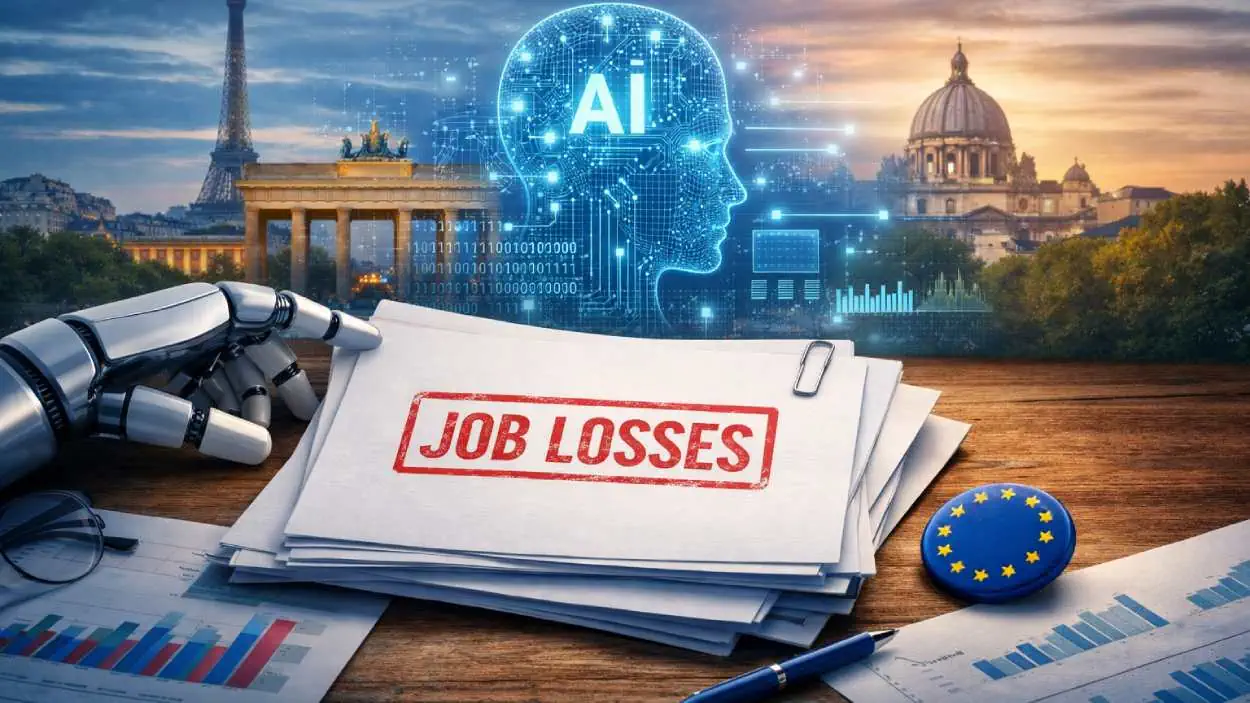







Europe’s biggest banks are preparing to cut more than 200,000 jobs by 2030 as artificial intelligence transforms the industry and forces a deep restructuring of their operations.
Quick Summary – TLDR:
- Morgan Stanley projects over 200,000 banking jobs will disappear in Europe by 2030 due to AI and automation.
- The cuts target back-office and compliance roles as banks adopt AI for risk checks, customer service, and reporting.
- Major banks like ABN AMRO and Société Générale are already implementing large-scale workforce reductions.
- The shift also affects global peers, with firms like Goldman Sachs and UBS launching AI-driven restructuring.
What Happened?
A new analysis by Morgan Stanley, cited by the Financial Times, has revealed that Europe’s banks are poised to cut about 10% of their workforce over the next few years. The reduction translates to more than 200,000 jobs across 35 major banks, driven largely by AI adoption, digital transformation, and continued branch closures.
The job cuts are expected to hit back-office functions the hardest, including areas like risk management, compliance, transaction processing, and customer support, where AI can streamline operations at scale.
Morgan Stanley analysts estimate European banks could cut about 10% of roles, roughly 212,000 jobs, by 2030 as AI and digital delivery replace routine work.
— Rohan Paul (@rohanpaul_ai) January 1, 2026
The call is driven by investor pressure on European lenders to cut costs and lift returns on equity that have lagged US… pic.twitter.com/fDARxW3fWV
AI’s Growing Role in Reshaping Banking
For years, European banks have struggled with high cost-to-income ratios, often exceeding 60%, despite ongoing cost-cutting efforts. As digital-first competitors and instant payments reshape customer expectations, traditional banks are now accelerating the shift to AI-driven automation to improve efficiency.
Morgan Stanley’s report suggests banks could achieve 20% to 30% efficiency gains in departments with structured, repetitive, and data-heavy tasks. These include:
- Know-your-customer (KYC) verification.
- Loan processing.
- Trade matching.
- Anti-money laundering (AML) checks.
- Internal reporting and reconciliations.
With AI models now mature enough to handle document summarization, code generation, and even credit decisioning, banks are deploying them in contact centers and compliance departments to speed up operations and reduce costs.
Early Movers: Who’s Cutting Jobs Already
Some banks are already executing major workforce cuts:
- ABN AMRO has announced plans to reduce its workforce by 20% by 2028, attributing the decision to digitalization and simplification.
- Société Générale CEO Slavomir Kucera said “no area is off-limits” in its restructuring strategy.
- UBS has created an AI avatar of analysts to deliver personalized video insights to clients, signaling a shift in how banks use talent and technology.
- In the U.S., Goldman Sachs launched the “OneGS 3.0” initiative to combine hiring freezes with automation of client onboarding and regulatory work.
These actions reflect the broader trend of AI reducing the need for traditional human labor in banking operations.
The Human Cost and Regulatory Concerns
While AI promises faster decisions and better customer experiences, the human impact is significant. Entire departments, particularly central services and middle-office roles, face downsizing. Although front-line roles in complex corporate lending and wealth management may be safer for now, even these are being reevaluated as technology evolves.
There are also concerns about regulatory oversight. The EU’s AI Act classifies many banking applications as high-risk, requiring rigorous human oversight. The European Banking Authority and ECB are pressing institutions to monitor model risk, fairness, and data quality, increasing the cost and complexity of implementation.
To avoid reputational damage from AI errors such as mispriced loans or hallucinated chat responses, banks are establishing “human-in-the-loop” safeguards, while ramping up model validation and governance efforts.
Gradual Rollout Due to Labor Dynamics
The projected job cuts will not happen overnight. Labor laws, unions, and national regulations in Europe typically require lengthy consultations and severance agreements. For instance, banks in Spain and Italy have historically leaned on early retirement and voluntary exits during restructuring.
Therefore, the estimated 200,000 job reduction is expected to occur in phases through 2030 rather than in one sweep.
SQ Magazine Takeaway
Honestly, this shift is massive. As someone who follows tech and finance closely, it’s clear AI is no longer a futuristic concept in banking. It’s here, it’s real, and it’s changing the rules fast. What struck me most is how AI is cutting jobs and creating new roles at the same time, like in data engineering and AI governance. But there’s a fine balance. Banks that cut too deep may lose critical knowledge. This is a tough pivot, but banks have no choice but to make one. Let’s hope they do it with enough foresight to keep both efficiency and trust intact.