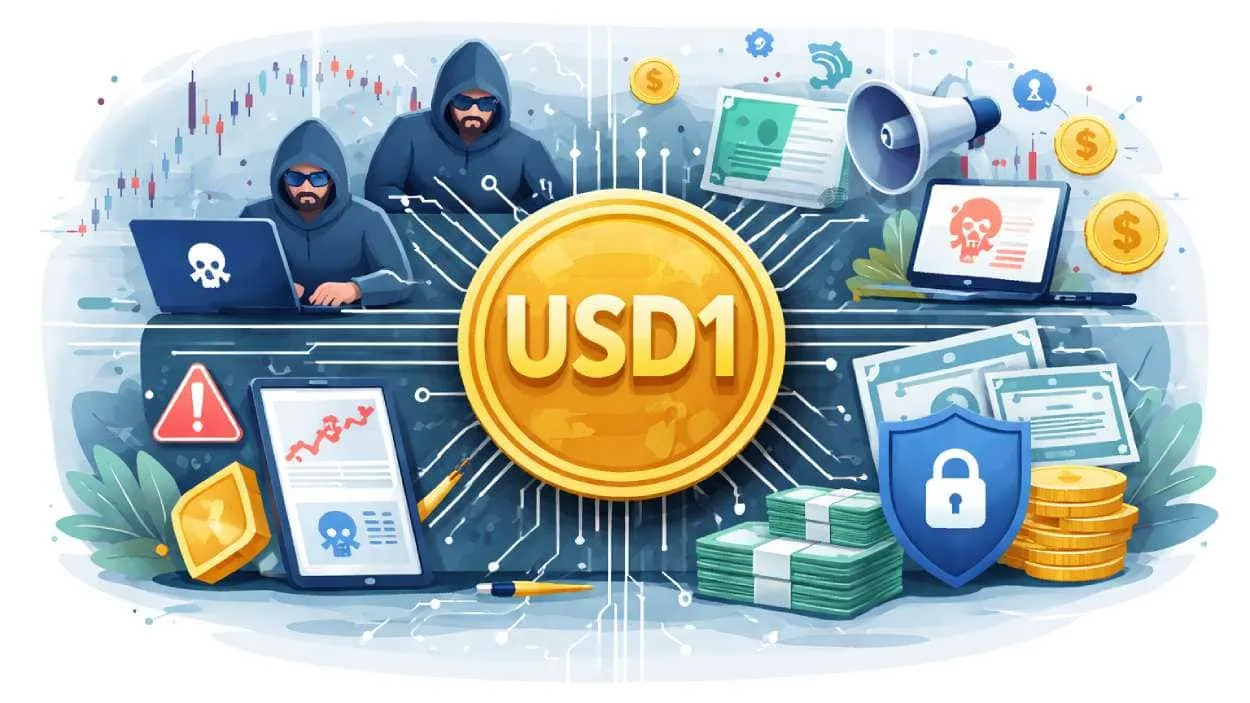







USD1 briefly slipped below its dollar peg on Monday as World Liberty Financial claimed it was targeted in a coordinated social media and short selling attack.
Quick Summary – TLDR:
- USD1 fell as low as $0.994, around 0.6 percent below its $1 peg before recovering.
- WLFI says hacked cofounder accounts, paid influencers, and large short positions were part of a coordinated attack.
- The company claims its mint and redeem mechanism and 1 to 1 reserves kept the stablecoin steady.
- The episode comes amid growing scrutiny of Trump linked crypto ventures and USD1’s expanding footprint.
What Happened?
World Liberty Financial, a crypto firm with close ties to President Donald Trump’s family, said Monday that its USD1 stablecoin was targeted in a coordinated attack designed to trigger panic and profit from volatility.
The token briefly fell to between $0.994 and $0.997 during the day, according to market data, before moving back toward its intended $1 price level.
A Brief Dip Below the Dollar Peg
USD1, a dollar backed stablecoin issued in partnership with crypto custodian BitGo, saw a short lived price deviation that raised questions across crypto markets. At its lowest point, the token traded roughly 0.6 percent below its peg, though it later recovered to about $0.998 and closer to parity.
Tiny price deviations are not unusual in the stablecoin market. Experts generally consider fluctuations of 0.01 percent to 0.03 percent as routine, often caused by trading spreads, liquidity conditions, exchange differences, and arbitrage delays. A deviation becomes more serious when it is sustained for a longer period. In this case, USD1’s dip was temporary.
Allegations of a Coordinated Attack
In a post on X, World Liberty Financial claimed attackers hacked several WLFI cofounder accounts, paid influencers to spread fear, uncertainty, and doubt, and opened massive short positions in the project’s free floating token WLFI.
The company framed the activity as an attempt to manufacture chaos and profit from instability around USD1.
A coordinated attack was launched against USD1 this morning. Attackers hacked several WLFI cofounder accounts, paid influencers to spread FUD, and opened massive $WLFI shorts to profit from the manufactured chaos.
— WLFI (@worldlibertyfi) February 23, 2026
It didn’t work.
Thanks to USD1’s sound mint-and-redeem mechanism…
WLFI spokesman David Wachsman reinforced that message in a statement to The Block. Wachsman said:
The exact mechanics behind the alleged attack remain unclear.

How USD1 Is Structured?
USD1 is backed 1 to 1 by reserves that include short term US Treasuries, US dollar deposits, and cash equivalents held in custody by BitGo. According to the company, the stablecoin publishes monthly reserve attestations signed by consulting firm Crowe.
The token has grown rapidly and now carries a market capitalization of about $5 billion, placing it among the larger dollar backed stablecoins, though it still trails major players such as Tether’s USDT and Circle’s USDC.
At the heart of WLFI’s defense is its mint and redeem mechanism, which allows holders to exchange USD1 for an equivalent amount of US dollars. Supporters argue that this design helps maintain price stability during periods of stress.
Broader Context and Market Reaction
WLFI’s native token fell about 3 percent during the episode. Meanwhile, market observers noted that Eric Trump, a cofounder of World Liberty, deleted several WLFI related posts on X before the token moved lower.
Eric Trump, co-founder of WLFI, deleted several WLFI-related posts on X. Following the move, WLFI briefly fell more than 8%, while the USD stablecoin USD1 temporarily depegged to 0.9802 USDT. https://t.co/5W4apuqsb3 pic.twitter.com/7dUMJPApEh
— Wu Blockchain (@WuBlockchain) February 23, 2026
The company has drawn attention in recent months. Earlier this year, WLTC Holdings LLC filed an application to establish a national trust bank to expand USD1 operations. World Liberty is also active in crypto lending.
Controversy has followed as well. A United Arab Emirates based entity previously used USD1 to facilitate a $2 billion investment in Binance. In addition, an Abu Dhabi investment vehicle backed by Sheikh Tahnoon bin Zayed Al Nahyan acquired a 49 percent stake in World Liberty Financial for $500 million before President Donald Trump’s inauguration. Binance later elevated USD1 as a trading pair on its platform.
SQ Magazine Takeaway
From my perspective, this episode shows how stablecoins are truly tested under pressure. Social media noise and aggressive short positions can shake sentiment fast. But what really matters is whether redemptions work and reserves are solid.
If USD1’s structure held up as claimed, that is a strong signal of resilience. At the same time, any project tied to political figures will face intense scrutiny. Trust in stablecoins depends on transparency, and moments like this put that trust under a microscope.