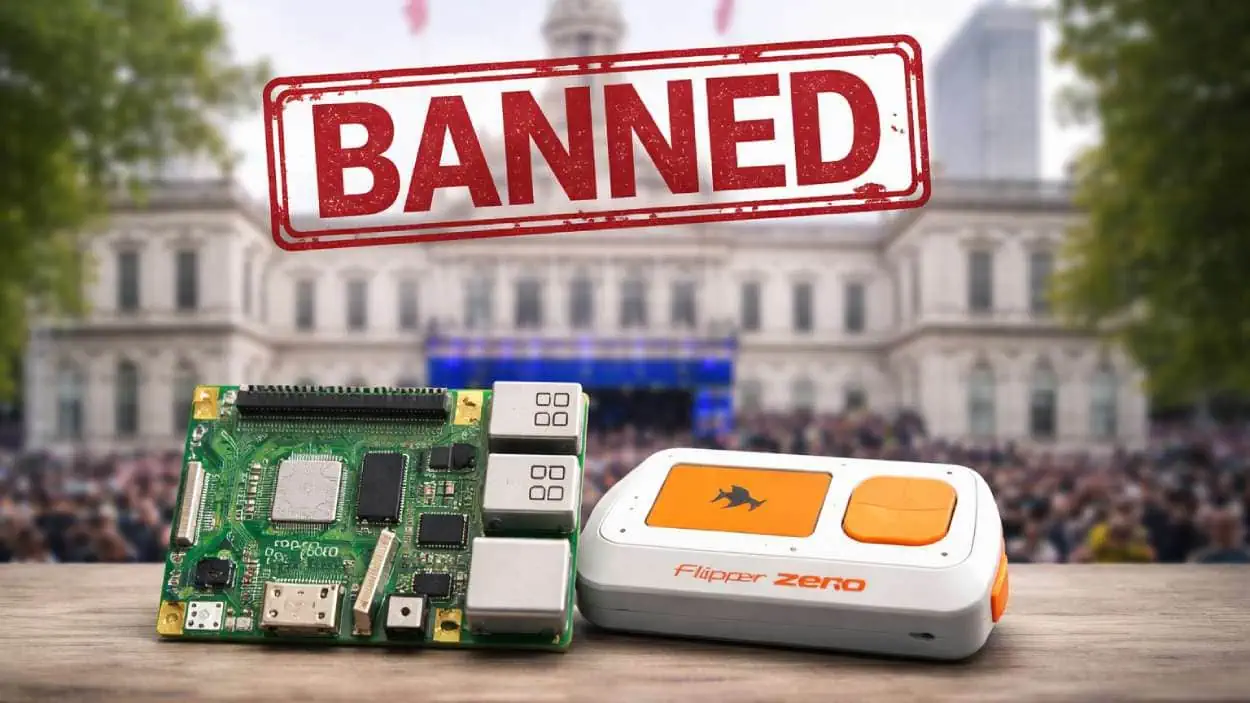







New York City’s upcoming mayoral inauguration has banned Raspberry Pi and Flipper Zero devices from the event, a move that has sparked criticism from technologists, educators, and privacy advocates.
Quick Summary – TLDR:
- NYC’s 2026 mayoral inauguration prohibits Raspberry Pi and Flipper Zero, grouping them with weapons and explosives.
- No clear reason has been provided for the ban, prompting confusion and criticism.
- Experts argue this sets a troubling precedent by banning specific brand-name tech rather than capabilities.
- Laptops and smartphones, which are more powerful and versatile, remain permitted.
What Happened?
The official list of prohibited items for the 2026 New York City mayoral inauguration includes two surprising entries: the Raspberry Pi, a low-cost single-board computer, and the Flipper Zero, a popular multi-tool for testing electronic protocols. These tech gadgets join more predictable bans on weapons, explosives, drones, and alcohol.
Their inclusion has triggered debate over the lack of clarity, potential for selective enforcement, and the broader implications for open-source hardware users.
❗️BANNED: NYC mayoral inauguration bans Raspberry Pi and Flipper Zero alongside explosives
— International Cyber Digest (@IntCyberDigest) December 31, 2025
Nobody knows why they name exactly these two models instead of a general ban. These educational devices are often used in classrooms. It doesn’t do their name well. pic.twitter.com/NKFI2bLsSJ
Unusual Tech Ban Raises Eyebrows
Unlike typical event security rules that prohibit categories like large bags or drones, the inauguration’s list names Raspberry Pi and Flipper Zero directly. This level of specificity stands out. Most consumer electronics, including laptops, tablets, and smartphones, are not mentioned, despite offering far greater connectivity and computational capabilities.
The Flipper Zero is a compact device used by security researchers and hobbyists for learning and testing protocols like RFID, NFC, Bluetooth, and infrared. Meanwhile, the Raspberry Pi is a general-purpose Linux-based computer found in classrooms, media centers, and accessibility projects.
Critics argue that banning specific tools without explaining their risk profile is not only vague, but potentially harmful. It places popular educational and development tools in the same category as explosives and illegal substances.
No Clear Justification Offered
Event organizers have not explained why Raspberry Pi or Flipper Zero were singled out. According to the FAQ on the official inauguration site, the devices appear at the very bottom of the banned items list without context.
Security expert Stefan Klatt posted on X, “On the list of prohibited items published in advance, in addition to classic sources of danger such as firearms, drones, and glass bottles, two devices from the IT world are explicitly named: the Raspberry Pi and the Flipper Zero. How do you say that you have no idea without saying it?“
This mirrors the sentiment in the tech community that the policy is less about real threats and more about optics. One editorial even called it “anxiety fossilized into policy.“

Concerns of Vague Enforcement and Precedent
Many argue that banning specific brands rather than addressing behaviors or risks creates confusion. If the goal is to prevent electronic interference, that could be addressed by stating “unauthorized transmitters” or “signal interception tools.”
Instead, this kind of enforcement leaves open the possibility that other similar tools like Arduino boards, ESP32s, BeagleBones could also be targeted in the future. This puts hobbyists, artists, and students at risk of unnecessary scrutiny for using off-the-shelf components.
Moreover, enforcement becomes selective and arbitrary. Someone with a Raspberry Pi might be stopped at the gate, while someone carrying a smartphone with hacking tools installed sails through.
Event Safety or Security Theater?
The inconsistency has led many to question whether this is a case of “security theater” rather than effective safety planning. Critics argue that truly effective public safety policies should focus on capabilities and context, not just names of tools.
An editorial from Adafruit summarized it well: “Public safety is a beacon, a flashlight, not a fog machine.”
SQ Magazine Takeaway
Honestly, this feels like a missed opportunity by NYC’s new administration. Public events should be safe, absolutely. But safety policies also need to be smart, clear, and fair. Singling out gadgets like Raspberry Pi and Flipper Zero without explanation just doesn’t sit right. These are tools millions use to learn and build. When you slap them next to explosives on a banned list, it sends the wrong message to educators, makers, and the next generation of tech innovators. We can do better. And New York definitely can too.