





Imagine waking up to the gentle buzz of your phone, checking the morning news, scrolling through messages, and booking your ride to work, all before even leaving your bed. This small routine speaks volumes about the place mobile phones hold in our lives today.
Mobile phones aren’t just communication devices; they will be personal assistants, entertainment centers, health trackers, and shopping hubs, deeply woven into the fabric of daily life. In this article, we’ll dive deep into the latest mobile phone usage statistics to help you better understand the trends shaping our digital world.
Editor’s Choice
- 93% of the global population owns a mobile phone, up from 91% last year.
- Average daily mobile screen time has reached 4 hours and 37 minutes globally.
- In the United States, 97% of adults own a mobile phone, with 92% owning a smartphone.
- 5G technology adoption has surged, with nearly 3 billion subscriptions representing about 33% of global mobile users.
- Mobile e-commerce transactions now account for 60% of total online sales, up from 57%.
- Globally, over 8 billion mobile subscriptions exist, exceeding the world population.
- Mobile gaming revenue crossed $130 billion worldwide, leading digital gaming segments.
Recent Developments
- AI-powered smartphones accounted for 25% of all new mobile device sales.
- Satellite connectivity became a standard feature in 10% of flagship smartphones.
- Foldable smartphones saw a 50% increase in shipments year-over-year.
- On-device AI processing (no cloud dependency) captured 65.7% market share in new mobile releases.
- Wearable integration with mobile apps expanded by 25%, creating new lifestyle ecosystems.
- Privacy-focused smartphones grew 15% in market popularity.
- Virtual reality (VR) headsets tethered to mobile phones rose by 40% in sales.
- Gesture control technologies became available on 15% of high-end smartphones.
- Augmented Reality (AR) shopping apps expanded by 35% in user engagement.
Screen Time Awareness and Reduction Efforts by Generation
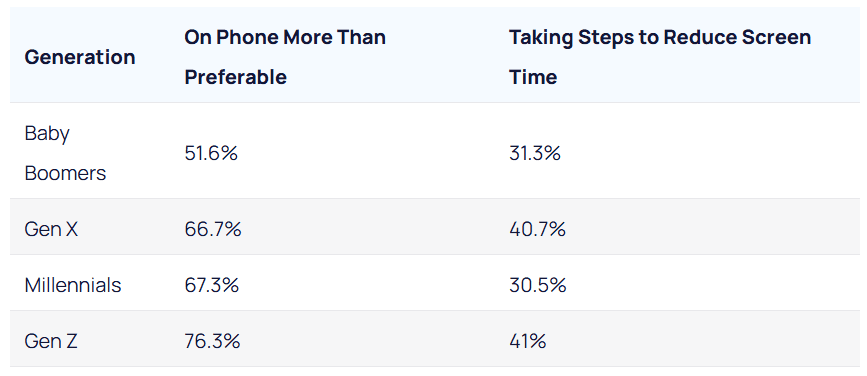
- Gen Z reports the highest overuse, with 76.3% saying they spend more time on phones than they prefer, while 41% are actively trying to reduce screen time.
- Millennials also show heavy usage, as 67.3% admit excessive phone use, yet only 30.5% are taking steps to cut back.
- Gen X demonstrates both high usage and strong corrective action, with 66.7% exceeding preferred use and 40.7% working to reduce it.
- Baby Boomers report the lowest overuse at 51.6%, and 31.3% are attempting to limit their screen time.
- Across all generations, a majority (over 50%) acknowledge spending too much time on their phones, highlighting widespread digital dependence.
- Despite high awareness, the share actively reducing usage remains significantly lower, indicating a gap between recognition and behavior change.
- Younger generations, particularly Gen Z, face the greatest screen time challenges but also show relatively strong motivation to improve habits.
Average Daily Mobile Phone Usage Time
- The global average daily mobile usage reached 4 hours and 37 minutes.
- Mobile video consumption accounts for 1.5 hours of total daily phone usage.
- Social media apps occupy about 2.5 hours of daily mobile time.
- Gaming on mobile devices averages 1.2 hours daily among users aged 18–34.
- Productivity apps saw a 25% increase in usage time from last year.
- Mobile device multitasking now occurs 20% more often than last year.

Global Mobile Connectivity Statistics
- There are 5.9 billion unique mobile subscribers, representing 72% of the world’s population.
- The number of unique mobile subscribers grew by +2.1% year-over-year, an increase of 120 million users.
- Global cellular mobile connections (excluding IoT) reached 8.8 billion, up +1.5% or 130 million connections.
- The world has 4.9 billion unique cellular data subscribers, marking a +2.5% increase or 120 million more subscribers.
- The total number of broadband mobile connections stands at 8.4 billion, reflecting strong global mobile internet adoption.
- 95% of all mobile connections are now broadband, indicating a shift toward faster mobile internet services.
- The average number of mobile connections per unique subscriber is 1.52, showing multiple connections per user.
Why People Use Social Media Apps on Smartphones
- Boredom is by far the dominant driver, with 51.8% of users turning to social media simply to pass the time.
- Curiosity ranks second at 18.6%, indicating many users browse to discover new content or trends.
- Accessing information motivates 16% of users, showing social platforms also function as news and learning hubs.
- About 9.4% use social media due to loneliness, highlighting its role in emotional connection and companionship.
- Only 3.8% report using social apps primarily for necessity or work, suggesting limited professional reliance.
- Health-related purposes account for a minimal 0.4%, making it the least common reason for usage.
- Overall, entertainment-driven motives (boredom + curiosity) overwhelmingly outweigh practical or functional uses, underscoring social media’s role as a primary digital pastime.

Mobile Phone Usage by Region
- North America leads in mobile phone penetration, with 98% of individuals owning a mobile device.
- In Europe, mobile phone ownership is steady at 94%, with Western Europe accounting for the highest concentration.
- In the Asia-Pacific region, 91% of the population owns a mobile phone, marking a 5% increase from last year.
- Sub-Saharan Africa witnessed a notable surge, with mobile ownership jumping to 76%.
- Latin America has reached an ownership rate of 87%, driven by the increased affordability of smartphones.
- Middle Eastern countries, including the UAE and Saudi Arabia, report ownership rates exceeding 96%.
- Rural mobile phone usage globally grew by 10% year-over-year, closing the gap with urban populations.
- Mobile phone dependency is highest in urban China, where 99% of residents own at least one mobile device.
Mobile Internet Usage Trends
- 71% of global internet traffic comes from mobile devices.
- In the US, 65% of all web visits are initiated via smartphones.
- Mobile internet usage in India surged by 15% year-over-year, with primary access for 87% of users.
- Video streaming via mobile devices accounts for 57% of total mobile data usage globally.
- The average mobile internet speed globally improved to 65 Mbps, up from 62 Mbps.
- Mobile hotspot usage increased by 20% compared to last year, especially among remote workers.
- Africa’s mobile data consumption per user grew by 24%, indicating accelerated digital adoption.
- Mobile internet usage in Latin America reaches 84% of the total population.
- 5G networks carry 38% of global mobile internet traffic.
Popular Activities on Mobile Phones
- Messaging apps remain the most used category, with 95% of mobile users active on apps like WhatsApp, Messenger, and Telegram.
- Mobile video streaming apps like YouTube and Netflix account for 70% of entertainment app usage.
- Mobile gaming holds strong, with 60% of smartphone owners playing games regularly.
- Mobile banking usage grew by 15%, with 75% of users accessing financial services through apps.
- Social media consumption through mobile covers 85% of total social media use globally.
- Online learning platforms report that 52% of sessions come from mobile devices.
- Mobile news app usage jumped 25%, particularly during major global events.

Impact of 5G on Mobile Usage Patterns
- Mobile download speeds are, on average, 5x faster on 5G compared to 4G.
- Cloud gaming on mobile has risen by 40%, thanks to 5G’s low latency.
- In urban areas, 70% of mobile video content is streamed in 4K quality because of faster 5G speeds.
- Mobile AR app usage has increased 150% since the widespread 5G rollout.
- Average mobile data usage per person has increased to 20 GB/month from 18 GB/month.
- Remote work productivity apps used via mobile experienced a 25% boost in session times with better connectivity.
- Mobile live-streaming events increased audience sizes by 40% in regions with full 5G coverage.
Mobile App Usage Statistics
- The average smartphone user now has 80+ apps installed, but actively uses only 30 of them monthly.
- Mobile app downloads reached 299 billion globally.
- The top-grossing app category remains gaming, contributing to 41% of app revenue.
- Time spent on mobile apps increased by 6%, averaging 4.9 hours per day.
- Subscription-based apps like fitness, meditation, and entertainment saw a 22% boost in user spending.
- Finance apps were the fastest-growing category in terms of downloads, up 25% from last year.
- Social media apps such as TikTok and Instagram led to user engagement, with an average session time of 35 minutes.
- Productivity apps witnessed a 17% rise in daily active users.
- Mobile food delivery apps like DoorDash and Uber Eats reported a 18% increase in orders.
Health and Well-being Effects of Mobile Usage
- 45% of US adults report feeling “overwhelmed” by their mobile device usage.
- Mobile screen time management apps grew by 30% in downloads, indicating rising concern over digital health.
- Teenagers experience a 35% higher risk of sleep disruption linked to excessive mobile use.
- Mobile phone-related eye strain complaints among users rose by 20%.
- Meditation and mental wellness apps grew by 15%, signaling healthier device engagement.
- About 25% of adults have implemented “phone-free zones” in their homes.
- Fitness tracking apps usage expanded by 28%, combating sedentary habits.
- Blue light filter usage among mobile users rose by 22% over the past year.

Time Spent on Social Media via Mobile Phones
- Users spend an average of 2.6 hours daily on social media via mobile devices.
- Facebook remains the most-used platform globally, with 70% of mobile users accessing it daily.
- TikTok saw the highest growth, with users spending an average of 60 minutes per day.
- Instagram mobile sessions rose by 18%, with users averaging 37 minutes per session.
- Snapchat mobile users increased by 10%, with strong appeal among Gen Z.
- LinkedIn mobile activity jumped by 15%, driven by mobile-friendly job searches.
- Twitter (now X) users spend around 25 minutes per day via mobile access.
- Over 91% of YouTube’s global watch time comes from mobile devices.
- Daily active social media users on mobile grew by 9% globally.
Mobile Device Usage for E-commerce and Payments
- Mobile commerce (m-commerce) generates $2.8 trillion globally.
- In the US, 44% of all e-commerce sales come from mobile devices.
- One-click payments via mobile grew by 25%, boosting conversions.
- Mobile wallet usage, including apps like Apple Pay and Google Pay, rose by 30%.
- Buy Now, Pay Later (BNPL) transactions via mobile climbed by 35% compared to last year.
- Mobile shopping cart abandonment rates remain high at 79%.
- Voice commerce (shopping via voice assistants) increased by 22% on mobile platforms.
- Retail apps saw a 18% increase in monthly active users.
- Mobile coupon usage surged by 25%, with customers favoring instant digital savings.
Environmental Impact of Mobile Phone Consumption
- Over 1.6 billion mobile phones are discarded globally.
- Only 20% of discarded mobile phones are properly recycled, despite global initiatives.
- The carbon footprint of mobile phone production rose by 8% year-over-year.
- Refurbished phone sales offset approximately 12 million tons of CO2 emissions.
- Major brands pledged to use 60% recycled materials in new mobile devices.
- Mobile device energy efficiency improved by 10%, helping reduce lifetime emissions.
- Smartphone battery recycling program participation rose by 35% globally.
- E-waste awareness campaigns increased in visibility by 23% in North America.
- 5G devices are 20% more energy-efficient than their 4G predecessors.
Frequently Asked Questions (FAQs)
US adults spend 5 hours 16 minutes daily on smartphones.
Americans check their phones an average of 186 times per day.
90% of mobile time is spent in apps rather than browsers.
Conclusion
Today, mobile phones will be more than ever the gateway to how we live, work, and interact with the world. With mobile ownership nearing universal levels, daily usage times climbing, and emerging technologies like 5G, AI, and AR revolutionizing how we use our devices, the future of mobile connectivity looks dynamic and transformative.
However, these advances also bring new challenges around health, sustainability, and digital balance. As we move forward, the evolution of mobile phone usage will continue to shape industries, lifestyles, and societies across the globe.