






What is learning gamification?
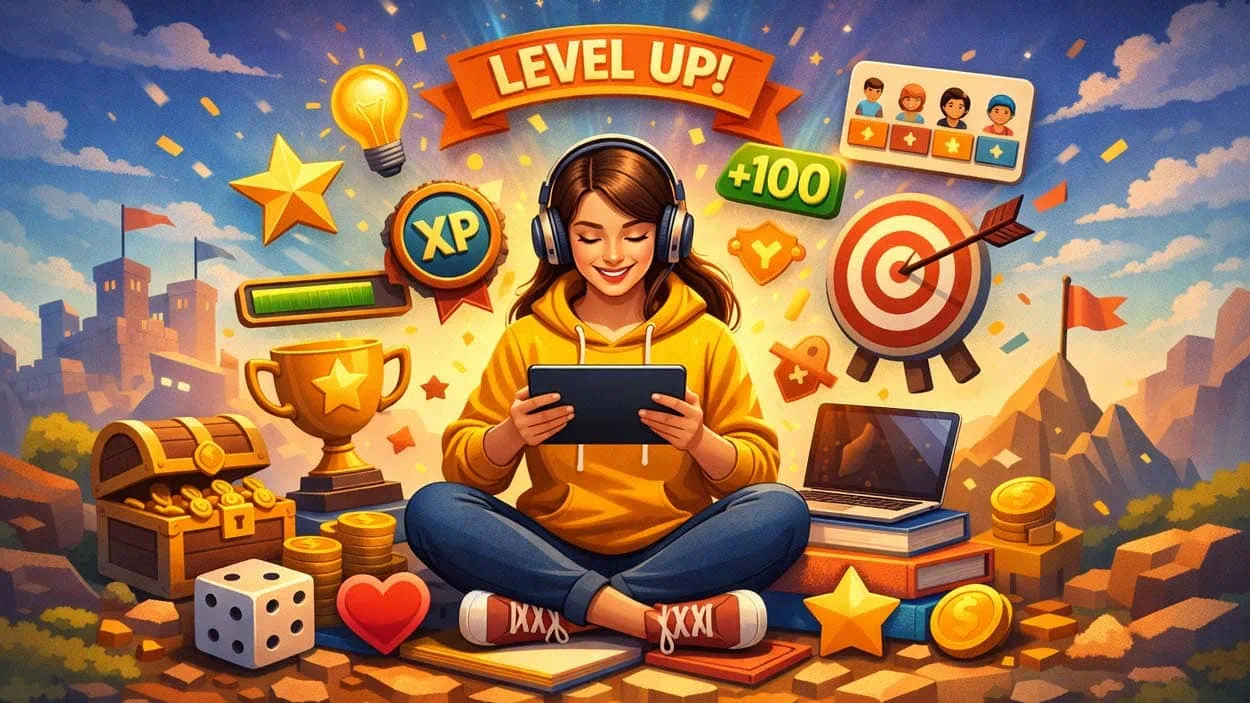
At its core, it is the integration of game-design elements for educational purposes, such as point systems, leaderboards, achievement badges, streak counters, timed challenges, progress bars, and more. They are integrated into apps or platforms to improve user engagement and knowledge retention. It is a sophisticated structural approach designed to solve a growing modern crisis: the rapid decline of human attention.
Digital learning apps have shifted toward gamified models that prioritize high-frequency rewards (and it is not about the video game-type methods). For instance, the Headway app uses a gamified microlearning approach to help users digest core ideas from nonfiction books in just 10 or 15 minutes. It also helps people to read more and pass a series of achievable, rewarded milestones.
Also, this structure directly addresses the completion gap. So, let’s see how gamification works in practice across the world’s most successful learning platforms!
How Does It Work?
We’ve all been there: you start a new book or sign up for an online course with the best intentions, only to find the tab still open three weeks later, untouched. It is that our brains are constantly fighting for focus in a world designed to distract us. Our attention spans are shorter than ever, and this is exactly where learning gamification comes in.
Gamification for learning aims operates through reinforcement loops tied to small tasks. Behavioral psychology explains thatimmediate feedback increases the probability of repeated behavior, and brings inspiration for motivation and reinforcement theory.
The structure typically follows this sequence:
- You complete a defined action, such as finishing a lesson.
- The system assigns a visible reward, such as points or a badge.
- A progress tracker updates.
- A streak counter records consistency.
When applied to microlearning, this model divides long materials into short sessions. Completion becomes measurable within minutes. That structure directly addresses the completion gap documented in large-scale online education data.
Examples of Gamification at Apps and Platforms
Digital learning platforms apply gamification to increase measurable completion rates. Below, you can see how this model works inside specific apps or web platforms:
1. Headway App: Read Core Ideas of Nonfiction Books in 15 Minutes
Many adults report difficulty finishing nonfiction books due to time constraints. Microlearning formats reduce that time threshold. The Headway app condenses nonfiction titles into summaries that take about 15 minutes to read. After finishing a summary, your dashboard updates automatically.
A streak counter increases when you read on consecutive days. That visible tracking converts reading into a measurable routine. You can see how many summaries you completed in a certain day or week, and you get achievement badges to unlock after defined milestones.
Key features:
- Daily streak counter linked to reading sessions
- Achievement badges tied to completion numbers
- Visual dashboard showing progress percentage
- Categorized collections that track reading volume

2. Nibble App: Learn Different Subjects, History, and Basic Concepts With Daily Challenges
Nibble focuses on learning through short interactive tasks and lessons. The app and web platform apply micro-lesson formats designed for brief daily sessions. Each activity lasts 5 or 10 minutes.
After completing a lesson, the system awards points and updates your streak. Challenges appear daily, encouraging consistent engagement. Progress indicators track points of your mastery over time. This structure supports repetition without long study blocks. You complete one task and immediately see measurable progress. That short reinforcement loop maintains daily usage.
Key features:
- Daily challenge system with timed tasks
- Streak tracking connected to lesson completion
- Progress visualization by topic
- Points awarded after each exercise
3. Duolingo: Practice Vocabulary With Points
Duolingo is perhaps the most recognizable example of how game mechanics can solve the problem of inconsistent daily practice. By turning language acquisition into a competitive experience, the app ensures that users return daily to protect their progress:
- Problem: Language learning requires extreme consistency, yet most learners quit within the first month due to a lack of immediate feedback.
- Evidence: Duolingo reported over 500 million users, attributing much of its growth to high retention rates driven by social competition.
- Psychology: This follows B.F. Skinner’s theory of operant conditioning. You perform a task (a lesson), receive a positive stimulus (XP and sounds), and are thus more likely to repeat the behavior.
4. Quizlet: Repeat Flashcards With Adaptive Scores
Quizlet digitizes the Leitner flashcard method through algorithmic repetition. The system draws on the Ebbinghaus Forgetting Curve, which shows that recall declines without timed review. When you answer a flashcard incorrectly, it reappears more often. Correct responses reduce repetition frequency.
The system tracks the accuracy percentage across sessions. That adaptive scoring creates measurable retention progress. You observe improvement in recall rates across study blocks. For example, Quizlet moves beyond simple memorization by using an algorithm that adapts to your performance.
Key features:
- Spaced repetition: The app calculates the optimal time for you to review a card before you forget it.
- Study progress indicator: A percentage bar that shows how close you are to “mastery” of a specific set.
5. Coursera: You Complete Modules With Certificates
Coursera applies gamification to higher education and professional certification. While the content is academic, the structure is modular and reward-heavy. Coursera applies gamification to structured online education, breaking it into modules with visible progress tracking. Each completed section contributes toward a certificate.
Assessment scores appear instantly after submission. The modular design reduces long-course fatigue. You can focus on one section at a time, and progress remains visible across weeks.
6. Habitica: You Track Tasks as Game Quests
Habitica converts daily tasks into role-playing mechanics. Some platforms provide avatar-based accountability and found measurable reductions in procrastination within gamified task systems. For example, when you complete a task, your avatar gains experience points. When you skip a task, avatar health decreases.
That direct consequence alters daily behavior. And basically, you get the system that transforms routine productivity into tracked progress:
- Context: Standard to-do lists are often ignored because they lack consequences; therefore, in Habitica, if you fail to complete a task, your digital avatar loses points or health.
- Psychology: It is about behavioral gamification, which found that “avatar-based accountability” significantly reduces procrastination in remote workers.
How Learning Gamification Works in Practice
So, what is learning gamification in a functional sense? It is the application of the reward loop to cognitive tasks. As you can see, you can complete a small task and receive an immediate visual or auditory reward, so your brain releases dopamine and wants to continue the process. This creates a positive association with continuous learning.
If you find yourself struggling to maintain a learning habit, the most effective strategy is to switch from passive tools to gamified ones. You can test a structured app like those mentioned above and observe your own completion rates over a two-week period or a month. Often, the simple presence of a streak counter is the difference between quitting and mastery!