In the early days of the internet, simply having a website was enough. Then came search engines. And soon after, the question every business had to answer: Can people find us on Google? Fast forward today, and the world of Google SEO has transformed into a dynamic, data-driven battleground where ranking well means more than just visibility; it means survival in an increasingly digital-first economy.
Whether you’re a local bakery or a Fortune 500 company, SEO has become a pillar of digital strategy. In this report, we unpack the latest Google SEO statistics, offering a clear view of how search behavior, Google’s algorithms, and SEO tactics are evolving so you can stay ahead of the curve.
Editor’s Choice
- 90.8% of all search engine traffic flows through Google, maintaining dominance despite AI tools and competitors.
- 68% of online experiences begin with a search engine, with users turning to Google for everything from product research to write my essay queries when they need academic support.
- Websites ranking in the first organic position on Google earn an average CTR of 39.8%, while position 10 receives just 1.6% of clicks.
- Mobile-first indexing impacts 100% of websites indexed by Google, making mobile optimization essential.
- Voice search accounts for over 20% of searches performed in Google apps, and about 27% of people use voice search on their mobile devices.
- Businesses publishing long-form content (2,000+ words) generate 3.8x more backlinks, aiding top rankings.
Recent Developments
- Search Generative Experience affects 40% of searches.
- AI Overviews blend summaries into 84% of queries.
- Passage indexing boosts niche query relevance by 7%.
- Web Stories increase mobile engagement 40%.
- Maps search themes group businesses by intent.
- Helpful Content System uses Gemini 3 for real-time evaluation.
- Voice integration advances with Gemini in Android Auto.
- IndexNow is adopted by 3+ million websites.
- Pros/cons schema enriches snippets for CTR gains.
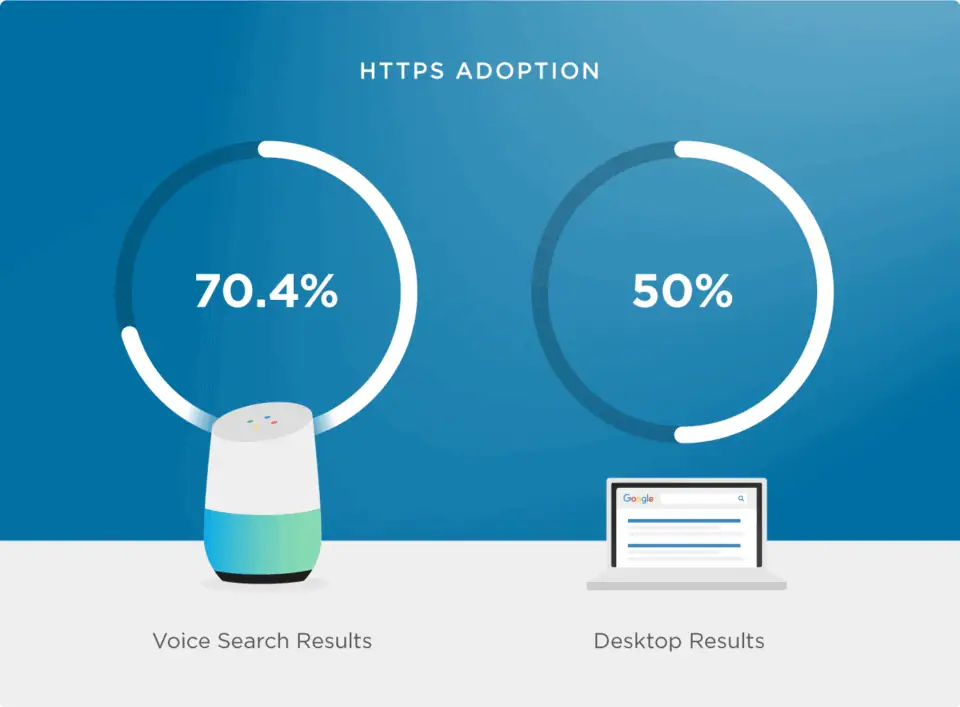
HTTPS Adoption in Search Results
- 70.4% of voice search results are served over HTTPS, highlighting strong security requirements for voice-based queries and smart assistants.
- Only 50% of desktop search results currently use HTTPS, showing slower security adoption compared to emerging search formats.
- Google prioritizes secure websites more heavily in voice search, reinforcing HTTPS as a ranking and trust factor.
- The growing gap between voice and desktop HTTPS adoption signals that security standards rise faster as new search behaviors emerge.
Global SEO Usage Trends
- Global businesses spend an estimated $94 billion on SEO services.
- 55–60% of all website traffic is sourced from organic and paid search.
- 65% of marketing teams prioritize SEO for the highest ROI among digital channels.
- Organic search drives 53% of all website traffic globally.
- 70–75% of marketers view high-quality content as the most effective SEO tactic.
- 88% of B2B marketers incorporate SEO into their content strategy.
- 79% of SEO professionals track search intent as a key ranking factor.
- Average business websites receive 33% more Google search traffic due to optimized content.
- 58% of global e-commerce sites implement structured data for SERP visibility.
- Visual search queries grow at 31% YoY in fashion and home decor.

Google’s Share in the Search Engine Market
- Google controls 90.83% of the search engine market globally.
- In the United States, Google’s market share stands at 88.01%, with Bing at 6.5%.
- On mobile devices, Google holds 95.17% of searches in the US.
- Chrome browser accounts for 66.16% of global desktop and mobile browsing.
- In emerging markets like India and Brazil, Google’s share is 97.17% and 91.88%.
- The Google app maintains 1.5 billion monthly active users.
- Google Lens handles nearly 20 billion visual searches monthly.
- Voice searches on Android comprise 27% of mobile queries.
- Google Discover drives traffic to over 800 million websites monthly.
- Trust in Google’s result accuracy remains at 89% among users.
SERPs Featuring AI Overviews (AIOs)
- 47.4% of search engine results pages now include AI Overviews (AIOs), signaling a major shift toward AI-driven search experiences.
- A slight majority, 52.6% of SERPs, still appear without AIOs, showing that traditional result formats remain prevalent.
- Nearly one in two SERPs already feature AI-generated summaries, highlighting how quickly AI is reshaping visibility and click behavior.
- The growing presence of AIOs reduces reliance on classic blue links, potentially impacting organic click-through rates.
- As AIO adoption expands, publishers and brands must optimize for AI-readable content, not just rankings.

Impact of Core Web Vitals on SEO Rankings
- Websites scoring “Good” on all Core Web Vitals are 34% more likely to rank in the top 10.
- Average LCP for top-ranking sites is 2.13 seconds on desktop.
- Google weighs INP heavily, replacing FID as a Core Web Vital.
- Sites with CLS under 0.1 achieve 17% higher page engagement.
- 78% of web developers prioritize Core Web Vitals in deployments.
- eCommerce sites passing Core Web Vitals see 22.8% revenue increase from organic traffic.
- Poor Core Web Vitals cause 43% higher bounce rates on mobile.
- Google highlights fast pages with the “Page Experience” badge in mobile SERPs.
- 15-30% conversion improvements for eCommerce, optimizing to good thresholds.
- Sites failing Core Web Vitals are 15% less likely for Google Top Stories.
Mobile-First Indexing and Its Influence on SEO
- 100% of websites in Google’s index use mobile-first crawling.
- Mobile-optimized sites have 48% lower bounce rates than desktop versions.
- 66% of Google search traffic originates from mobile devices.
- Mobile page speed gains of 0.5 seconds boost conversions by 9.7%.
- Non-responsive sites lose 27% organic traffic after six months.
- Google’s Mobile-Friendly Test API exceeds 23 million uses annually.
- 74% of users avoid returning to non-mobile-friendly sites.
- PWAs achieve 25% adoption among content platforms for mobile SEO.
- Excessive mobile interstitials trigger Google usability penalties.
- 57% of total search traffic comes from mobile globally.
Google Search Intent by Query Volume
- Transactional searches account for 0.69% of keyword volume.
- Informational searches account for 52.65% of all keyword queries.
- Navigational intent makes up 32.15% of search volume.
- Commercial intent represents 14.51% of searches.

Voice Search Optimization Statistics
- Voice searches account for 27% of mobile Google queries.
- 70% of voice search results derive from the top three SERP positions.
- The average voice search result contains 29 words.
- Voice search prevails among 18–34 year-olds at 54% usage.
- “Near me” voice searches surge 500% for local businesses.
- Featured snippets power 40.7% of voice search answers.
- FAQ schema boosts voice visibility by up to 58%.
- Voice-optimized pages load 52% faster than average.
- US smart speaker users total 153.5 million.
- Conversational keywords surge 22% in top-ranking results.
Click-Through Rates by Google SERP Position
- First organic result earns 39.8% CTR.
- Second position achieves 18.7% CTR.
- Third position records 10.2% CTR.
- Positions 7-10 account for under 5% of clicks combined.
- Featured snippets reduce top organic CTR by 8-10%.
- “People Also Ask” appears in 57.9% of queries.
- Branded queries attain 42.2% CTR.
- Structured data markup lifts CTR by 30%.
- Emojis in titles raise CTR by 13.7%.
- Desktop users show 19% higher first-link clicks than mobile users.
Google Organic CTR Breakdown by Position
- Position 1 achieves 39.8% CTR.
- Position 2 captures 18.7% CTR.
- Position 3 earns 10.2% CTR.
- Position 4 sees 7.2% CTR.
- Position 5 gets 5.1% CTR.
- Position 6 drops to 4.4% CTR.
- Position 7 records 3.0% CTR.
- Position 8 secures 2.1% CTR.
- Position 9 has 1.9% CTR.
- Position 10 receives 1.6% CTR.

Top Review Platforms Consumers Use for Local Businesses
- 81% of consumers use Google to evaluate local businesses.
- 45% rely on Facebook for reviews.
- 44% use Yelp for detailed feedback.
- 21% trust TripAdvisor, especially for travel.
- 20% check Better Business Bureau for credibility.
- 16% utilize Apple Maps for recommendations.
- 10% turn to Trustpilot for verification.
- 9% select Healthgrades for healthcare providers.
- 7% use Angi for home services.
- 6% access Yellow Pages.
- 3% selected none of the above.
Role of AI and Machine Learning in Google SEO
- Search Generative Experience influences 31% of US queries.
- Google implements 1,200+ annual machine learning updates.
- BERT, MUM, and Gemini enhance contextual relevance.
- AI SEO tools adoption grows 61% yearly.
- AI-generated content comprises 74% of new webpages.
- 87% of content marketers use AI for creation.
- AI predictive autocomplete affects 60% of mobile searches.
- AI content gap users outperform competitors 2.3x in SERPs.
- SpamBrain blocks 99% of link spam attempts.
- AI SERP adjustments reduce volatility by 17%.
Most Web Pages Get Zero Google Traffic
- 96.55% of pages receive 0 Google visits, totaling 13.6 billion pages.
- 1.94% of pages get 1–10 visits, 270.4 million pages.
- 1.08% of pages receive 11–100 visits, 150.6 million pages.
- 0.36% of pages generate 101–1,000 visits, 50.3 million pages.
- 0.07% of pages exceed 1,000 visits, 9.8 million pages.
Google Algorithm Update Frequency and Effects
- Google released 4 confirmed updates in 2025: 3 core and 1 spam.
- Thin content sites dropped an average 19% in rankings post-update.
- Spam policies tightened against AI-generated low-quality pages.
- Recovery from major updates averages 2-5 months.
- Helpful Content System demotes search-engine-first content continuously.
- Link relevance outweighs volume in off-page signals.
- High E-E-A-T pages resist ranking drops effectively.
- YMYL sites like medical and finance, hit hardest.
- Rank volatility spiked 15.2% in April 2025.
Average Content Length and Ranking Correlation
- The average first-page Google result contains 1,447 words.
- Long-form content (2,000+ words) outranks short-form by 56%.
- Listicles and how-to articles 38% more likely for featured snippets.
- Content with FAQs, tables, and bullets boosts engagement 32%.
- Content updated within 90 days outperforms by 24%.
- Semantic optimization lifts the average ranking 12 spots.
- Embedded videos increase first-page ranking 53%.
- Top content averages 9th grade reading level.
- 3.8x more backlinks for position one versus positions two to ten.
Top Challenges Faced by SEO Professionals
- 38% cite budget constraints as the top challenge.
- 36% struggle with constant algorithm changes.
- 34.8% face strategy alignment issues.
- 32.9% lack resources like time and tools.
- 27.3% deal with management misunderstandings.
SEO Conversion Rate Benchmarks Across Industries
- The average SEO conversion rate across industries is 2.9%.
- Legal services achieve 7.6% conversion rate.
- Financial services record 6.1%.
- Education reaches 4.3%.
- Healthcare websites convert at 4.8%.
- B2B SaaS averages 3.5%, demos at 5.2%.
- E-commerce SEO yields 2.2% average.
- Schema markup boosts conversions 16%.
- Local services convert leads at 19.5%.
- The media industry lowest at 0.8%.
Link-Building Strategies and Their Effectiveness
- Backlinks rank among the top 3 Google factors, prioritizing quality.
- #1 pages average 3.8x more backlinks than positions 2–10.
- Guest blogging yields 27% link acquisition success.
- Broken link building achieves 12% average response rate.
- Digital PR secures 3.2x more high-authority backlinks.
- 42% of marketers convert unlinked mentions via tools.
- Original research earns 24% more backlinks.
- Skyscraper technique gains 197% more backlinks with outreach.
- Linkable assets deliver 38% higher link ROI.
- Google devalues low-quality directories and PBN links aggressively.
Conclusion
SEO is no longer about simply adding keywords to a page or collecting backlinks at scale. It’s about understanding user intent, delivering fast and engaging experiences, and leveraging tools like AI and structured data to align with Google’s evolving algorithms.
Businesses that adapt to changes, like voice search, Core Web Vitals, video integration, and AI-enhanced content creation, stand to win the visibility battle. Meanwhile, those ignoring these shifts may find themselves buried under better-optimized competitors.
Whether you’re a startup looking to grow or a legacy brand aiming to hold your ground, the key takeaway is this: Google SEO rewards depth, relevance, and user-centered strategy above all.