







Remote hiring has gone from a pandemic-era necessity to a defining feature of the modern labor market, yet the landscape continues to shift today. Companies are balancing hybrid, remote, and in-office models to attract talent, while millions of workers prioritize flexibility, autonomy, and work-life balance over traditional employment structures.
Real-world impact is evident: global talent platforms increasingly recruit across borders, and U.S. labor data shows significant portions of the workforce opting for remote roles. As trends continue to evolve, it’s worth understanding just how remote hiring is shaping work today and what that means for businesses and jobseekers alike. Explore the data below to get the full picture.
Editor’s Choice
- 22.8% of the U.S. workforce works remotely, representing over 36 million Americans.
- 52% of U.S. jobs are hybrid, 28% fully remote among remote-capable employees.
- Fully remote job postings increased by 3% on platforms like FlexJobs.
- 85% of workers prioritize remote work over salary when choosing jobs.
- 16% of companies worldwide operate fully remote.
- Remote freelance postings in customer service and nursing nearly doubled.
- 59% of UK HR leaders expect most new hires from abroad via remote hiring.
Recent Developments
- 20–25% of U.S. telework-capable jobs are remote roles, holding steady.
- Fully remote job growth rose 4% in Q1 2026, continuing the rebound.
- Companies with RTO mandates lost 30% more talent to remote-first firms.
- 21% of Gen Z prefer full remote work, down from older generations’ 35%.
- 87% of workers prioritize remote options over salary in surveys.
- 54% of U.S. employees now work in hybrid arrangements.
- 38% of global job postings offer remote or hybrid flexibility.
Education Level and Access to Remote Work
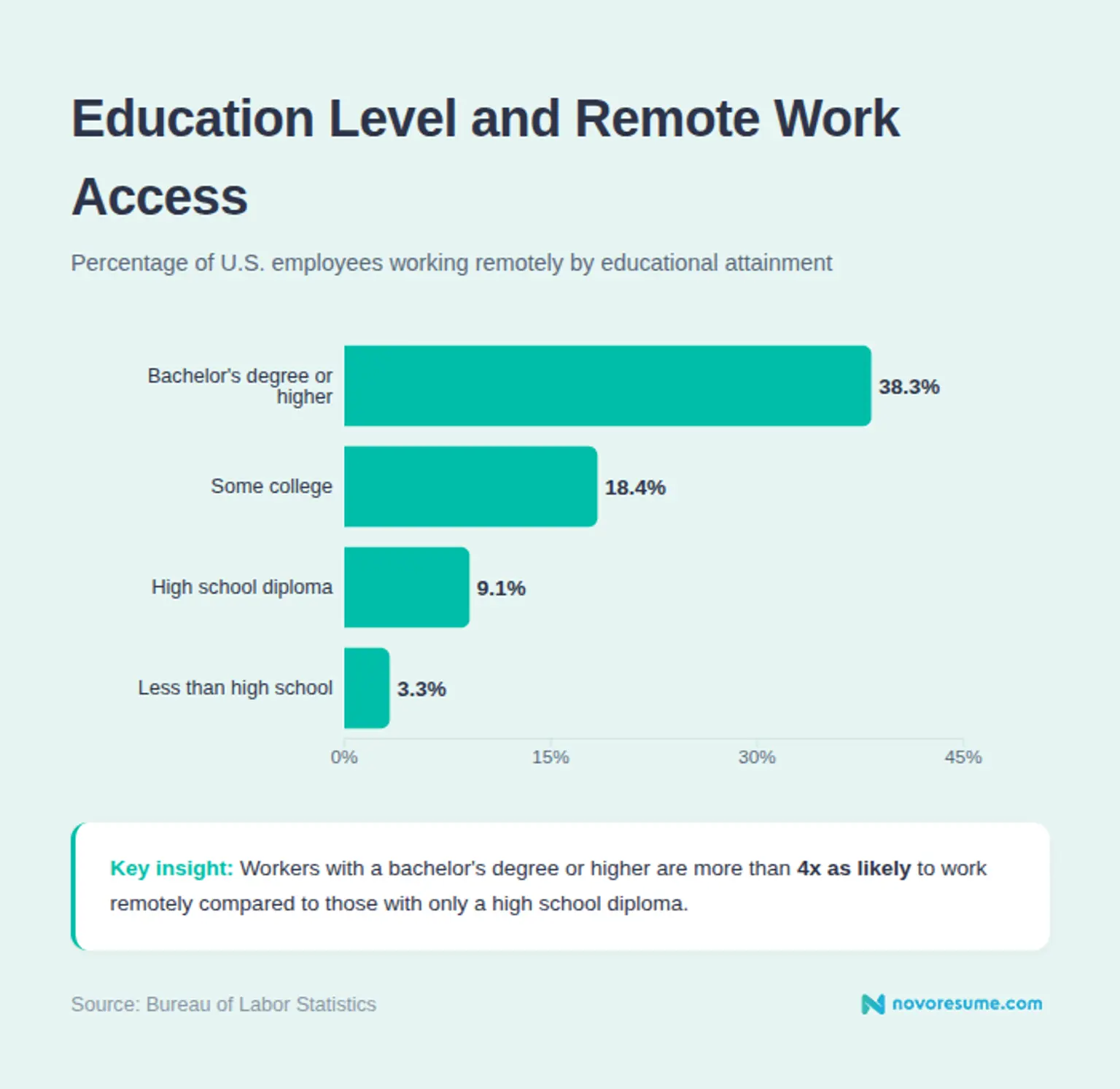
- 38.3% of U.S. workers with a bachelor’s degree or higher work remotely. This group has the highest access to remote jobs.
- Only 18.4% of workers with some college education work remotely. This is less than half the rate of college graduates.
- Just 9.1% of workers with a high school diploma work remotely.
- Only 3.3% of workers with less than a high school education work remotely.
- Workers with a bachelor’s degree or higher are more than 4 times more likely to work remotely than those with only a high school diploma.
- Remote work access clearly increases with higher education levels.
Growing Demand for Remote Talent
- Remote job applications exceed listings by a 3:1 ratio on major platforms.
- 62% of employers now source international talent for remote roles.
- 65% of workers prefer jobs offering remote or hybrid flexibility.
- FlexJobs reports 5% rise in remote postings across 20+ industries.
- 78% of remote workers report improved work-life balance.
- 57% of global companies offer hybrid or fully remote positions.
- 82% of candidates rank remote work above salary.

Remote Job Posting Statistics
- 24% of new U.S. job postings in Q4 2025 were hybrid, while 11% were fully remote.
- FlexJobs reports a 3% increase in remote postings late in 2025, breaking the earlier downward trend.
- Remote roles have stabilized at about 8–8.6% of job listings on major platforms.
- Remote job listings attract a disproportionate share of applications, often significantly more than their representation.
- Hybrid plus fully remote jobs account for 36% of global listings.
- Demand for remote job postings remains strong even as overall listings evolve.
- Freelance remote opportunities are growing across customer service, healthcare, and tech.
Remote, Hybrid, and On-Site Work by Industry in the U.S.
- The Information sector leads in flexible work. 49% work in hybrid roles, 22% work fully remote, and 28% work fully on-site.
- In Finance and insurance, 38% work hybrid and 30% work fully remote, while 32% stay on-site.
- Professional and business services show 36% hybrid, 23% fully remote, and 41% on-site.
- Arts and entertainment keeps 47% of workers on-site, while 35% work hybrid and 19% work fully remote.
- In Wholesale trade, a majority 54% work on-site, while 34% work hybrid and 12% work fully remote.
- Real estate reports 54% on-site, 36% hybrid, and only 9% fully remote.
- Utilities stands out with 23% fully remote, even though 57% still work on-site.
- In Government, 57% work on-site, 26% hybrid, and 17% fully remote.
- Health care and social assistance rely heavily on physical work, with 58% on-site, 24% hybrid, and 18% remote.
- Construction remains mostly physical, with 67% on-site and just 5% fully remote.
- In Education, 69% work on-site, while 22% work hybrid and 9% work remote.
- Manufacturing keeps 71% of workers on-site, with only 6% working fully remote.
- Retail trade has 73% on-site roles and only 7% fully remote.
- Transportation and warehousing shows 76% on-site, with just 6% remote.
- Hospitality and food services have the highest on-site share at 79%, while only 5% work fully remote.
- Overall, office-based industries offer more hybrid and remote options, while hands-on sectors still depend on on-site work.

By Region and Country
- In the United States, 26% of employees work fully remote, while 52% work hybrid as of 2025.
- Canada reports that over 20% of workers perform most of their hours remotely, with higher rates in tech and finance.
- In the UK, roughly 40% of workers engage in hybrid arrangements, while full-time remote roles account for about 14%.
- Germany’s hybrid adoption rate exceeds 35%, though full remote roles remain below 15%.
- Australia reports that nearly 37% of employees work at least part-time remotely.
- India has seen rapid growth in remote hiring, especially in IT and global outsourcing, with remote job postings rising year over year.
- Latin America continues to expand cross-border remote hiring, particularly in Brazil and Mexico, as U.S. companies seek cost-efficient skilled labor.
- In Eastern Europe, countries like Poland and Romania have experienced steady remote tech hiring growth, driven by international demand.
Freelance and Gig Work
- U.S. freelance workforce hits 70 million, 41% of total workforce.
- Freelancers generate $1.4 trillion in annual U.S. economic impact.
- 55% of Gen Z now freelances, leading all generations.
- Global gig economy reaches $475 billion in revenues.
- Fiverr/Upwork see 18% growth in software/marketing freelance demand.
- 76% of freelancers cite remote flexibility as the top reason.
- Healthcare/education/consulting contract hiring up 25%.
- 68% of companies use freelancers to cut fixed costs.
Challenges in Remote Hiring
- 57% of employers struggle with assessing culture fit in remote interviews.
- 68% of companies report heightened cybersecurity concerns with remote teams.
- 62% of managers cite maintaining team cohesion as the top remote challenge.
- Cross-jurisdictional hiring compliance complexity up 45%.
- 41% of remote workers experience isolation regularly.
- 73% of leaders face productivity monitoring without micromanagement issues.
- Global remote teams lose 28% collaboration efficiency due to time zones.
- RTO mandates triggered 22% turnover spikes in affected organizations.

Applicant Volume for Remote Job Postings
- Remote listings receive 2.8x more applications than in-office roles.
- Fully remote roles average 280 applications per posting.
- Remote roles are 16% of postings but attract 48% of applications.
- Remote-first firms saw 35% application surge after competitor RTO mandates.
- Software engineering remote roles get 400+ applications each.
- Remote application rates up 7% year-over-year despite hiring slowdown.
- Entry-level remote positions face a 4:1 higher competition ratio.
- Global remote roles boost applicant pools by 32% from cross-border candidates.
Time-to-Hire for Remote Roles
- Remote hiring cycles 15% faster than in-office through digital workflows.
- Virtual interviews cut scheduling delays by an average of 8 days.
- AI screening tools reduce time-to-hire by 5–7 days.
- Competitive remote roles extend screening 22% longer due to volume.
- U.S. remote tech roles average 32 days time-to-hire.
- 68% of companies adopt asynchronous interviews for remote speed.
- Remote onboarding systems cut admin delays by 40%.
- Global remote hiring adds 4–6 days for compliance paperwork.
Application Rates for Remote vs In-Office Roles
- Remote postings capture 52% of total applications despite 18% of listings.
- Candidates 64% more likely to apply to remote-flexible roles.
- In-office roles receive 40% fewer applications per listing than remote.
- Hybrid roles attract 2.2x applications compared to fully on-site.
- 82% of applicants cite commute savings as the primary remote preference.
- 86% of jobseekers prioritize remote/hybrid over in-office work.
- Remote-offering companies report 28% stronger employer branding.
- Competitive remote roles close 3 days faster due to high volume.

Remote Hiring Costs and Savings
- U.S. employers can save an average of $11,000 per year per remote employee, primarily through reduced office space and overhead.
- Companies can cut real estate costs by up to 30% by shifting to remote or hybrid models.
- 74% of CFOs said they plan to permanently shift some employees to remote work to reduce expenses.
- Employers report saving between $2,000–$5,000 per employee annually in utilities, office supplies, and facilities costs.
- Employees working remotely save an average of $4,000 per year on commuting and related expenses.
- Organizations adopting remote-first policies report lower turnover costs, with attrition reductions of up to 25%.
- Remote hiring reduces relocation expenses, which can average $21,000 per move for mid-level professionals.
- Digital onboarding platforms cut paperwork and administrative processing costs compared to in-person onboarding.
Salary and Compensation Trends for Remote Roles
- U.S. remote software engineers earn a median of $128,000 annually.
- Location-based pay creates 12% regional salary differences for remote roles.
- 63% of employers use national averages for remote compensation benchmarking.
- Home office stipends average $750 annually for fully remote employees.
- Salary-transparent remote postings attract 2.5x more applicants.
- Remote contractors earn 25% higher hourly rates without benefits.
- 78% of remote offers include health insurance matching on-site packages.
- Cybersecurity/AI remote roles command 15–20% salary premiums.
Diversity, Equity, and Inclusion in Remote Hiring
- Remote hiring reaches 25% more rural/underserved talent pools.
- 45% of remote workers say flexibility aids disability accessibility.
- Remote tech hiring improves female representation by 18%.
- Flexible remote work boosts working parent retention by 32%.
- Cross-border remote hiring adds 22% international workforce diversity.
- Inclusive remote recruiting lifts employee engagement 27% higher.
- 72% of jobseekers weigh DEI commitments in remote employer choice.
- Remote-first cuts geographic hiring bias by 35%.
AI and Automation in Remote Recruiting
- 48% of companies deploy AI across recruitment processes.
- AI applicant tracking cuts resume screening time by 65%.
- 72% of remote hiring uses chatbots for initial screening.
- Predictive analytics boosts candidate matching accuracy to 82%.
- AI video analysis is adopted by 59% of interview platforms.
- Automated skills tests are adopted by 67% for global technical hiring.
- AI recruitment tools reduce bias by 29% when monitored.
- HR tech investment grew 22% year-over-year.
Future Outlook for Remote Hiring
- 36.2 million Americans are projected to work remotely by the end of 2026.
- The hybrid model is expected to dominate 68% of North American roles.
- Remote infrastructure investment boosts satisfaction 42% higher.
- Cross-border hiring projected to rise 28% with compliance platforms.
- 58% of Gen Z prefer hybrid over fully remote arrangements.
- 81% of digital skill employers will maintain remote offerings.
- Remote tech market forecast to grow $19B through 2027.
- Formal remote policies increase workforce stability 35%.
Frequently Asked Questions (FAQs)
Roughly 26% of U.S. employees with remote-capable roles are fully remote as of the latest data.
There are approximately 73 million remote-capable jobs worldwide as of early 2026.
About 67% of remote job postings are for experienced-level positions.
Remote job listings (~8% of jobs) attract around 40% of total job applications in some markets.
Conclusion
Remote hiring is no longer a temporary adjustment; it is a structural shift in how organizations source, evaluate, and retain talent. The data shows clear economic incentives, strong candidate demand, and expanding global opportunities. At the same time, employers must address compliance, culture, cybersecurity, and engagement challenges to sustain success.
Hybrid and remote hiring models will likely remain central to workforce strategy, especially for companies competing in knowledge-driven industries. Businesses that refine their remote recruiting processes, embrace AI responsibly, and prioritize inclusion will gain a measurable advantage in attracting top talent.