





Prompt engineering sits at the crossroads of human language and artificial intelligence (AI), shaping how users interact with large language models (LLMs) like ChatGPT and Gemini. As AI tools increasingly embed into everyday workflows, the quality of prompts directly influences task outcomes, from automated coding and content creation to data analysis and customer service. In healthcare and finance, strong prompt engineering can improve diagnostic suggestions and streamline compliance reporting, showcasing clear real-world impact on decision quality and speed. Explore the following sections for a data‑driven view of how this emerging discipline is evolving today and why it matters for businesses, developers, and AI practitioners.
Editor’s Choice
- North America’s share of the prompt engineering market exceeded $133 billion in 2024.
- Roles like Prompt Engineer grew by +135.8% in demand in 2025.
- 84% of developers are using or plan to use AI tools in development processes in 2025.
- 95% of Fortune 500 companies report using AI in some capacity as of 2025.
- AI adoption in enterprise business units reached 78% in 2025.
- Structured prompt processes reduce AI errors by up to 76%.
Recent Developments
- Weekly generative AI adoption in companies rose from 37% to 72% year‑over‑year.
- AI usage at work (including prompts) climbed to 45% of workers reporting regular use as of Q3 2025.
- Nearly all employees (94%) and C‑suite leaders (99%) report familiarity with generative AI tools.
- Global companies using AI hit 78%, with 90% planning increased investment.
- Developers using AI in workflows daily reached 51% in 2025.
- The broader generative AI market is set to surpass $62.7 billion in 2025.
- Structured prompting processes correlate with 34% higher satisfaction in AI implementations.
- Consumer adoption indicates 38% of users leveraging AI tools in 2025, up from 8% in 2023.
Prompt Engineering Global Market Growth Insights
- The global prompt engineering market is valued at $0.85 billion in 2024, highlighting its early but rapidly scaling adoption phase.
- Market size rises to $1.13 billion in 2025, signaling strong enterprise and developer demand.
- Continued expansion is projected with the market reaching $1.52 billion in 2026 as AI integration deepens across industries.
- By 2027, prompt engineering is expected to generate $2.01 billion, reflecting the broader commercialization of generative AI tools.
- Growth accelerates further to $2.66 billion in 2028, driven by advanced prompt optimization and workflow automation.
- The market is forecast to hit $3.43 billion by 2029, underscoring its transition into a core AI capability.
- Overall, the market is growing at a strong 32.10% CAGR, positioning prompt engineering as one of the fastest-growing segments in the AI ecosystem.

What is Prompt Engineering?
- Prompt engineering is the practice of designing and refining instructions to guide AI responses.
- Prompt engineering grows at a 32.90% CAGR through 2034.
- North America holds 35% market share.
- Asia Pacific expands at 38.82% CAGR.
- Software segment dominates with 72% share.
- U.S. market is valued at $143.22 billion.
- 45% say prompt engineering requires most AI skills.
- Organizations report 34% higher AI satisfaction.

Evolution of Prompt Engineering
- LinkedIn postings for prompt engineering have risen 434% since 2023.
- Commercial demand for prompt engineers grows by +135.8%.
- N-shot prompting captures 40% technique market share.
- Software component dominates with 72% market share.
- Chain-of-thought prompting shows the fastest technique growth.
- North America leads with 35% global market share.
- Asia Pacific expands at 38.82% CAGR.
- U.S. prompt engineering reaches $143.22 billion.
- 95% customer interactions involve AI prompting
Key Concepts in Prompt Engineering
- N-shot prompting dominates with 40% market share among techniques.
- Few-shot examples improve pattern recognition by 25% on average.
- Structured prompts reduce computational costs by 76%.
- Clarity in prompts enhances output quality by 35%.
- Contextual details align models to intent 42% better.
- Dynamic prompts increase performance by 28% via feedback.
- Specificity lowers hallucinations by 22%.
- Constraint definition cuts errors by 31% in responses.

Common Prompt Engineering Techniques
- N-shot prompting holds 40% market share among techniques.
- Chain-of-thought prompting grows at the fastest rate in the technique segment.
- Zero-shot prompting achieves 85% accuracy on simple tasks.
- One-shot prompting improves output consistency by 20%.
- Few-shot prompting boosts performance 30% over zero-shot.
- Generated knowledge prompting enhances context by 25%.
- Analogy prompting clarifies instructions 35% better.
- Task decomposition reduces errors by 28% in complex tasks.
- Iterative refinement lifts model accuracy 22% via loops.
Effectiveness of Different Prompt Types
- Few-shot prompts outperform zero-shot by 25-40% in accuracy.
- Zero-shot prompting cuts inference costs by 50%.
- Chain-of-Thought improves reasoning 30-50% on benchmarks.
- Example order shifts accuracy 40+ points in a few shots.
- Multitask prompts exceed single-task 15% on complex LLMs.
- Structured prompting reduces output variability by 35%.
- Context-rich prompts boost F1 scores by 28%.
- Semantic examples enhance effectiveness 22% across domains.
- CoT prompting raises interpretability by 45%.
Best Practices for Prompt Engineering
- Iterative refinement boosts output quality by 35%.
- Clarity in prompts reduces irrelevant results by 42%.
- Explicit parameters enhance precision 28%.
- Contextual details improve accuracy by 30%.
- Feedback loops align models 25% better with goals.
- Example-based guidance lifts relevance 22%.
- Persona specification increases task success 31%.
- Richer context aids creative tasks 40% more.
- Structured systems cut errors 27% overall.

Role of Context in Prompt Engineering
- Contextual details boost response accuracy by 30%.
- Relevant context reduces generic outputs by 42%.
- Conversation history improves multi-turn success 35%.
- Context engineering enhances reliability by 28% in production.
- Background materials lift knowledge tasks by 25%.
- Task constraints sharpen focus 31% via embedding.
- Semantic context raises relevance by 22%.
- Temporary context enriches outputs by 40% without retraining.
- Metadata inclusion cuts errors by 27%.
Model-Specific Prompt Strategies
- Smaller models gain 45% more from structured context.
- Large LLMs handle broad prompts 30% better without details.
- Few-shot cues maintain coherence 28% higher.
- CoT prompts aid analysis by 35% in complex steps.
- Task-adapted prompts boost performance 40% across models.
- Retrieval-augmented outperforms zero-shot by 25% in detection.
- Hybrid strategies balance quality 32% better.
- Prompt pilots show 22% real-task gains.
- Domain-specific examples lift efficiency 31%.
Prompt Engineering Manager Salary by Industry
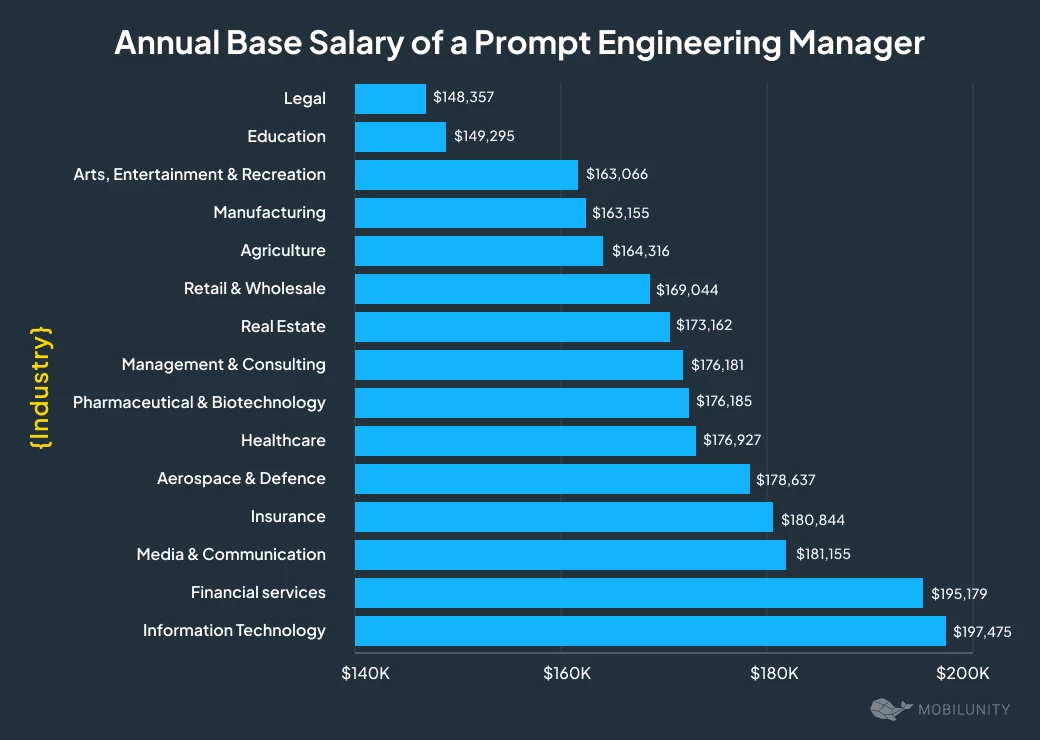
- Information Technology leads salary levels, with an average base pay of $197,475, reflecting strong demand for AI expertise in tech-driven firms.
- Financial Services follows closely, offering $195,179, driven by AI adoption in trading, risk modeling, and automation.
- Media and Communication professionals earn around $181,155, highlighting the value of prompt engineering in content and audience analytics.
- Insurance roles average $180,844, supported by AI use in underwriting and claims optimization.
- Aerospace and Defence positions command $178,637, where precision and compliance-heavy AI systems are critical.
- Healthcare salaries reach $176,927, fueled by AI deployment in diagnostics, operations, and patient engagement.
- Pharmaceutical and Biotechnology roles pay approximately $176,185, reflecting AI’s role in research and drug discovery.
- Management and Consulting averages $176,181, as firms monetize prompt engineering across client AI strategies.
- Real Estate offers $173,162, driven by AI-powered valuation, forecasting, and customer engagement tools.
- Retail and Wholesale roles earn about $169,044, supported by AI use in personalization and demand forecasting.
- Agriculture averages $164,316, as AI expands into precision farming and supply optimization.
- Manufacturing reports $163,155, where AI enhances automation and quality control.
- Arts, Entertainment, and Recreation see salaries around $163,066, reflecting creative AI and generative content use cases.
- Education positions average $149,295, highlighting slower but growing institutional adoption.
- Legal remains the lowest-paying sector at $148,357, though AI usage is steadily increasing in compliance and research.
Use of Examples in Prompts
- Few-shot prompting raises accuracy 25-40% over zero-shot.
- Task-relevant examples boost reliability by 30%.
- Example selection cuts token costs by 20% when optimized.
- Excess examples increase latency by 35% without gains.
- Tailored examples enhance domain relevance by 28%.
- Structured input-output pairs ensure 95% format adherence.
- Hybrid examples with context lift performance 32%.
- Pattern learning from examples improves reasoning by 22%.
- Selective examples reduce scalability issues by 27%.
Importance of Output Formatting
- Structured prompts reduce ambiguity by 35%.
- JSON formatting aligns outputs 42% better.
- Format constraints cut processing costs by 28%.
- Clear formatting boosts interoperability by 30%.
- Formatting lowers hallucinations by 25% in tasks.
- Structure tokens impact latency by 22%.
- Consistent formats minimize post-processing by 31%.
- Bullet formatting enhances clarity by 27%.
- Explicit constraints save 20% computational load.
Impacts of Prompt Engineering on AI Performance
- Structured prompts increase accuracy by 35%.
- Context plus examples boosts relevance by 42%.
- Tailored prompts cut errors by 28%.
- F1 scores rise 30% with task designs.
- Prompt choice outperforms model size by 25%.
- Engineering reduces latency by 22%.
- User satisfaction grows 31% across tasks.
- Human refinement enhances integration by 27%.
- Efficiency metrics improve 40% overall.
Prompt Iteration and Refinement
- Iterative revisions cut errors by 35%.
- 45% users see improvement after iterations with guidance.
- Automated tools reduce refinement time by 30%.
- Feedback loops boost alignment 28%.
- Scoring functions rank variants 25% more robustly.
- Analytics dashboards speed tasks 20-40%.
- Developers test 3-6 variants per task.
- Refinement tools lower hallucinations 22%.
- Workflows enhance reliability by 31%.
Challenges in Prompt Engineering
- 46% developers distrust AI output accuracy.
- Prompt injection affects 4% enterprise prompts with data leaks.
- 35% LLM apps are vulnerable to injection attacks.
- Bias impacts 28% generative outputs.
- Token costs rise 40% with rich context.
- 4% prompts expose sensitive corporate data.
- Reproducibility fails 25% due to platform inconsistencies.
- 30% adoption slowed by accuracy concerns.
- Ethical bias mitigation was adopted by 22% teams.
Prompt Engineering Tools and Platforms
- Projected growth exceeds $6.5 trillion by 2034.
- Prompt editors capture 72% software segment share.
- Evaluation dashboards boost adoption by 35%.
- Versioning tools enable 28% better governance.
- Low-code interfaces expand nontechnical use by 40%.
- Monitoring flags 25% risky outputs in real-time.
- Agentic integrations guide 30% more workflows.
- Analytics reveal 22% performance trends.
Ethical Considerations in Prompt Engineering
- Bias mitigation reduces stereotypes by 28%.
- Ethical prompts cut harmful content by 35%.
- 46% developers flag fairness concerns.
- Transparency builds 30% higher trust.
- Prompt cycles consume 25% more energy.
- Privacy risks affect 4% sensitive prompts.
- Compliance alignment avoids 22% misinformation.
- Ethical frameworks are adopted by 31% organizations.
- Governance debates impact 27% prompt policies.
Future Trends in Prompt Engineering
- Adaptive optimization automates 30% prompt refinements.
- Agentic AI demands multi-stage prompts 40% more.
- Low-code tools boost expert adoption by 35%.
- Multimodal prompting surges 28% in usage.
- Cross-functional roles grow 25% beyond tech.
- Governance frameworks include 31% audit trails.
- Bias research yields 22% new standards.
- Ethical scoring guides 27% safer construction.
- Automation expands capabilities 32% overall.
Frequently Asked Questions (FAQs)
Over 45% of respondents indicated that generative AI and prompt engineering will require most AI skills in the coming years.
The prompt engineering and agent programming tools market size is $6.95 billion in 2025.
68% of firms now provide training in prompt engineering skills.
Conclusion
Prompt engineering has grown from a niche craft into a strategic capability shaping how AI systems deliver value and manage risk. Its challenges range from security vulnerabilities like prompt injection to trust and fairness concerns among developers. Investments in tools, platforms, and ethical frameworks are rapidly expanding to support diverse use cases and users.
Looking ahead, adaptive optimization, multimodal integration, and ethical accountability will define the next wave of prompt engineering advancements. As organizations refine their approaches to crafting and governing prompts, the effectiveness and impact of AI will increasingly hinge on the sophistication of prompt strategies used today.