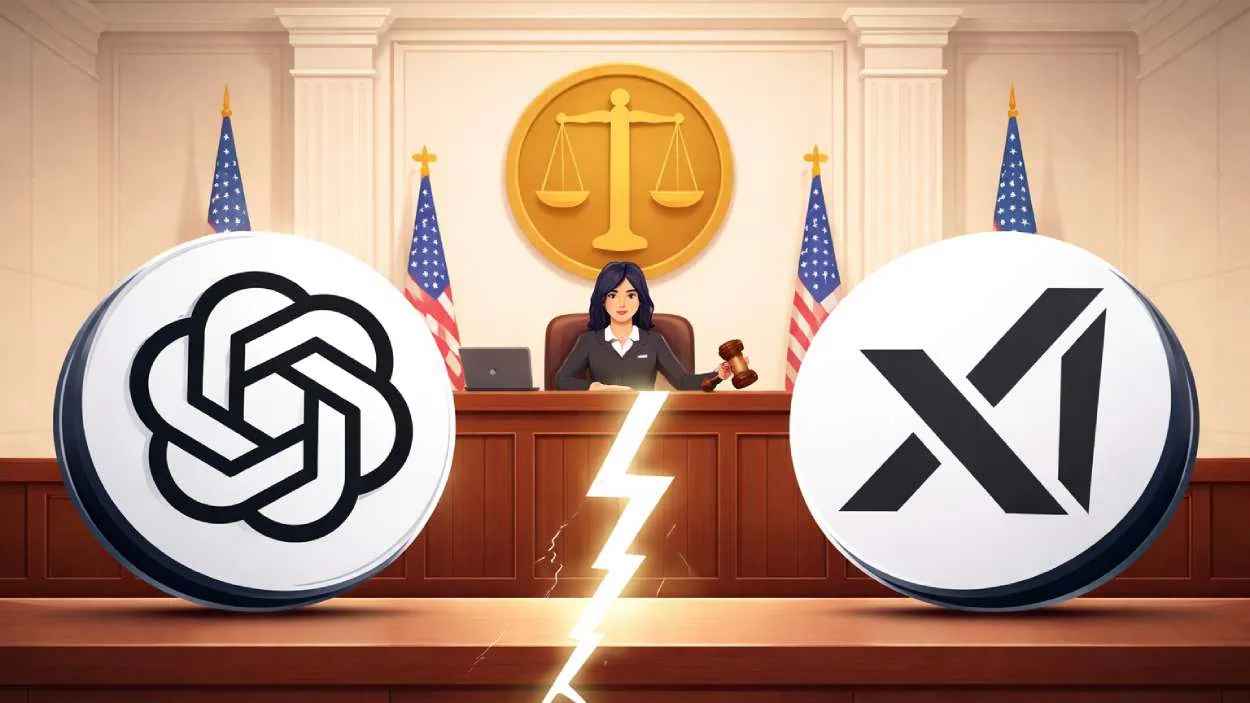







A US federal judge has dismissed xAI’s lawsuit accusing OpenAI of stealing trade secrets through employee poaching, handing a legal win to the ChatGPT maker while allowing Elon Musk’s startup a chance to amend its claims.
Quick Summary – TLDR:
- A California federal judge dismissed xAI’s trade secrets lawsuit against OpenAI.
- The court said xAI failed to show misconduct by OpenAI itself.
- xAI can file an amended complaint by March 17.
- The ruling reinforces the high legal bar for trade secret claims tied to employee movement.
What Happened?
US District Judge Rita F. Lin granted OpenAI’s motion to dismiss the case on Tuesday, finding that xAI’s complaint lacked specific facts tying OpenAI directly to any alleged wrongdoing. However, the court allowed xAI to refile an amended complaint before March 17, giving the company another opportunity to strengthen its case.
The lawsuit, originally filed last September, accused OpenAI of orchestrating a coordinated and unlawful campaign to recruit xAI employees and gain access to sensitive company information.
Judge Says Allegations Focused on Employees, Not OpenAI
At the heart of the dispute were claims that eight former xAI engineers joined OpenAI around the same time and allegedly took confidential information with them. xAI argued that OpenAI induced these employees to misappropriate source code, training methods, and data center deployment strategies related to its Grok chatbot.
The complaint alleged that OpenAI acted “by hook or by crook” to lure talent away with multi million dollar compensation packages. One early engineer, Xuechen Li, was accused of uploading the entire xAI source code base to a personal cloud account while communicating with OpenAI recruiter Tifa Chen on Signal. According to the filing, he met her virtually minutes later and received a multi million dollar offer by July 28, which he accepted by August 1.
Despite these claims, Judge Lin ruled that the complaint did not sufficiently connect OpenAI itself to any illegal conduct.
“Notably absent are allegations about the conduct of OpenAI itself,” Lin wrote. She added that xAI did not allege facts showing OpenAI induced employees to steal trade secrets or that OpenAI used any stolen information after hiring them.
The judge emphasized that to move forward into discovery, a plaintiff must present facts that, if true, show the defendant committed the wrongful act. Timing alone, including the fact that several employees joined OpenAI in close succession, was not enough.
Additional Allegations and Court Response
xAI also accused former employees of retaining work chats on their devices after leaving and refusing to provide certifications about confidential information. Another former staff member was allegedly said to have unsuccessfully tried to access xAI information about hiring and data center optimization after joining OpenAI. Two others simply left xAI for OpenAI.
The court found that these accusations largely centered on individual employee conduct rather than actions taken by OpenAI as a company.
Importantly, Judge Lin barred xAI from adding new claims or parties in any amended filing without court permission.

OpenAI Responds
OpenAI welcomed the decision publicly. In a statement posted on X, the company said it “welcomed” the judge’s decision and described the lawsuit as “baseless” and “another front in Mr. Musk’s ongoing campaign of harassment.”
We welcome the Court’s decision. This baseless lawsuit was never anything more than yet another front in Mr. Musk’s ongoing campaign of harassment.https://t.co/N4E0reaRF3 pic.twitter.com/ABpFG6m2T3
— OpenAI Newsroom (@OpenAINewsroom) February 24, 2026
The dismissal represents a significant legal win for OpenAI, though the case is not fully closed. xAI retains the right to submit a revised complaint, which legal experts say would need to be far more detailed.
Ishita Sharma, managing partner at Fathom Legal, told Decrypt that the ruling “is reinforcing the high bar for claiming corporate trade-secret liability when employee movement is involved. Mere ‘poaching’ isn’t enough without concrete links tying the employer to misuse.”
She added that any revised complaint “will need to be much more detailed” and may have to focus on specific conduct by OpenAI or narrower allegations about individual ex-employees rather than the company broadly.”
SQ Magazine Takeaway
From my perspective, this ruling highlights how difficult it is to win trade secret cases in fast moving AI markets. Courts are demanding clear, fact based proof, not just suspicion built around employee exits. Simply hiring talent from a rival is not illegal. If xAI wants this case to move forward, it will need much stronger evidence directly linking OpenAI to wrongdoing. Until then, this looks like a clear legal victory for OpenAI in its growing rivalry with Elon Musk.