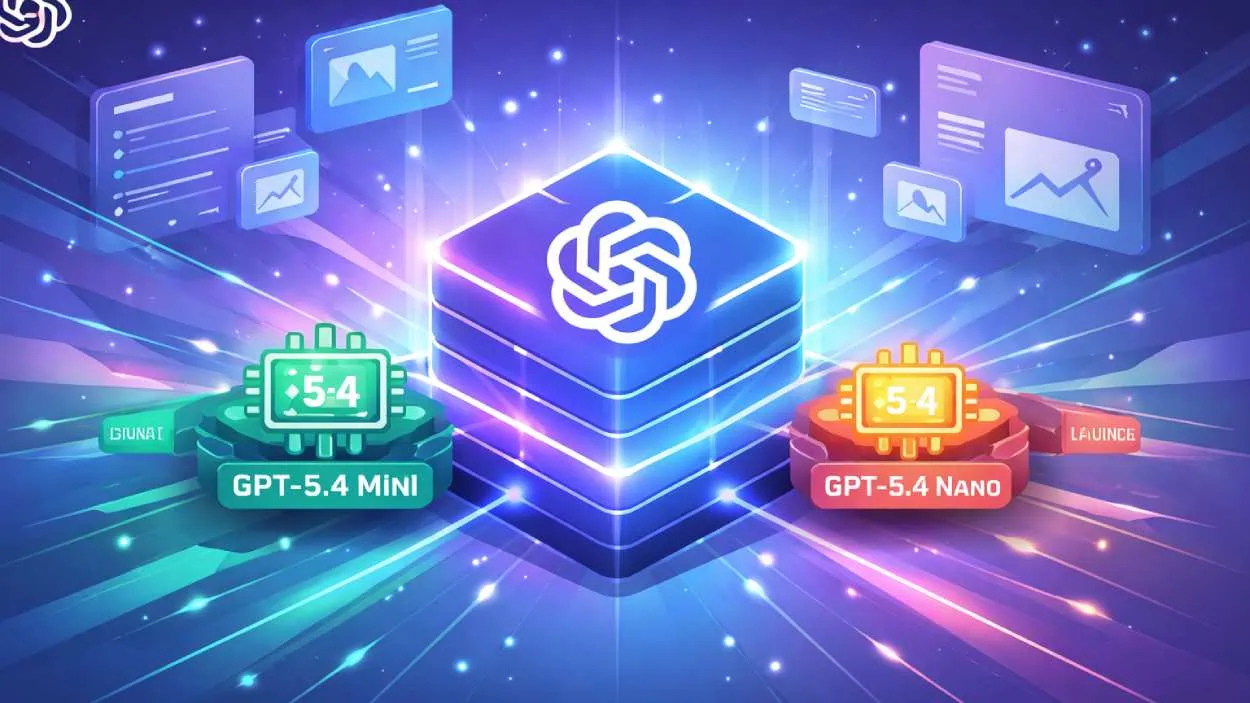







OpenAI has launched GPT 5.4 Mini and Nano, introducing faster and more cost efficient AI models designed for large scale workloads.
Quick Summary (TLDR)
- GPT 5.4 Mini delivers strong improvements in coding, reasoning, and multimodal tasks while running over 2x faster.
- GPT 5.4 Nano is the cheapest and fastest option, built for simple, high volume tasks.
- Both models are designed for low latency applications like coding assistants and real time systems.
- OpenAI is pushing a multi model approach to balance performance, speed, and cost.
What Happened?
OpenAI introduced GPT 5.4 Mini and GPT 5.4 Nano as part of its effort to make AI faster, cheaper, and more scalable. These models target developers and businesses that need high performance without the cost and latency of larger systems.
The company highlighted that both models are optimized for real world use cases where speed directly affects user experience, such as coding tools, automation systems, and multimodal applications.
GPT-5.4 mini is available today in ChatGPT, Codex, and the API.
— OpenAI (@OpenAI) March 17, 2026
Optimized for coding, computer use, multimodal understanding, and subagents. And it’s 2x faster than GPT-5 mini.https://t.co/DKh2cC5S3F pic.twitter.com/sirArgn37L
Smaller Models, Bigger Impact
OpenAI is clearly shifting focus toward efficient AI systems that can handle large workloads without slowing down applications. GPT 5.4 Mini stands out as a major upgrade over earlier mini models.
- It improves performance in coding, reasoning, and tool usage.
- It runs more than twice as fast as GPT 5 Mini.
- It approaches the performance of the larger GPT 5.4 model in several benchmarks.
- It performs strongly in multimodal tasks, including interpreting complex user interface screenshots.
In benchmarks like SWE Bench Pro and OSWorld Verified, GPT 5.4 Mini comes close to the flagship model while outperforming its predecessor.
GPT 5.4 Nano Focuses on Speed and Cost
GPT 5.4 Nano is designed for situations where speed and affordability matter most. It is best suited for simpler, repetitive tasks such as:
- Classification
- Data extraction
- Ranking
- Supporting coding tasks
While it does not match the advanced reasoning of larger models, it delivers fast responses at very low cost, making it ideal for high frequency operations.

Built for Real Time AI Workloads
Both models are tailored for environments where latency directly shapes user experience. This includes:
- Coding assistants that need instant feedback.
- Subagents handling background tasks.
- Systems that analyze screenshots and user interfaces.
- Multimodal apps processing text and images in real time.
OpenAI emphasized that in many practical scenarios, faster models outperform larger ones because they respond quickly and still handle complex tasks effectively.
Multi Model Strategy Gains Momentum
One of the biggest shifts highlighted in this launch is OpenAI’s push toward a multi model ecosystem.
Instead of relying on a single large model, developers can now combine systems:
- Larger models handle planning and decision making.
- Smaller models like GPT 5.4 Mini execute tasks quickly at scale.
This approach allows teams to optimize both performance and cost, especially in complex applications.
Availability and Pricing
GPT 5.4 Mini is available across multiple platforms:
- API, ChatGPT, and Codex.
- Supports text, image inputs, tool use, web search, file search, and more.
- Offers a 400,000 token context window.
- Pricing starts at $0.75 per million input tokens and $4.50 per million output tokens.
Within Codex, it uses only about 30 percent of the GPT 5.4 quota, making it a cost efficient option for simpler tasks.
GPT 5.4 Nano is currently available via API only:
- Priced at $0.20 per million input tokens.
- $1.25 per million output tokens.
- Designed for lightweight, high volume use cases.
In ChatGPT, GPT 5.4 Mini is accessible to Free and Go users through the Thinking feature and also acts as a fallback for higher tier usage limits.
SQ Magazine Takeaway
I think this launch clearly shows where AI is heading next. It is not just about building bigger models anymore. It is about building smarter systems that balance speed, cost, and performance.
GPT 5.4 Mini feels like the real star here. It delivers near flagship level performance but at a fraction of the cost and time. For developers, this could genuinely change how AI systems are built.
Nano, on the other hand, quietly solves a big problem. Not every task needs a powerful model. Having a cheap and fast option for repetitive work makes a lot of sense.
Overall, this feels like a practical step forward. OpenAI is making AI more usable in real world applications, not just more powerful.