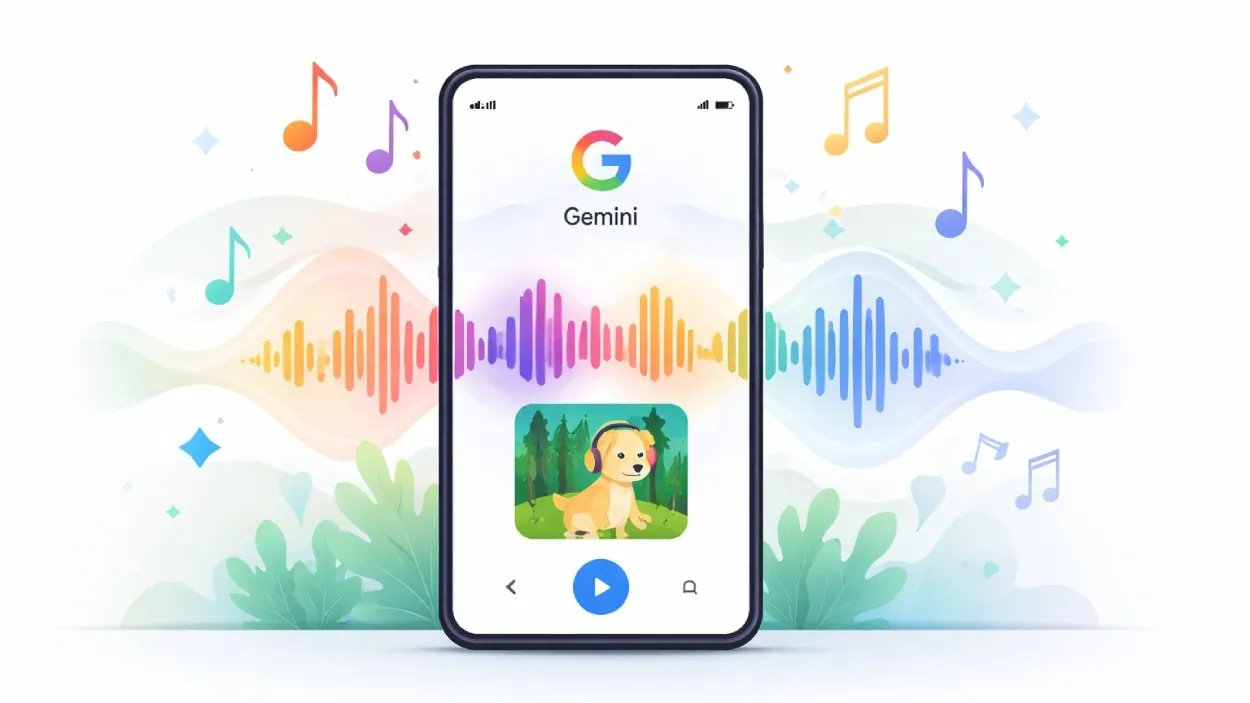







Google is adding AI music generation to the Gemini app using DeepMind’s Lyria 3 model, letting users create short songs with lyrics, cover art, and share links in seconds.
Quick Summary – TLDR:
- Google is rolling out Lyria 3 in beta inside the Gemini app for 18 plus users worldwide.
- Gemini can generate a 30 second track from text prompts, or match the mood of an uploaded photo or video.
- Every track includes a SynthID watermark, and Gemini can help verify if uploaded audio is AI generated using Google tools.
- Lyria 3 is also coming to YouTube Dream Track, expanding availability beyond the United States.
What Happened?
Google announced a new music making feature in the Gemini app powered by DeepMind’s Lyria 3 model. It is launching in beta, and it lets users create a short track by describing what they want or by uploading media for inspiration.
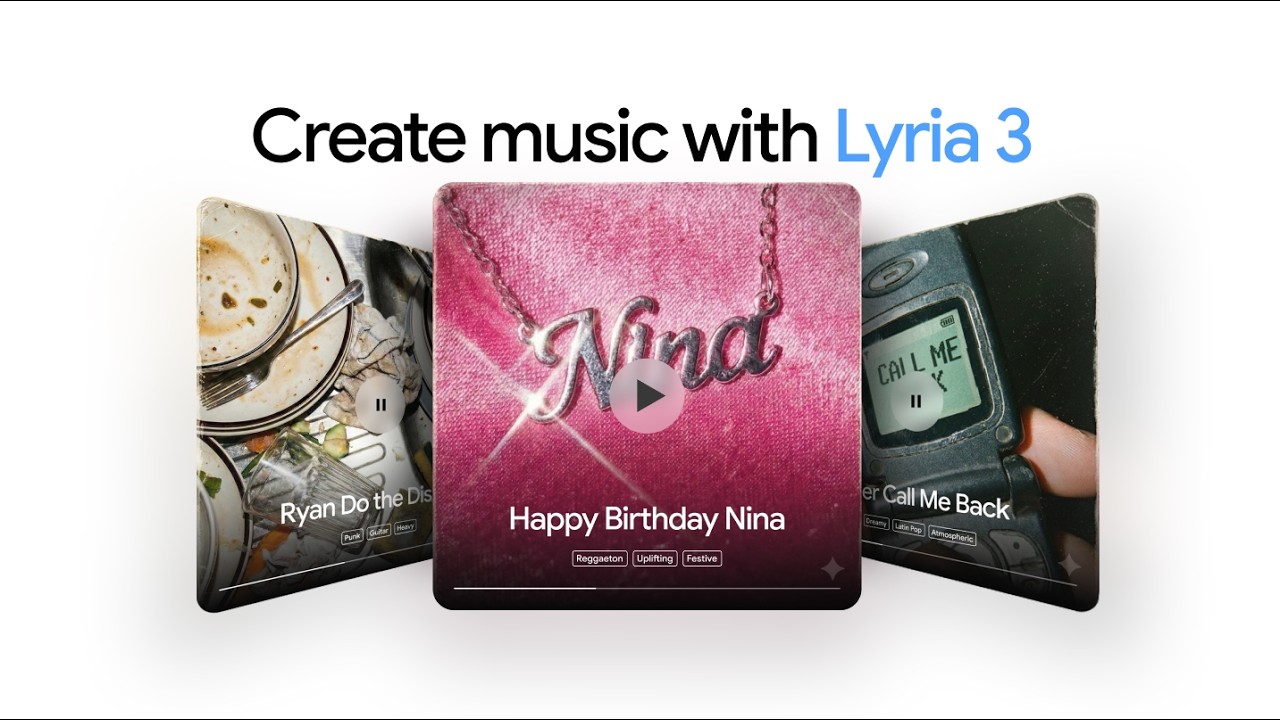
Gemini turns music prompts into tracks
The big change is that music creation is now baked into the Gemini experience. Instead of going to a separate tool, you can ask Gemini for a song the same way you ask it for a summary or an image. Google says more than 100 million people use Gemini, and this update is clearly aimed at turning the chatbot into a more complete creative workspace.
Users can start simple with text to track. Type a genre and mood, or something personal like a memory or an inside joke, and Gemini will generate a 30 second song. It can produce instrumental audio or a track with lyrics, and it will also create custom cover art generated by Nano Banana.
Google keeps positioning the feature as a quick creative tool, not a professional music suite. The point is fast ideas you can share, like a funny tune for a friend or a short soundtrack for a clip.
Photo and video prompts bring mood based soundtracks
Gemini can also work from uploads. You can drop in a photo or a video, and the system will generate a track that matches the mood of what you shared. Google’s examples include creating a song about a pet on a hike or building a soundtrack that fits the vibe of a short video clip.
This is part of Google’s broader push into multimodal creation. Gemini already leans on models for images and video experiments, and now music is joining the same workflow, inside the same chat window.

More control and better output quality in Lyria 3
Google says Lyria 3 improves on earlier Lyria models in a few key ways:
- Lyrics are optional, and Gemini can generate them for you from your prompt.
- You get more creative control over style, vocals, and tempo.
- The model can produce more realistic and more musically complex tracks.
The tracks are still capped at 30 seconds, which is likely a mix of product design and practical guardrails. Shorter clips are easier to generate quickly, and they avoid some of the heavier issues that come with longer, more complete songs.
YouTube Dream Track expands globally
Google is not keeping Lyria 3 locked inside Gemini. The company is also bringing it to YouTube Dream Track, a tool that helps creators make AI generated tracks for content like Shorts soundtracks. Dream Track previously had limited availability, including being restricted to United States creators, and Google says this release expands it to creators in other countries.
That matters because distribution is where Google can move faster than smaller music AI startups. If Gemini and YouTube both push Lyria 3 at the same time, it becomes much easier for casual users and creators to try AI music without hunting for a separate platform.
SynthID watermarking and new audio verification tools
Google is also leaning hard on trust and labeling. Every Gemini generated song is embedded with SynthID, Google’s imperceptible watermark designed to identify AI generated content.
On top of that, Gemini is gaining audio verification features. Users will be able to upload an audio file and ask Gemini if it was generated using Google AI. Gemini will check for SynthID and also use its own analysis to respond. Google says this expands verification inside the app beyond images and video to include audio.
Copyright concerns and artist style prompts
AI music has become a hot legal and cultural issue. Some platforms are experimenting with monetizing AI music, while parts of the music industry have pushed back with lawsuits tied to training data and copyright. Google says Lyria 3 is designed for original expression, not for directly copying artists.
Google also says if a user names a specific artist, Gemini will treat it as broad inspiration and generate a track with a similar style or mood, and the company claims it has filters to check outputs against existing content. Google adds that users can report content that may violate rights, and that its policies prohibit violating intellectual property.
Availability and who gets higher limits
Music generation is rolling out to all Gemini users 18 plus worldwide, with support for English, German, Spanish, French, Hindi, Japanese, Korean, and Portuguese, and more languages planned later. Google says it is rolling out on desktop first, with mobile access coming over the next several days. The company also notes that Google AI Plus, Pro, and Ultra subscribers will get higher limits.
SQ Magazine Takeaway
I think Google is making a smart move by putting music generation directly inside Gemini instead of shipping yet another separate app. This is exactly how AI wins in the real world, not by being the fanciest demo, but by being the easiest tool to use when you already have something open. The SynthID watermark and the new audio verification features are also a good sign because AI music is already messy, and we need clearer labels before it gets flooded with spam and fake streams. The only thing I do not love is the 30 second cap, but I get why it is there. Google is playing it safe while still letting millions of people try creating music in seconds.