---
title: "Email Warmup: Tools & Strategies to Double Your Open Rates"
date: 2026-04-23
author: "Robert A. Lee"
featured_image: "https://sqmagazine.co.uk/wp-content/uploads/2026/04/email-warmup-tools.jpg"
categories:
- name: "Internet"
url: "/internet.md"
tags:
- name: "SP"
url: "/tag/sp.md"
---
# Email Warmup: Tools & Strategies to Double Your Open Rates
If your cold emails are not getting opened, the problem often starts long before the subject line. Email warmup helps build sender reputation, improve inbox placement, and reduce the odds of landing in spam when you start or scale outreach. The right tool can automate that process, monitor mailbox health, and make it easier to grow volume without hurting deliverability. The five tools below stand out for different reasons: some are better for simple setup, some fit agencies, and some are stronger for teams that want a warmup built into a broader outreach workflow. Pricing and feature availability can change, so treat the table as a practical starting point.
Tool namePricingBest forSnov.io Email WarmupFrom $29.25/moGreat if you already want outreach + warmup in one platform. Agencies: solid for teams running multichannel campaigns. Enterprises: works best when warmup is part of a larger sales engagement processLemwarmFrom $63/moGreat if you already want outreach + warmup in one platform. Agencies: solid for teams running multichannel campaigns. Enterprises: works best when warmup is part of a larger sales engagement processMailreachFrom $25/moSuitable if you want warmup plus outreach automation. Agencies: very strong fit because of client dashboards and team controls. Enterprises: good for larger, process-heavy outbound programsSmartReach.ioFrom $39/mosuitable if you want warmup plus outreach automation. Agencies: very strong fit because of client dashboards and team controls. Enterprises: good for larger, process-heavy outbound programsWarmup InboxFrom $19/moOne of the easiest low-friction options. Agencies: cost-effective for warming multiple inboxes. Enterprises: better as a focused warmup tool than as a full sales engagement suite## What Is Email Warmup?
Email warmup is the process of gradually building trust in a new or underused email account so mailbox providers see it as a legitimate sender rather than a risk. Instead of sending a large batch of cold emails on day one, you start with lower volume and steady activity. That activity often includes sending, opening, replying to, and moving emails out of spam to create [healthier engagement signals](https://sqmagazine.co.uk/spam-statistics/).
In practice, warmup tools automate that process. They usually simulate positive inbox behavior, increase volume over time, and help monitor whether your messages are landing in the inbox, promotions tab, or spam folder. This matters because providers like Gmail and Outlook pay close attention to sender reputation, authentication, spam complaints, and engagement quality when deciding where messages should go.
Email warmup is not a shortcut or a replacement for proper setup. You still need strong fundamentals such as SPF, DKIM, and DMARC, a clean sending domain, and a sensible sending pattern. Warmup simply gives a new mailbox a safer ramp-up period, which is especially useful before launching cold outreach, sales sequences, or outbound campaigns at scale.
## Why Email Warmup Is Necessary
Email warmup is necessary because inbox providers do not automatically trust a new sender. A fresh domain or mailbox has little to no reputation history, which makes sudden outreach volume look suspicious. When that happens, even well-written emails can miss the primary inbox. Providers evaluate signals like authentication, complaint rates, delivery errors, and recipient engagement to decide whether your email deserves placement in the inbox.
This has become even more important as sender requirements have tightened. Google requires authentication for all senders to personal Gmail accounts, and bulk senders must meet stricter standards, including SPF, DKIM, and DMARC. Outlook has also enforced stronger authentication requirements for high-volume senders. In other words, deliverability is now tied not only to what you send, but also to how responsibly you ramp sending activity and maintain domain health.
For cold email automation, that matters a lot. If you connect a new mailbox to an outreach tool and immediately push aggressive volume, you increase the risk of spam placement, throttling, or reputation damage. A warmup period helps reduce that risk by giving your mailbox time to establish more natural sending patterns before outreach scales. That makes warmup a practical safeguard, not just an optional extra.
## Key Benefits of Email Warmup
The biggest benefit of email warmup is better inbox placement. When your mailbox builds a stronger reputation over time, your emails have a better chance of landing where people can actually see them. That creates the conditions for higher open rates, more replies, and healthier campaign performance overall. Warmup also helps protect newer domains from the kind of sudden negative signals that can damage future outreach.
Another major advantage is improved visibility into mailbox health. Many warmup tools now pair the warmup process with spam monitoring, blacklist checks, authentication tracking, and reputation insights. That makes it easier to catch issues early instead of discovering them only after campaign results drop. Google’s Postmaster Tools, for example, gives senders data on spam rate, authentication, reputation, and delivery errors, which shows how closely deliverability and sender health are connected.
Warmup also supports safer scaling. Once a mailbox has established a more reliable baseline, you can increase sending volume more confidently and with less guesswork. For teams running cold outreach, that means fewer avoidable deliverability problems and a stronger foundation for automation. It does not guarantee doubled open rates on its own, but it can significantly improve the odds that your emails are seen in the first place.
## Best Email Warmup Tools
The best email warmup tools do more than automate email exchanges. They help build sender reputation, improve inbox placement, and prepare accounts for safer outreach scaling. Some work as standalone solutions, while others are more useful as part of a broader sales engagement stack. Snov.io Email Warmup is a strong option for teams that want warmup, deliverability support, and cold email automation in one platform.
### Snov.io Email Warmup
[Snovio email warmup tool](https://snov.io/email-warm-up) is a built-in feature designed to help new or inactive email accounts develop a healthier sending reputation before outreach begins. It supports major providers like Gmail, Outlook, Yahoo, and other mailbox services, which makes it flexible for different sending setups. The tool automates warmup through AI-powered same-thread conversations, creating more natural engagement patterns than simple back-and-forth exchanges.
It also offers practical controls such as provider-based warmup settings, plain-text mode, blacklist monitoring, bulk updates, and progress tracking. Because it is part of the wider Snov.io ecosystem, users can manage warmup, deliverability, prospecting, and outreach from one place. That makes it especially useful for teams that want a more connected outbound workflow.
**Pros for Snov.io Cold Email Automation**
- Fits naturally into a full outbound workflow, so warmup does not have to be managed as a separate process
- Supports multiple email providers, which is helpful for teams working with different mailbox setups
- Uses AI-powered same-thread conversations to create more realistic engagement activity
- Allows bulk warmup management, which is practical when preparing several sender accounts at once
- Includes blacklist monitoring and progress tracking, making it easier to spot issues early
- Works well for scaling outreach, especially when you want warmup and campaign setup in the same platform
### Lemwarm
Lemwarm is an email warmup tool built by Lemlist for users who want deliverability support inside a broader cold outreach platform. It is designed to help new or low-activity mailboxes build trust gradually through automated warmup activity and safer sending patterns. One of its main advantages is how tightly it connects with the lemlist ecosystem, which makes setup easier for teams already running outbound campaigns there. Lemwarm is positioned as a deliverability layer rather than just a standalone warmup utility, so it fits naturally into campaign preparation and sender reputation management. It is especially appealing for users who want warmup, outreach, and multichannel sequencing under one roof. For teams already invested in Lemlist, that integrated experience is one of Lemwarm’s strongest selling points.
**Pros for Lemwarm Cold Email Automation**
- Works especially well inside the lemlist workflow, so warmup feels like part of campaign setup rather than a separate task
- Helps support deliverability before scaling outreach, which is useful for newer sender accounts
- Included with eligible paid lemlist seats, which adds value for teams already using the platform
- Strong fit for multichannel outbound teams that want warmup and campaign execution in one place
- Reduces tool sprawl by combining warmup with a broader sales engagement environment
### Mailreach
Mailreach is a dedicated deliverability tool focused heavily on email warmup, sender reputation, and inbox placement. Unlike broader outreach platforms, it is built primarily for the technical side of getting emails seen, which makes it attractive for teams that want a specialized solution. In addition to automated warmup, Mailreach emphasizes spam testing, blacklist checks, domain health monitoring, and deliverability diagnostics. That narrower focus can be a real advantage for users who already have an outreach platform and only need stronger infrastructure around mailbox health. It is often positioned as a tool for improving and maintaining reputation across multiple inboxes and domains. For teams that care most about deliverability performance, Mailreach offers a more focused approach than all-in-one sales tools.
**Pros for Mailreach Cold Email Automation**
- Strong deliverability focus, which is helpful when inbox placement is the main concern
- Includes warmup plus monitoring tools such as spam testing and reputation checks
- Useful for teams managing multiple mailboxes or domains across ongoing outreach campaigns
- Pairs well with external outreach platforms, since it can act as the deliverability layer in your stack
- Good choice for senders who want deeper visibility into mailbox health before increasing email volume
### SmartReach.io
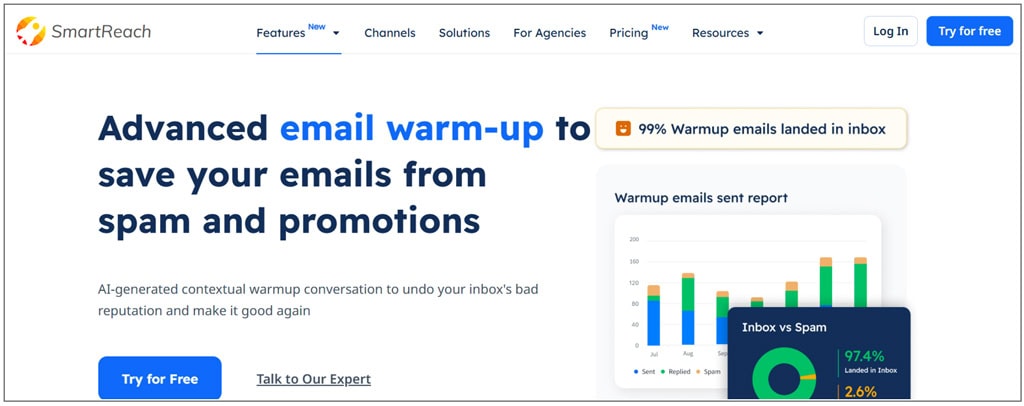
SmartReach.io is a sales engagement platform that includes email warmup as part of a wider cold outreach system. It combines warmup with features such as inbox rotation, email verification, unified inbox management, multichannel outreach, and global safety settings. That makes it more than a basic warmup tool, especially for teams that want to connect sender reputation work with campaign execution.
SmartReach.io is also built with agencies and larger outbound teams in mind, offering controls like agency dashboards, roles, permissions, audit trails, and two-factor authentication. Its positioning is practical: help users send at scale while protecting deliverability. For teams that want both outreach automation and warmup in the same platform, it is a strong all-in-one option.
**Pros for SmartReach.io Cold Email Automation**
- Combines warmup with outreach automation, which simplifies the outbound stack
- Includes inbox rotation and global safety settings, useful for protecting deliverability at scale
- Offers free email verification and unified inbox features, which support cleaner campaign operations
- Strong fit for agencies and teams, thanks to permissions, dashboards, and audit controls
- Designed for higher-volume workflows, making it useful when cold outreach becomes more operationally complex
### Warmup Inbox
Warmup Inbox is a focused email warmup tool built for users who want a simpler setup and a more lightweight learning curve. It is designed to warm inboxes automatically while also giving users extra visibility into deliverability and email health. The platform supports major providers, including Google and Outlook, and also offers related tools around email health, blacklist checking, authentication support, and SMTP testing.
Compared with broader sales engagement suites, Warmup Inbox feels more specialized and accessible, which makes it appealing for solo users and smaller teams. Its positioning is straightforward: improve sender reputation without overwhelming users with too many unrelated features. That makes it a practical choice for teams that want a dedicated warmup product instead of a full outbound platform.
**Pros for Warm Inbox Cold Email Automation**
- Easy to set up and use, which is ideal for smaller teams or first-time warmup users
- Focused specifically on warmup and deliverability, without the complexity of a large sales suite
- Supports major mailbox providers, including Google and Outlook
- Offers extra inbox-health utilities, which can help diagnose setup or deliverability issues
- Cost-effective option for warming multiple inboxes, especially when simplicity matters more than multichannel features
## 5 Factors to Consider Before Choosing an Email Warmup Tool
Not every email warmup tool fits the same sending strategy. Some are better for solo founders warming one inbox, while others are built for agencies or teams managing multiple sender accounts. The best choice depends on how easily the tool fits into your workflow, how much automation it offers, and whether it supports the email provider you already use. It is also worth looking beyond the headline feature list. Reporting depth, ease of scaling, and long-term cost can have a direct impact on whether the tool remains useful once your outreach volume grows. Before choosing a platform, it helps to evaluate these five factors side by side.
### Ease of Use
A warmup tool should be easy to set up, understand, and manage from day one. If the interface is confusing or the setup process takes too long, it can slow down campaign preparation and increase the chances of configuration mistakes. That matters even more for smaller teams that do not have a dedicated deliverability specialist.
A user-friendly tool should make it simple to connect mailboxes, adjust warmup settings, monitor progress, and spot issues quickly. Clear dashboards, guided setup, and centralized controls can save time and reduce manual work. For solo professionals and lean sales teams, ease of use is often one of the most important buying factors.
### Automation Capabilities
Strong automation features can make a big difference when you are preparing inboxes for cold email campaigns. A basic tool may only send automated warmup emails, while a more advanced one can simulate replies, move emails out of spam, increase sending volume gradually, and apply settings across multiple accounts. The more automated the process is, the easier it becomes to scale safely.
This is especially important for agencies and outbound teams managing several mailboxes at once. Instead of adjusting each inbox manually, they can rely on automation to maintain consistency across sender accounts. A good email warmup tool should reduce repetitive work while still giving you enough control over how warmup progresses.
### Compatibility with Your Email Provider
Before choosing a tool, make sure it works well with your existing email provider. Not every warmup platform supports the same mailbox types, and some perform better with certain providers than others. If your team uses Gmail, Outlook, or a mix of providers, compatibility becomes a practical issue rather than a minor detail.
The right tool should connect smoothly with your current sending environment and avoid creating extra setup friction. This matters even more if you plan to warm multiple inboxes across different domains or providers. A flexible platform will make onboarding easier and help keep your warmup process consistent as your outreach setup expands.
### Detailed Analytics and Reporting
Warmup is easier to manage when you can actually see what is happening inside your inboxes. Good analytics help you track progress, monitor deliverability signals, and catch problems before they affect campaign performance. Without that visibility, it becomes harder to know whether your mailboxes are improving or drifting toward spam placement.
Useful reporting can include inbox placement signals, spam folder movement, blacklist alerts, reputation indicators, and mailbox-level performance summaries. For larger teams, centralized reporting is especially valuable because it makes it easier to compare sender accounts and identify weak points. Detailed analytics turn warmup from a passive process into something you can monitor and improve over time.
### Cost-Effectiveness
The cheapest warmup tool is not always the most cost-effective one. A lower monthly price may look attractive at first, but it can become limiting if the platform lacks automation, reporting, or support for multiple inboxes. On the other hand, a more expensive tool may provide better value if it combines warmup with outreach features you would otherwise pay for separately.
The right choice depends on your use case. Solo professionals may prefer a simple and affordable tool that handles the basics well. Agencies and larger teams often benefit more from a platform that saves time, supports scale, and reduces the need for extra tools. Cost-effectiveness is really about the balance between price, usability, and long-term value.
## Choosing the Right Email Warmup Tool
The best email warmup tool depends on how you plan to scale outreach, how many inboxes you manage, and how much control you need over deliverability. Some tools are better for simple warmup and fast setup, while others make more sense for agencies and teams that want warmup built into a broader cold email automation workflow. The right choice is usually the one that fits your existing process without adding unnecessary complexity.
If you want an all-in-one platform, tools that combine warmup with outreach and mailbox management can offer better long-term value. If your main priority is sender reputation and inbox placement, a more specialized warmup tool may be the better fit. In either case, it is worth paying close attention to automation, analytics, provider compatibility, and pricing before making a decision.
Email warmup alone will not fix every deliverability issue, but it can give your campaigns a much stronger starting point. When paired with proper authentication, sensible sending volume, and relevant messaging, it helps create the conditions for better inbox placement and stronger open rates over time.